





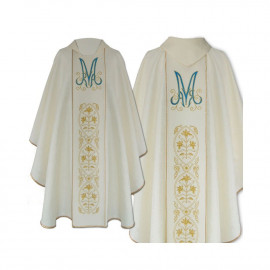
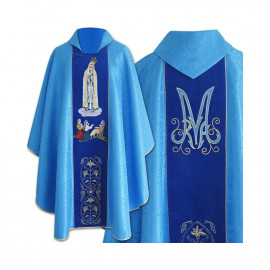
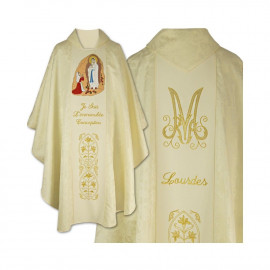
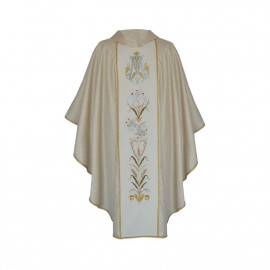
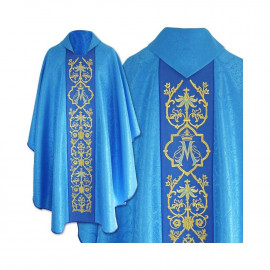
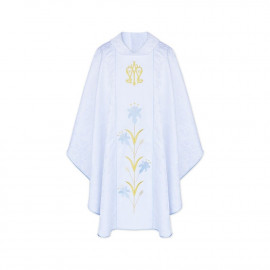
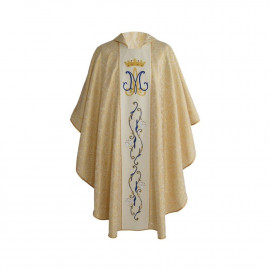
What Are Marian Chasubles?
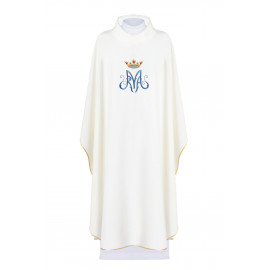
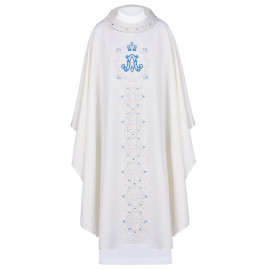
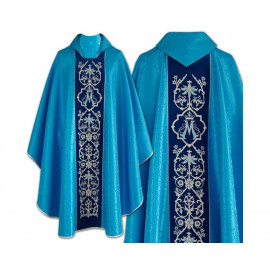
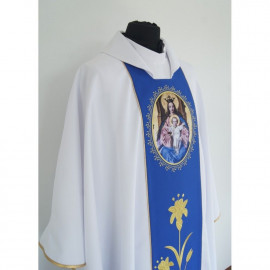
Marian chasubles are liturgical vestments decorated with Marian motifs — images of the Blessed Virgin Mary, her symbols, and devotional imagery. They are worn on Marian feasts and during devotions to Our Lady.
Common Marian Symbols
- Immaculate Heart of Mary
- Our Lady of Guadalupe
- Our Lady of Fatima
- Assumption of Mary
- Rosary and Marian crowns
- Blue and white color schemes
Materials and Embroidery
Our Marian chasubles are crafted from fine silk, brocade, and damask with hand-embroidered Marian symbols. Available in white, blue, and gold fabrics appropriate for Marian celebrations.
Feast Days
Marian chasubles are particularly appropriate for the Solemnity of the Immaculate Conception, the Assumption, Our Lady of Guadalupe, and other Marian feasts throughout the liturgical year.
What Is a Marian Chasuble?
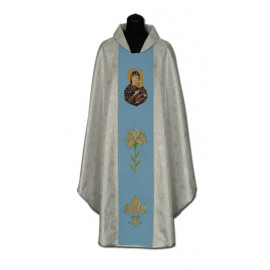
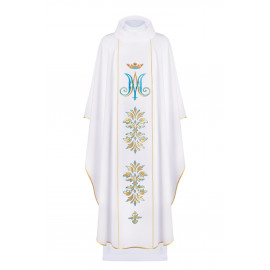
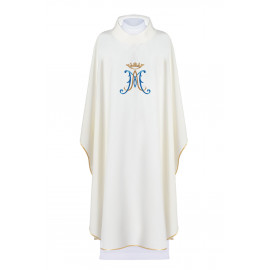
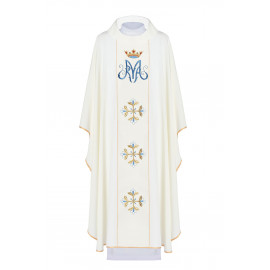
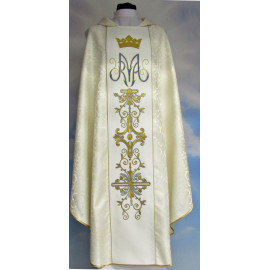
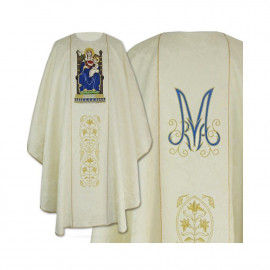
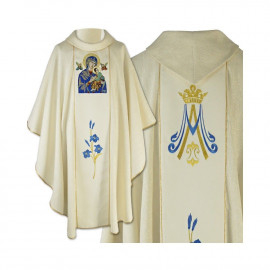
A Marian chasuble is a liturgical vestment — the outermost garment worn by a priest over the alb and stole at Mass — decorated with symbols of the Blessed Virgin Mary. It belongs to the class of chasubles, the vestment proper to the priest who offers the Eucharist, and is distinguished from the other colours and patterns in the sacristy by its Marian imagery: the Immaculate Heart, a Marian monogram such as "AM" (Ave Maria), roses, lilies, a crown of twelve stars, or the portrait of Our Lady.
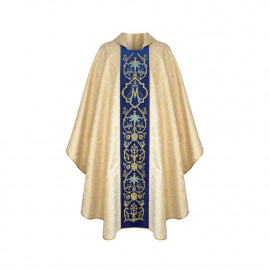
The colour is itself a Marian sign. Blue is the colour most often associated with Our Lady in Western devotion; white and gold are the festive colours of her great solemnities; ecru and ivory suits the quieter memorials. The chasuble is worn with a matching stole, and many of our sets include both.
Marian Symbolism on a Chasuble
The embroidery on a Marian chasuble is never merely decorative — each motif carries a meaning worked out over centuries of Catholic devotion. The most common symbols you will find on our vestments are:
- Immaculate Heart of Mary — the heart pierced by a sword and encircled by roses, a sign of Our Lady's love and her share in the Passion of Christ (see the devotion of the Immaculate Heart).
- Marian monogram — the letters "AM" or "M" with a cross, an ancient abbreviation of Ave Maria.
- Roses and lilies — the lily for purity, the rose for the "Mystic Rose" of the Litany of Loreto.
- Our Lady of Guadalupe, Fatima and Perpetual Help — the portrait of a specific appearance of the Virgin, often reproduced front and back.
- Crown of twelve stars — from the woman clothed with the sun in the Book of Revelation, a traditional image of Mary.
When Is a Marian Chasuble Worn?
A Marian chasuble is worn on the days the Church keeps for the Mother of God, including the Solemnity of Mary, Mother of God (1 January), the Immaculate Conception (8 December), the Assumption (15 August), Our Lady of Guadalupe (12 December), Our Lady of Fatima (13 May) and Our Lady of the Rosary (7 October). It is also the fitting vestment for Saturday Masses in honour of Our Lady, for May and October devotions, for parish patronal feasts dedicated to Mary, and for weddings and first Communions celebrated under her patronage.
Because the liturgy assigns colour by season, a sacristy is usually prepared with Marian vestments in blue and white for the Marian feasts that fall outside the great penitential seasons. On the rare Marian memorial that falls in Advent or Lent, the seasonal violet or rose is preferred.
Styles: Gothic, Semi-Gothic and Roman
Our Marian chasubles come in the three cuts most used today. The choice is one of taste and of how the chasuble is worn in your church:
| Style | Shape | Look | Typical price |
|---|---|---|---|
| Gothic | Full, rounded cloak, wide over the shoulders | Traditional, ample, highly visible embroidery | $139–$250 |
| Semi-Gothic | Narrower than the Gothic, a lighter drape | Balanced, comfortable for a long Mass | $149–$300 |
| Roman (fiddleback) | Shorter, with decorated front and back panels | Clean lines, an image framed front and back | $248–$600 |
Marian Chasuble vs. Gothic Chasuble: the two terms describe different things. "Marian" tells you the decoration — it is a Marian chasuble because of the embroidery. "Gothic" tells you the cut — a Gothic chasuble because of its full, rounded shape. A Marian chasuble can be Gothic, semi-Gothic or Roman, and most of our Marian models are available in more than one cut.
Materials and Embroidery
Our Marian vestments are made in Poland, hand-finished by embroiderers working with the traditional techniques of ecclesiastical textile art. The fabrics are damask, brocade and velvet — woven fabric with a visible pattern that catches the light — lined and interlined so the chasuble drapes without creasing. The embroidery is worked in thread and, on gilded models, in gold-toned metal thread; the symbols are outlined first and then filled so that the motif reads clearly from the nave as well as close up.
Each vestment is cut and sewn with enough weight to hang straight and enough lightness to stay comfortable through a sung Mass. Because the fabric is a natural-blend ecclesiastical textile, we recommend dry cleaning and storage on a hanger in a dust bag — see how to care for embroidered vestments and how to store liturgical vestments properly.
How Much Does a Marian Chasuble Cost?
At Best Catholic Shop a Marian chasuble costs between $139 and $600. The Gothic and semi-Gothic Marian chasubles start at $139–$161, mid-range models with fuller embroidery and matching sets run to about $250–$300, and the largest Roman chasubles with a portrait of Our Lady embroidered front and back, such as Our Lady of Fatima or Our Lady of Perpetual Help, reach $443–$600. Each price includes the matching stole.
Choosing a Marian Chasuble
When you choose a Marian vestment, work through four questions. First, which Marian feasts does your parish keep most solemnly? If it is a parish of Our Lady of Fatima or of the Rosary, a chasuble bearing that image will be used year after year. Second, blue or white? Blue marks the Marian devotion most strongly; white and gold match the great solemnities and sit well beside gold altar linen. Third, which cut suits your church — a Gothic chasuble for a traditional sanctuary, a Roman chasuble where a lighter, more sculpted line is preferred. Fourth, do you want a full set with the Marian stole and, where used, the chalice veil and burse in the same fabric? You can also see our complete guide to choosing a chasuble and the history of the chasuble.
Frequently Asked Questions About Marian Chasubles
Q: What Are the Different Types of Catholic Chasubles?
A: The main types are the Gothic chasuble, with a full rounded shape and wide shoulders; the semi-Gothic, a narrower version of the same cut; and the Roman or fiddleback chasuble, shorter with decorated front and back panels. Any of these can be a Marian chasuble if it carries Marian embroidery and is worn for Masses in honour of Our Lady.
Q: What Does a Chasuble Symbolize?
A: The chasuble is the priest's outermost vestment and traditionally symbolizes the yoke of Christ and the charity that should clothe the priest — it is the "seamless garment" in many explanations. On a Marian chasuble the added embroidery of the Immaculate Heart, roses or a Marian monogram turns the vestment toward honour of the Blessed Virgin Mary.
Q: What Does It Mean to Be a Marian Catholic?
A: A "Marian" Catholic is one who keeps a particular devotion to the Blessed Virgin Mary — praying the Rosary, honouring her feasts and seeking her intercession. Marian vestments express that devotion in the liturgy, clothing the celebration of Mass in honour of Our Lady.
Q: When Do You Wear a Marian Chasuble?
A: You wear a Marian chasuble for Masses in honour of the Blessed Virgin Mary: her solemnities and feasts such as the Immaculate Conception, the Assumption and Our Lady of Guadalupe, Marian memorials such as Our Lady of Fatima and Our Lady of the Rosary, Saturday votive Masses of Our Lady, May and October devotions, and parish or wedding Masses offered under her patronage.
Q: What Colour Is a Marian Chasuble?
A: Marian chasubles are most often blue, which Western devotion associates with Our Lady, or white and gold for her great solemnities. Ecru and ivory are used for quieter memorials. On a Marian feast that falls within Advent or Lent, the seasonal violet or rose is normally worn instead.
Q: How Much Does a Chasuble Cost?
A: At Best Catholic Shop a Marian chasuble costs between $139 and $600 depending on the cut, the fabric and how much embroidery the model carries. Gothic and semi-Gothic Marian chasubles start at $139, and large Roman chasubles with a full embroidered image of Our Lady reach $443–$600. Every price includes the matching stole.
Q: Does a Marian Chasuble Come with a Stole?
A: Yes. Each Marian chasuble in our collection is supplied complete with a matching stole in the same fabric and embroidery, so the priest wears a coordinated set. Matching chalice veils and burses in the same Marian fabric are also available.
Q: What Is the Difference Between a Marian Chasuble and a Gothic Chasuble?
A: "Marian" describes the decoration — a chasuble with embroidery of Our Lady — while "Gothic" describes the cut — a full, rounded shape with wide shoulders. They are not opposites: a Marian chasuble can be Gothic, semi-Gothic or Roman, since the Marian imagery can be applied to any of the three cuts.
Related Guides
Read our guides to choosing a chasuble, the history of the chasuble, the meaning of vestment colours and the complete guide to liturgical vestments. You can also browse our full range of chasubles, Marian stoles, Holy Family icons and sacred icons.
