
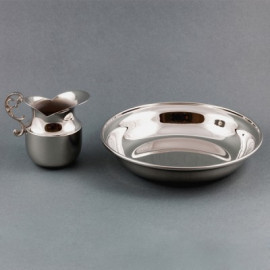
What Is a Lavabo Set?
A lavabo set is the pitcher (ewer) and basin (bowl) — often with a matching towel — used for the washing of hands in the Catholic liturgy. The priest uses it at the Lavabo rite of the Mass, when he washes his hands before the Consecration; the same term also refers to the small vessel of water kept near the tabernacle for the purification of fingers after Holy Communion.
The word comes from the Latin lavabo, "I shall wash," the opening of Psalm 26:6 — Lavabo inter innocentes manus meas, "I will wash my hands among the innocent." The gesture is not about hygiene: it expresses the desire for purity of heart before approaching the altar, and it recalls the washing of hands that the priests of the Old Covenant performed before entering the Temple.
What Is the Lavabo in the Catholic Mass?
At Mass, the lavabo (the washing of hands) takes place at the end of the Preparation of the Gifts, after the incensation, and immediately before the priest invites the people to pray. A server pours water from the ewer over the priest's fingers and the basin catches the water as it falls; the priest then dries his hands with the manuterge (finger towel). The action is accompanied by the psalm verse "I will wash my hands among the innocent…"
In a solemn Mass or when incense is used, the priest's hands are washed after the incensation as well. A small lavabo vessel of water also stands near the tabernacle so the priest can purify his fingers of any particles of the Blessed Sacrament after Holy Communion.
What Is Included in a Lavabo Set?
A complete lavabo set for a church consists of:
- Ewer (pitcher) — pours the water over the priest's hands; typically 12–16 cm (4.5–6.5 in) tall with a 0.3–0.5 L capacity.
- Basin (bowl) — catches the water; a parish lavabo bowl is usually 15–20 cm (6–8 in) in diameter.
- Manuterge (finger towel) — the small white towel on which the priest dries his hands; see our lavabo towels.
- Tray (optional) — keeps the ewer and bowl stable and carries them to the credence table.
Our current lavabo set is made of nickel-plated brass, with a bowl diameter of 17 cm (6.7 in) — a practical size for daily parish use. See the nickel-plated lavabo set in our catalog.
Types and Materials of Lavabo Sets
Lavabo sets are made in several materials, each with a different character:
- Brass and nickel-plated brass — durable, affordable, and easy to keep clean; the most common choice for parish sacristies.
- Silver and silver-plated — more formal, often chosen for cathedrals and solemn occasions.
- Crystal and glass — show the water clearly and pair well with crystal cruets; handle with care.
- Ceramic and stoneware — quiet and traditional; usually made for smaller altars and chapels.
Whichever material you choose, match the finish of your chalices, ciboria, and cruets and trays so the sanctuary vessels form one dignified set.
Lavabo, Ablution Bowl, and Piscina: Key Differences
These three terms are often confused, but they name different vessels:
- Lavabo set — the ewer and basin used at the washing of hands during Mass.
- Ablution bowl (or cup) — a small bowl of water kept by the tabernacle; the priest uses it to purify his fingers of particles of the Blessed Sacrament after Holy Communion.
- Piscina — a basin with a drain, built into the sacristy or sanctuary wall, used for pouring out the water from ablutions and for washing sacred vessels. A piscina drains away; a lavabo bowl does not.
In older churches you may also find a wall lavabo — a basin recessed into the sanctuary or sacristy wall; when it has a drain, it is called a piscina. If you need a vessel for pouring water at the credence table, you want a lavabo set — not a piscina, which is a permanent architectural fitting.
How to Choose a Lavabo Set for Your Church
- Size: a bowl of 15–20 cm (6–8 in) fits most parish altars; check that the ewer is easy to pour from without splashing.
- Stability: a wide, weighted base keeps the bowl from tipping when the server pours.
- Material: brass and nickel-plated sets handle daily use best; silver suits solemn occasions and cathedral use.
- Matching set: if your chalices or cruets have a specific finish, choose the same for the lavabo.
- Towel: keep a clean white manuterge with the set — it is used at every Mass.
How to Use and Care for a Lavabo Set
To use the set, the server holds the basin under the priest's hands and pours water from the ewer over his fingers; the priest then dries his hands on the manuterge. After Mass, empty the basin, rinse both vessels with warm water, and dry them with a soft cloth to prevent water spots. Metal sets can be polished occasionally with a non-abrasive polish; crystal and glass should be washed by hand. Store the set together — a tray keeps the pieces from knocking against each other in the sacristy cabinet. Towels should be washed after each use, following the same care as other liturgical linens.
Frequently Asked Questions About Lavabo Sets
What is the Catholic meaning of lavabo?
In the Catholic Mass, the lavabo is the washing of the priest's hands before the Consecration. It is a symbol of purification: the priest asks to be cleansed of his sins before offering the Holy Sacrifice, and the gesture recalls Psalm 26:6, "I will wash my hands among the innocent." The vessel used for this washing takes its name from the same word.
What does lavabo mean in English?
Lavabo is Latin for "I shall wash," from the first word of Psalm 26:6 in the Latin Vulgate. In English, "lavabo" refers both to the ritual washing of hands at Mass and to the ewer-and-basin set used for it. In some languages (and in Spanish) the word also means simply a washbasin or sink.
When is the lavabo used at Mass?
The lavabo takes place at the end of the Preparation of the Gifts, after the incensation, and just before the Eucharistic Prayer. The priest washes his hands while a server pours water from the ewer over them, and the basin catches the water below.
What is the difference between a lavabo bowl and an ablution bowl?
A lavabo bowl (basin) is the bowl of the lavabo set that catches the water during the washing of hands at Mass. An ablution bowl is a smaller vessel of water kept near the tabernacle for purifying the priest's fingers after Holy Communion. The two serve different moments of the liturgy, although both are small bowls of water.
What is included in a lavabo set?
A complete lavabo set includes an ewer (pitcher) for pouring the water, a basin (bowl) to catch it, and usually a manuterge — the finger towel for drying the priest's hands. Some sets add a tray to hold the pieces; two-piece sets with just the ewer and bowl are also common.
Does a lavabo set have to be made of precious metal?
No. The lavabo set is not one of the sacred vessels that must be made of precious metal — brass, nickel-plated brass, silver plate, crystal, glass, and ceramic sets are all used. Many parishes choose brass or nickel-plated sets for daily use because they are durable and easy to clean.
How large should a lavabo bowl be?
For parish use, a bowl of 15–20 cm (6–8 in) in diameter is comfortable: it catches the water without splashing and fits the credence table. Our nickel-plated brass lavabo set has a bowl diameter of 17 cm (6.7 in).
Is a lavabo the same as a piscina?
No. A lavabo set is the ewer and basin used at the washing of hands during Mass. A piscina is a basin with a drain built into the sacristy or sanctuary wall, used to pour out the water from ablutions and for washing sacred vessels. The terms are often confused because both involve water and a basin.
What is the lavabo prayer?
The lavabo prayer is the psalm verse the priest recites while washing his hands: "I will wash my hands among the innocent, and I will compass Thine altar, O Lord" (Psalm 26:6–12). It gives the rite its name and expresses the inner purification the washing signifies.
Where is the lavabo kept?
The lavabo set is usually kept on or near the credence table in the sanctuary, arranged on a tray with a clean manuterge towel ready for Mass. The small lavabo vessel of water near the tabernacle is kept covered when not in use.
Browse Our Lavabo Collection
Our lavabo set / hand-washing set is nickel-plated brass with a 17 cm (6.7 in) bowl — in stock and ready for parish use. To complete your sanctuary, see also our cruets and trays, chalices, ciboria, and lavabo towels.
