


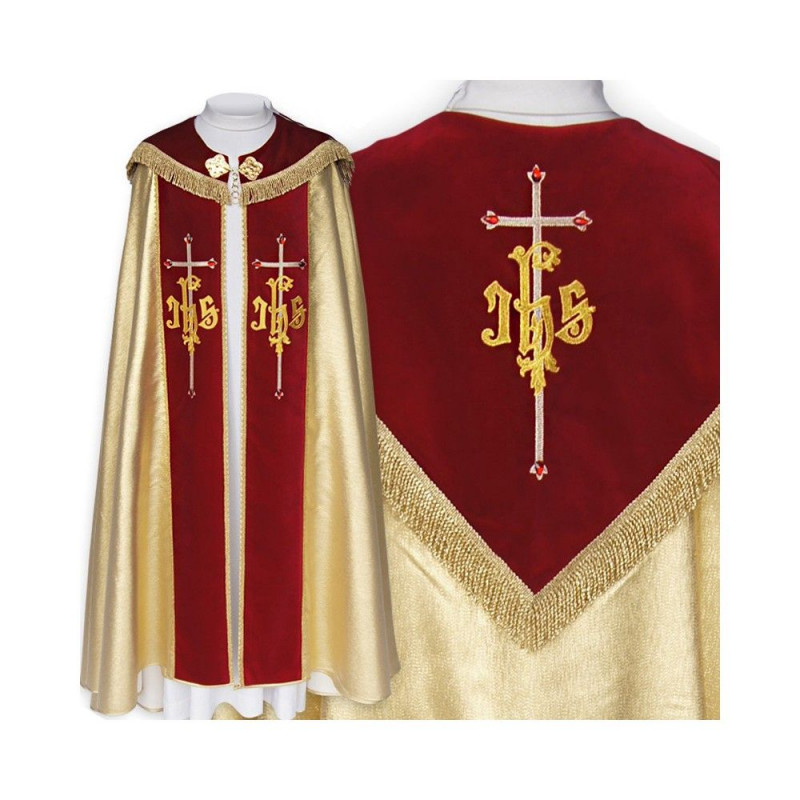
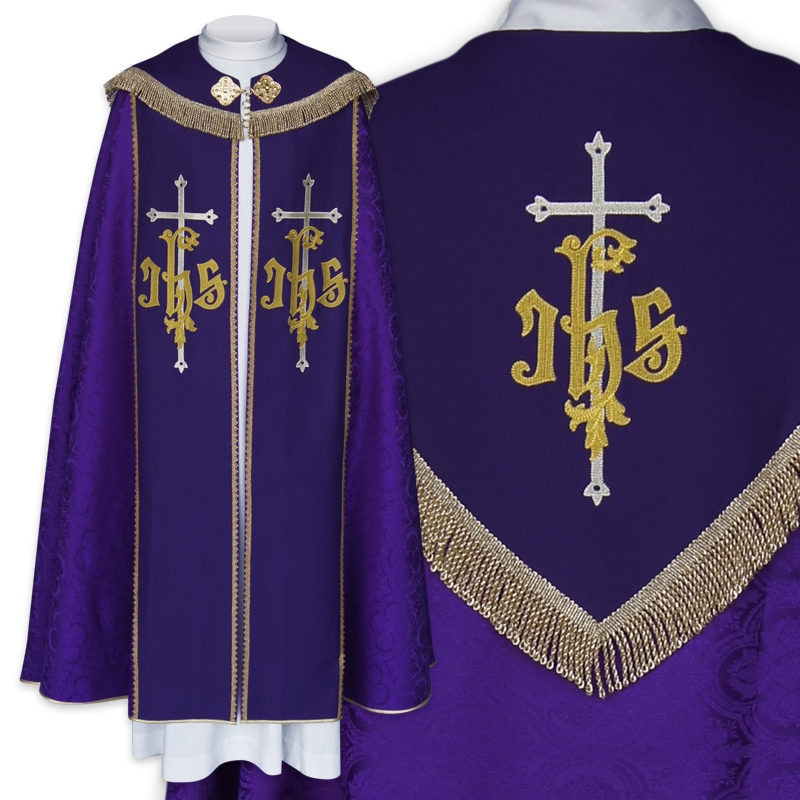
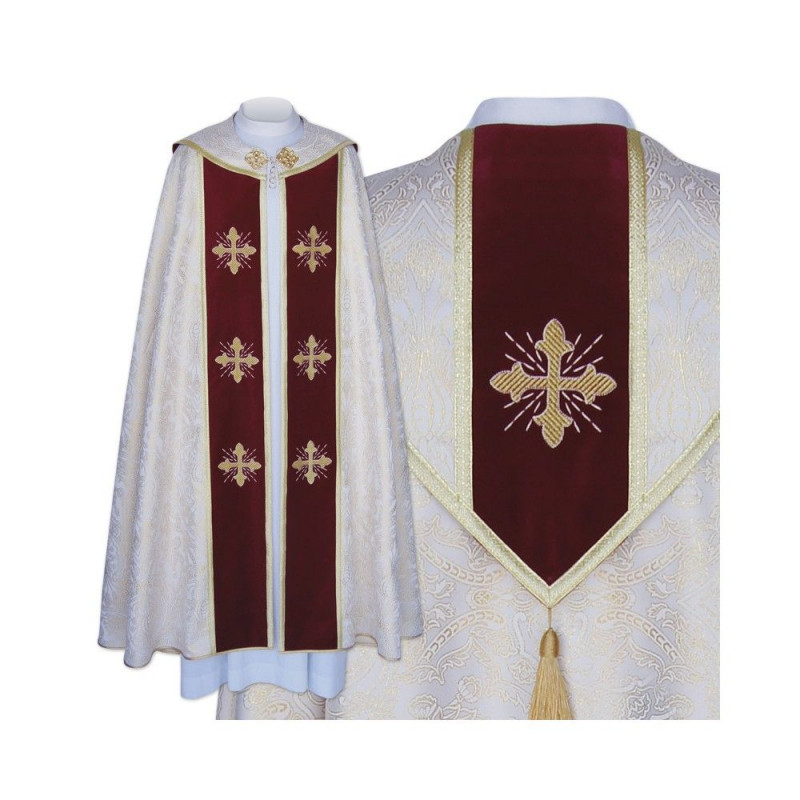
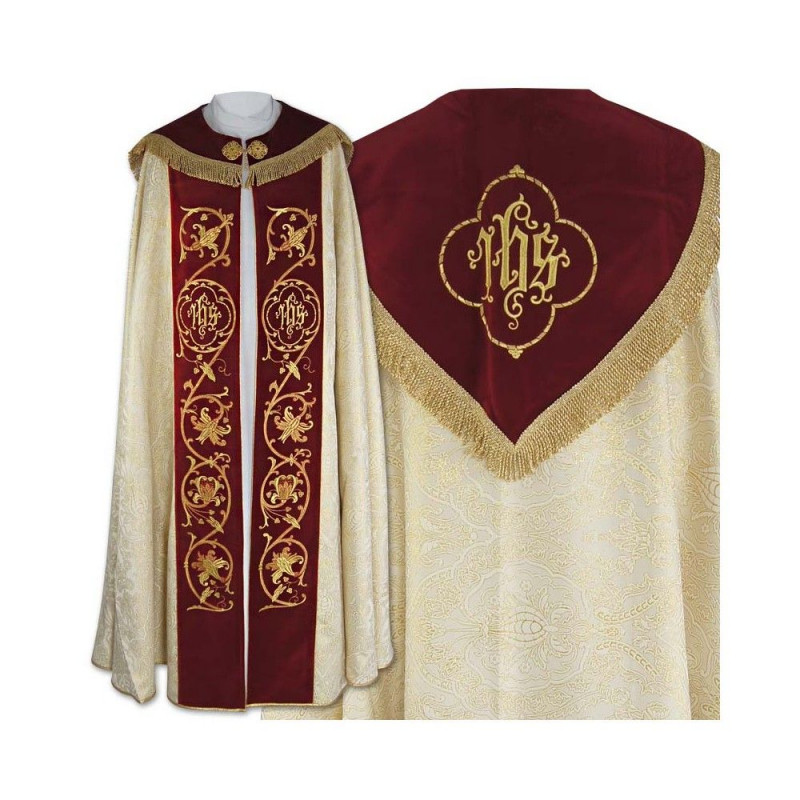
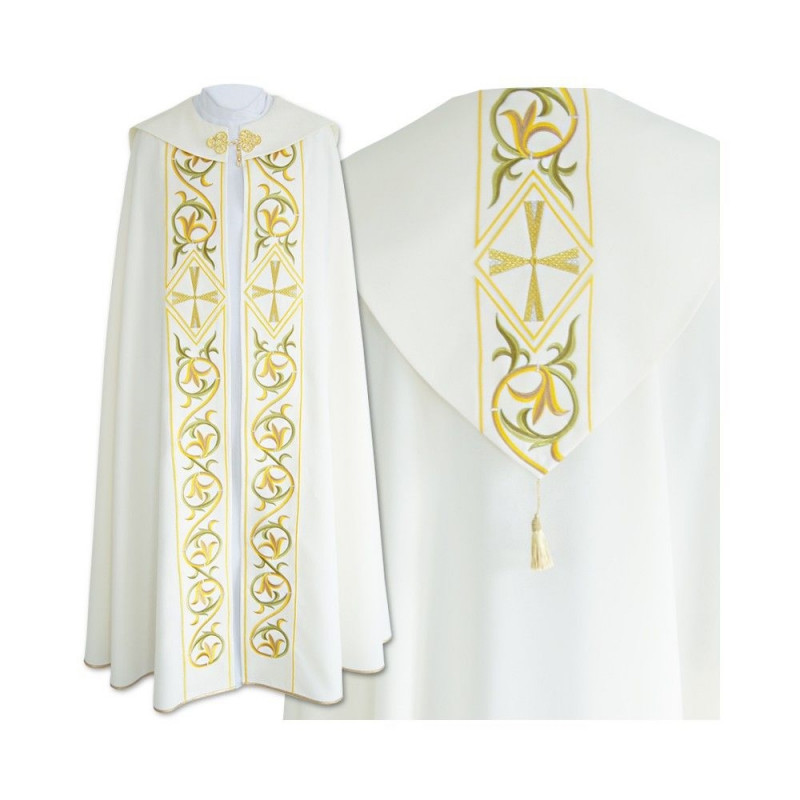
What Is a Catholic Cope?
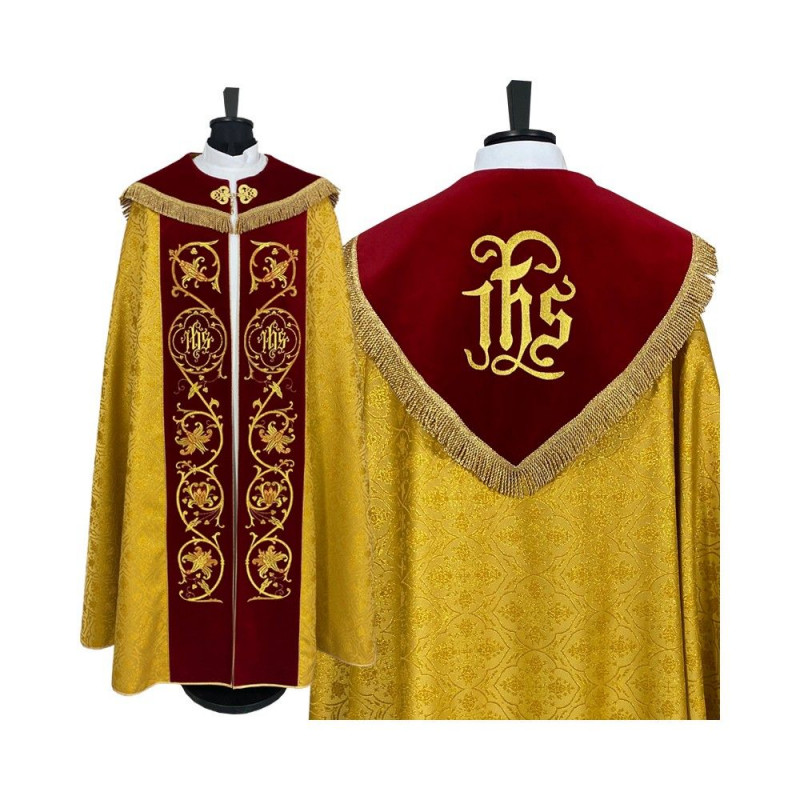
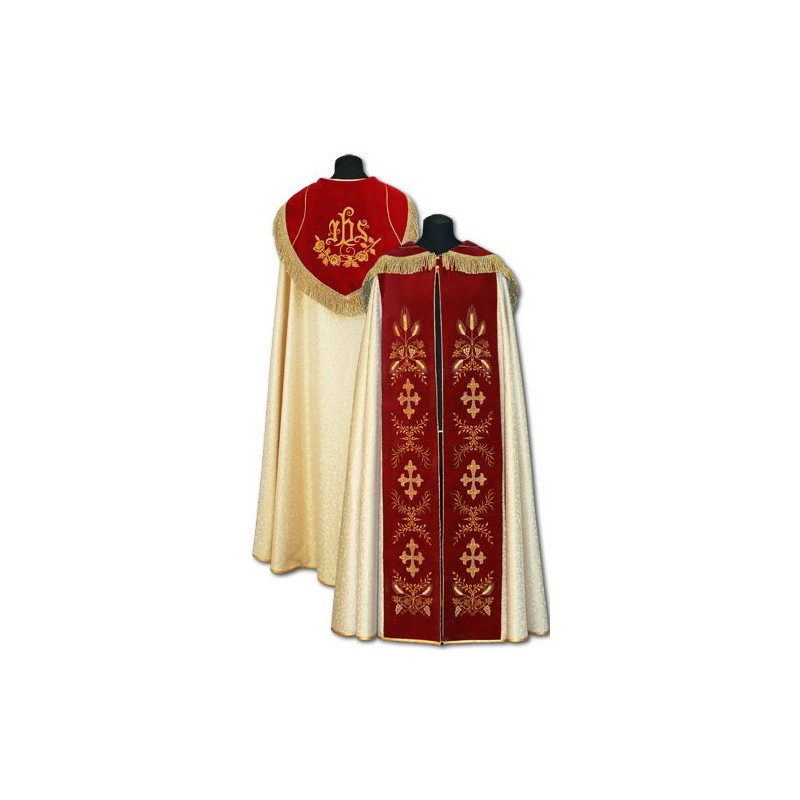
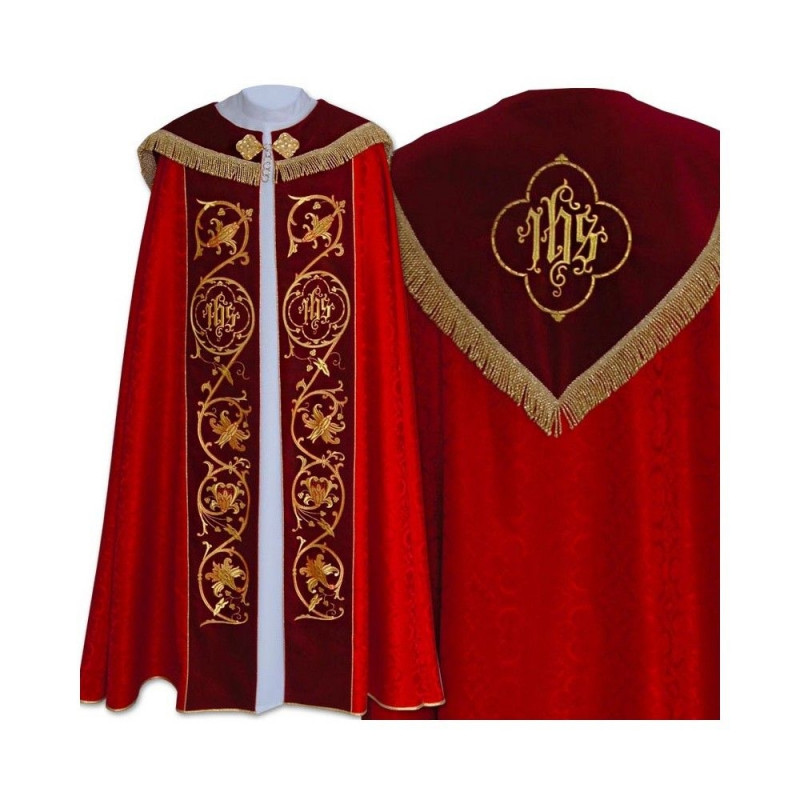
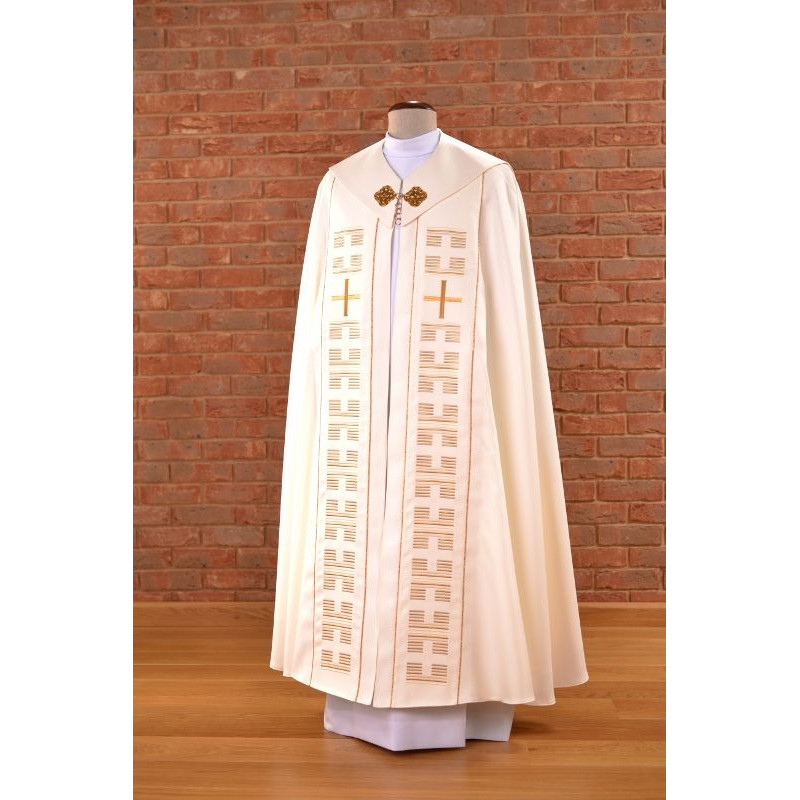
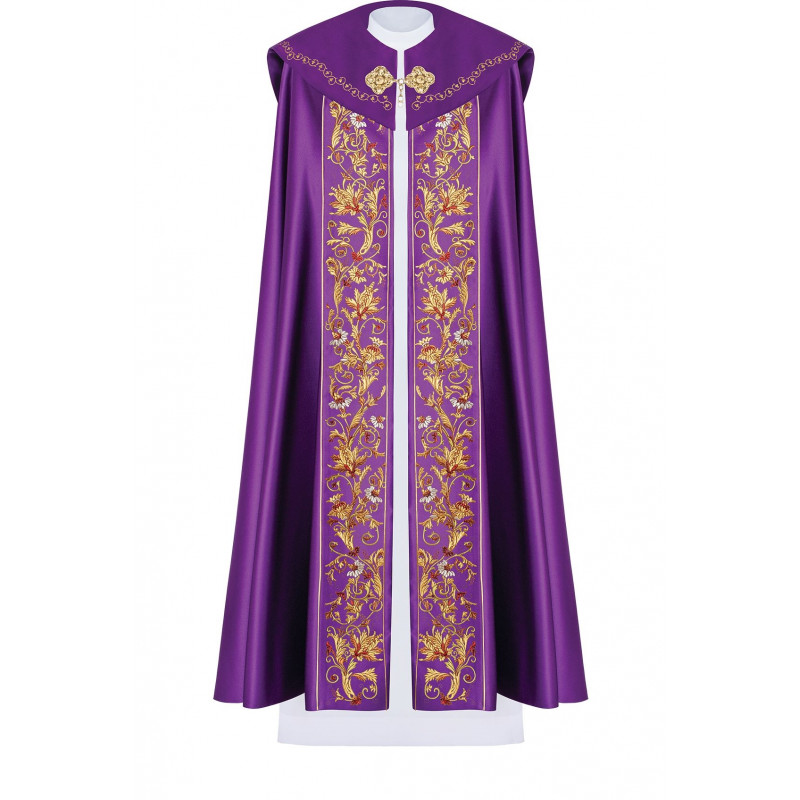
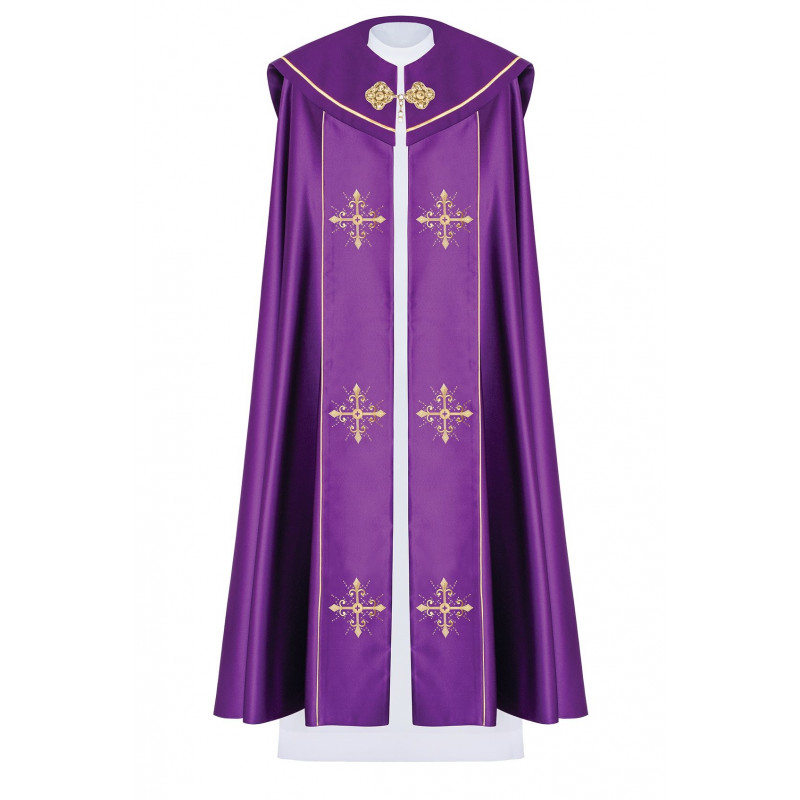
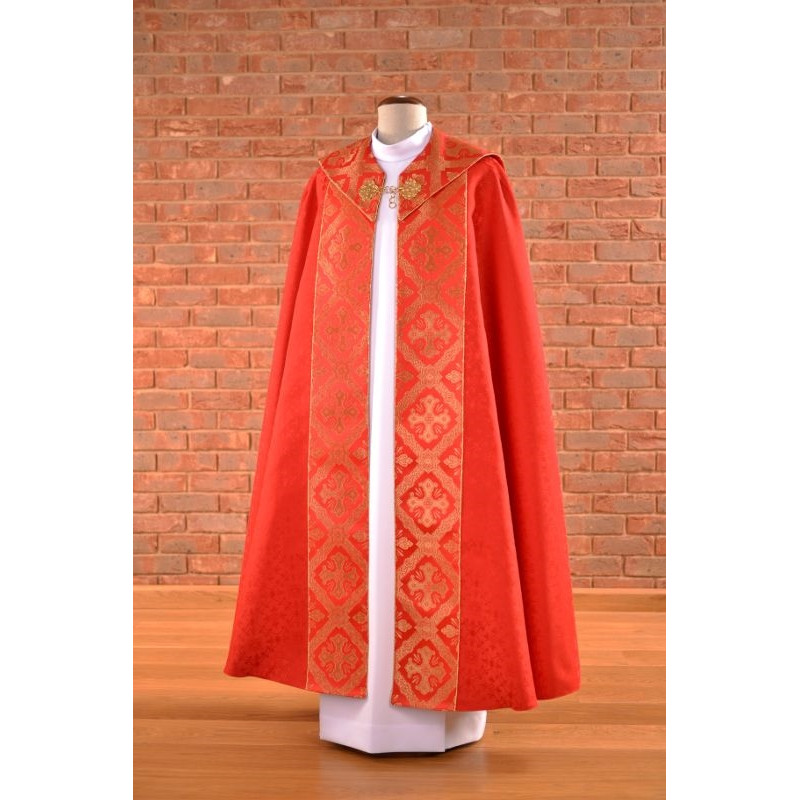
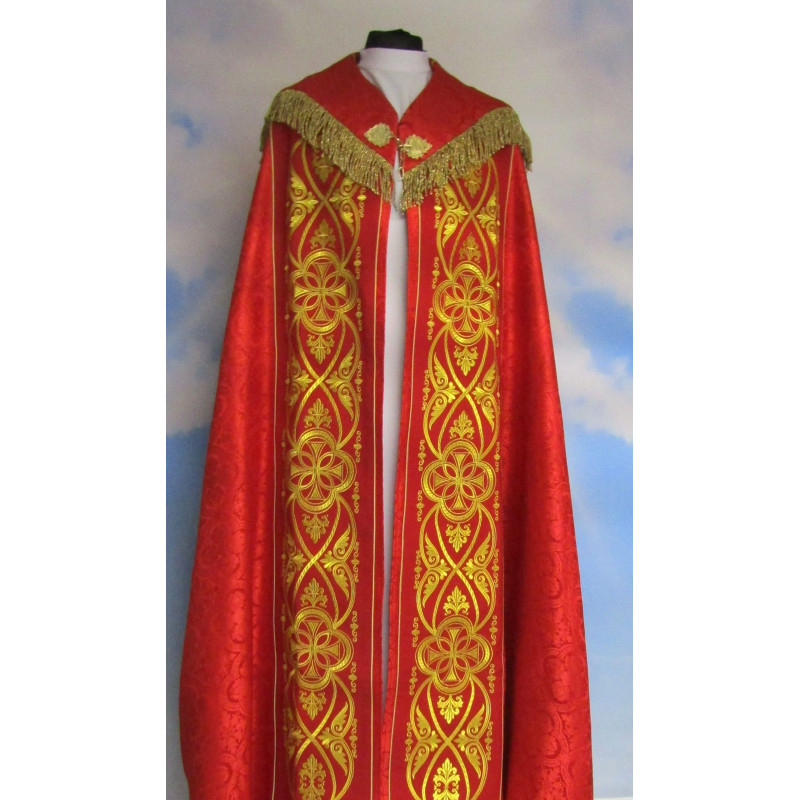
A Catholic cope — also called a liturgical cope, pluviale, cappa, or clergy cape — is a long, semicircular mantle worn by bishops, priests, and deacons for liturgical celebrations outside Mass. It is open at the front and fastened at the breast with a decorative clasp called a morse, or with a hook-and-chain closure. The cope is worn over an alb or surplice, and it is the traditional vestment for processions, Benediction of the Blessed Sacrament, the Liturgy of the Hours, and sacraments celebrated outside Mass.
Unlike the chasuble, which is closed and worn for the Eucharist, the cope leaves the arms free. That is why it is used for movement — walking in procession, carrying the Blessed Sacrament, blessing with holy water, or presiding at Vespers. A bishop normally wears the cope with a mitre and crozier; a priest wears it with the stole.
Our collection includes 126 clergy copes in Roman, Gothic, semi-Gothic, Marian, and funeral styles, in every liturgical color, from $202 to $845. Most are made in Poland; many include a matching inner stole. Each cope pairs with matching chasubles, stoles, mitres, and humeral veils.
Cope Terminology: Pluviale, Cappa, and the Morse
The word cope comes from the Latin cappa, a hooded cloak. In Latin liturgical books the vestment is also called pluviale ("rain cloak"), because it began as a practical outer garment worn against weather. The English word "cope" is related to "cape" and "chapel" (the chapel originally being the place where the cloak of St. Martin was kept).
Other terms you will meet:
- Morse — the clasp or brooch that fastens the cope at the breast. Medieval morses were often made of gold, enamel, or precious stones.
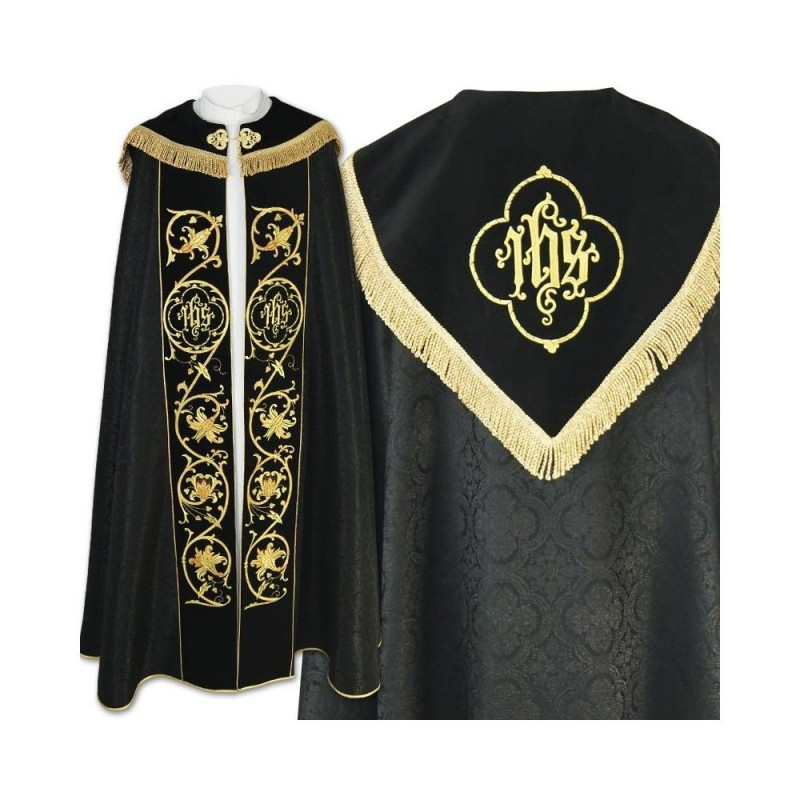
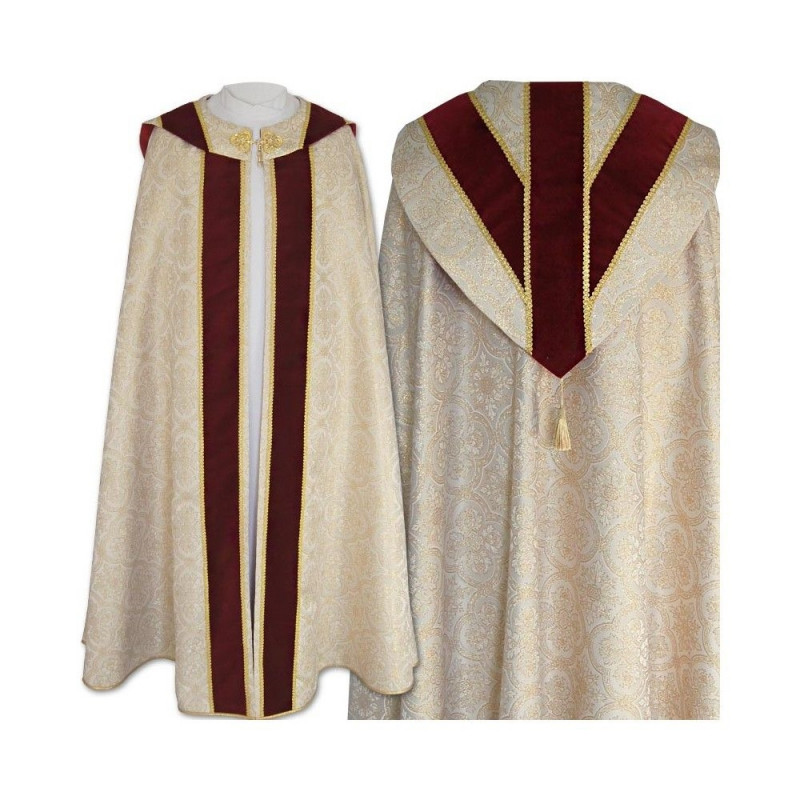
- Orphrey — the ornamental band, often embroidered in gold or silk, that runs along the front edges and across the top of the cope.
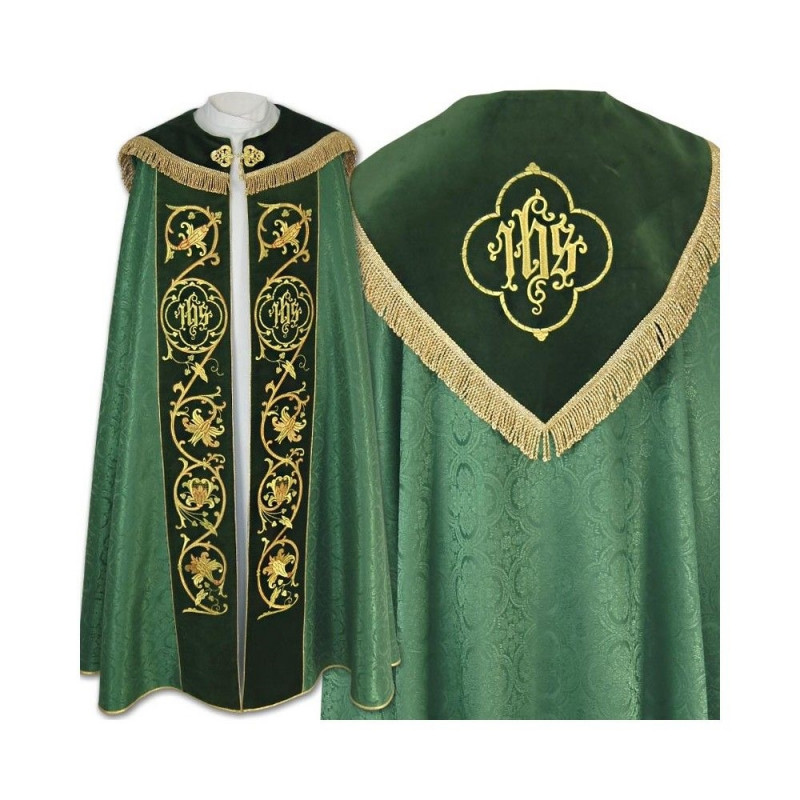
- Hood or shield — the decorative panel at the back of the cope. Early copes had a functional hood; later it became a stiffened shield of embroidery, sometimes with a fringe or a pompom.
- Lappets — the hanging ends of the hood or the front borders, depending on the cut.
- Cappa magna — the long, trained cloak worn by cardinals, bishops, and certain prelates on solemn occasions. It is not a cope, but it developed from the same garment.
- Mantum — a longer papal mantle fastened with a morse, historically worn by the pope.
In parish use, "cope", "liturgical cope", "processional cope", and "clergy cape" mean the same vestment. "Clergy cloak" is usually a different garment — an outdoor cloak; see our clergy cloaks for that style.
A Short History of the Cope
The cope began as a hooded cloak. The earliest mention of a cappa is in the writings of St. Gregory of Tours (6th century) and in the Miracula of St. Fursey, where it means a cloak with a hood. A letter written in 787 by Theodemar, abbot of Monte Cassino, in answer to Charlemagne, shows that the garment called cuculla in Gaul was known as cappa to the monks of Cassino.
For centuries the cope remained a practical garment. An inventory of the abbey of Saint-Riquier in 801 lists 200 cappae; by 831 the number had grown to 377. Most were ordinary cloaks of simple material. By the 12th century, the cope made of rich material had become a standard ceremonial vestment, and its use spread across Western Europe.
Because the cope kept its shape and was not cut down like the chasuble, many medieval examples survive. Two of the most famous are the Syon Cope in the Victoria and Albert Museum, London, and the Ascoli Cope in the Pinacoteca Civica in Ascoli Piceno. Both are masterpieces of opus anglicanum, the English embroidery admired across Europe in the 13th and 14th centuries. The morse itself could be a work of goldsmith's art: Benvenuto Cellini's career was launched by a morse he made for Pope Clement VII.
In the 20th century, the cope was simplified along with other vestments, but it never lost its place as the vestment of processions and Benediction. Today it is still worn by bishops, priests, and deacons in the Roman rite, and by Anglican and Lutheran clergy.
Parts of a Cope
A traditional cope has six parts:
| Part | What it is | What to check when buying |
|---|---|---|
| Body | Semicircular mantle, often 145–160 cm long | Drape, weight, and whether it hangs evenly |
| Orphrey | Embroidered band along the front edges and upper border | Density of embroidery, color match with the body |
| Hood / shield | Decorative panel at the back | Shape, stiffness, and embroidery motif |
| Morse or clasp | Clasp, brooch, or hook-and-chain closure at the breast | Security, ease of fastening, finish |
| Lining | Inner layer, often satin or cotton | Comfort, breathability, color |
| Stole | Optional matching stole worn under the cope | Length, embroidery, color match |
What Types of Catholic Copes Are Available?
Our copes fall into five families. The cut affects how the cope drapes; the embroidery affects the occasion.
| Style | Best for | Typical price |
|---|---|---|
| Roman cope | Parish processions, Benediction, cathedral use | $202–$300 |
| Gothic cope | Solemn processions, larger churches, fuller drape | $224–$464 |
| Semi-Gothic cope | Parishes that want a fuller cut with lighter weight | $269–$500 |
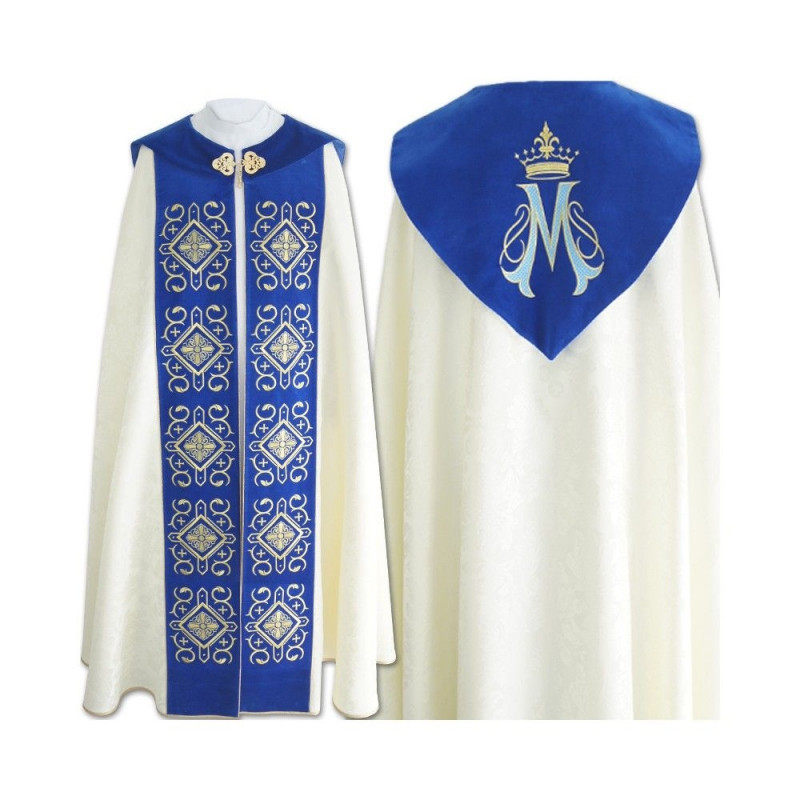
| Marian cope | Feasts of the Blessed Virgin Mary, May devotions, weddings | $228–$500 |
| Funeral cope | Funerals and All Souls; black, violet, or white | $224–$845 |
We also stock cope and stole sets and copes that pair with a matching mitre for bishops. If you need a specific color or motif, browse the collection above or contact us with the liturgical color and the embroidery you want.
What Liturgical Colors Are Available?
The cope normally follows the liturgical color of the day. The table below summarizes the Roman rite:
| Color | When it is worn | Typical cope use |
|---|---|---|
| White / gold | Christmas, Easter, solemnities, feasts of the Lord and Our Lady, weddings, baptisms | Benediction, processions of the Blessed Sacrament, ordinations |
| Red | Pentecost, Good Friday, feasts of the Passion, martyrs, confirmations | Processions, confirmations, feasts of martyrs |
| Green | Ordinary Time | Parish processions, Sunday Benediction |
| Violet / purple | Advent, Lent, funerals (in some places), penance | Lenten processions, penitential services, funerals |
| Black | Funerals (where customary), All Souls | Funeral processions and absolution |
| Rose | Gaudete and Laetare Sundays (where used) | Rare; usually a rose chasuble or cope |
| Blue | Marian feasts (custom in some places) | Marian processions and devotions |
Two practical rules from the Ceremonial of Bishops: white may always be worn for celebrations of a joyful character or before the Blessed Sacrament, and violet may always be worn for penitential celebrations. Cloth of gold may replace any color except violet and black. If you are buying for a parish, the most useful set is white/gold, red, green, and violet — those four cover most of the year.
Who Wears a Cope?
The cope may be worn by any rank of the Catholic clergy when assisting at a liturgical function. In practice:
- Bishops wear the cope with a mitre and crozier at pontifical ceremonies, processions, and Benediction. The Ceremonial of Bishops also envisages it when a bishop presides but does not celebrate Mass.
- Priests wear the cope for processions, Benediction, the Liturgy of the Hours, and sacraments celebrated outside Mass.
- Deacons may wear the cope when they preside at Benediction or Vespers, or when they assist at a solemn function. At Mass, the deacon's proper vestment is the dalmatic.
- Canons and chaplains wear the cope in choir and at chapter functions, according to local custom.
- Anglican and Lutheran clergy also wear copes; the cut and colors are similar, though the ceremonial differs.
The cope is never worn by the priest and sacred ministers who are celebrating Mass — the chasuble is the Mass vestment.
When Is a Cope Worn?
The cope is the vestment of celebrations outside Mass. It is worn at:
- Eucharistic processions — Corpus Christi, parish processions, and the procession before Benediction.
- Benediction of the Blessed Sacrament — the celebrant wears a cope, usually white or gold; the humeral veil is used for the blessing.
- The Liturgy of the Hours — Vespers, Lauds, and solemn Office, especially when celebrated in choir.
- The Asperges — the sprinkling of holy water before Sunday Mass, and the solemn blessing of water.
- Palm Sunday and the Easter Vigil — processions and the blessing of palms or the paschal candle.
- Feast of the Presentation of the Lord — the procession with candles.
- Sacraments outside Mass — baptism, confirmation, matrimony, penance in solemn form, anointing of the sick, and ordination (when the bishop does not concelebrate).
- Funerals — the absolution and the procession to the grave; black, violet, or white according to custom.
- Blessings and consecrations — churches, altars, cemeteries, and solemn blessings.
For the exact ceremonial in your diocese, follow the Ceremonial of Bishops and local custom. If you are planning a procession, our guide to Catholic processions covers the order of ministers, the canopy, and the vestments.
How Do You Wear a Cope?
Vesting in a cope takes a few seconds once the alb and stole are in place:
- Put on the alb (or surplice) and cincture. The cope is worn over them, not over the chasuble.
- Put on the stole in the usual way. For a priest, the stole hangs straight down; for a deacon, it crosses the chest.
- Hold the cope by the front edges and place it over the shoulders, with the hood or shield at the back.
- Fasten the morse, clasp, or hook-and-chain closure at the breast. The cope should sit evenly, with the front edges parallel.
- Leave the arms free. The cope is not closed like a chasuble; it is meant to drape and to be lifted when walking or blessing.
- A bishop adds the mitre and takes the crozier when appropriate.
For processions, the cope may be gathered over the arms or held at the sides; for Benediction, it stays open so the celebrant can use the humeral veil. If the cope is too long, have it shortened by a sacristy seamstress rather than pinning it — pins damage the orphrey.
Cope Sizes and How to Measure
A standard cope in our collection is about 145 cm (57 in) long. Copes are usually described by length and back width; a fuller cope may be 150–160 cm long. The right length is measured from the shoulder to the floor, plus 2–5 cm for drape.
| Measurement | How to take it | Typical range |
|---|---|---|
| Length | From the shoulder seam to the floor, in shoes | 140–160 cm |
| Back width | Across the shoulders, from arm to arm | 45–55 cm |
| Hem width | Across the bottom edge, laid flat | 140–160 cm |
| Neck opening | Around the base of the neck | 40–45 cm |
Most of our copes are made to a standard size; if you need a custom length, contact us before ordering. Made-to-order copes take an additional 3–14 business days before shipping.
What Materials and Embroidery Are Used?
Copes may be made of any rich or becoming material. Our collection uses:
- Satin — smooth, light, and receptive to raised embroidery; good for processions.
- Damask — patterned weave with a subtle sheen; durable and traditional.
- Brocade — heavy, richly patterned fabric for solemn occasions.
- Velvet — deep color and soft drape; often used for stripes and bands.
- Gabardine and cotton-stretch — lighter, breathable options for regular parish use.
- Jacquard — machine-woven pattern that mimics damask at a lower cost.
Embroidery motifs include the IHS christogram, the Jerusalem Cross, Marian symbols, rosettes, wheat and grapes, and floral orphreys. Gold and silver threads are used for the orphrey and hood. Some copes are hand-embroidered; others use machine embroidery. The product description always states the material and the motif, so you can match a cope to an existing chasuble or stole.
Cope vs Chasuble vs Humeral Veil
| Vestment | Shape | When worn | Fastening |
|---|---|---|---|
| Cope | Semicircular mantle, open front | Processions, Benediction, Liturgy of the Hours, sacraments outside Mass | Morse, clasp, or hook and chain |
| Chasuble | Closed outer vestment, sleeveless | Mass (Eucharistic liturgy) | None; slips over the head |
| Humeral veil | Long narrow veil | Benediction, processions of the Blessed Sacrament | Wrapped over the shoulders |
The simplest rule: chasuble at Mass, cope outside Mass, humeral veil for the blessing. A cope and a humeral veil are often used together at Benediction: the celebrant wears the cope and uses the veil to hold the monstrance.
How Do I Choose the Right Cope for My Parish?
- Start with the occasion. Benediction and processions need white/gold; funerals need black or violet; Ordinary Time needs green.
- Match the existing set. If your chasubles are Gothic, choose a Gothic cope; if they are Roman, choose a Roman cut.
- Choose the fabric for the climate. Light cotton-stretch for warm churches; damask or brocade for solemn, cooler buildings.
- Check the length. A cope that drags will wear at the hem; a cope that is too short looks cramped.
- Buy two or three colors first. White/gold, red, green, and violet cover most of the liturgical year.
- Plan for storage. A cope needs a wide hanger or a flat drawer; see our care guide.
How Do You Care for an Embroidered Cope?
Store the cope on a wide padded hanger or rolled flat in a garment bag. Avoid folding along the embroidery, which can crush the gold thread. Keep it away from direct sunlight and damp walls. Most embroidered copes should be dry cleaned; spot-clean only with a soft cloth and distilled water. Check the morse and the lining twice a year, and repair loose threads before they unravel. For step-by-step washing, storage, and repair advice, see our guide how to care for embroidered vestments.
How Much Does a Catholic Cope Cost?
Our copes range from $202 to $845. The price depends on the fabric, the amount of embroidery, the cut, and whether a stole is included:
| Range | What you get | Examples |
|---|---|---|
| $202–$258 | Roman or Gothic cope in satin, gabardine, or cotton-stretch with simple embroidery or gold stripes | White cope with golden stripes; green cope with gold stripes; red cope with gold belts |
| $269–$496 | Embroidered IHS or Jerusalem Cross cope, often with a stole; damask or brocade | Embroidered cope with Jerusalem Cross; Marian cope with stole |
| $513–$845 | Premium damask or velvet cope with rich embroidery, for cathedral or solemn use | Damask cope with velvet stripes; gold cope with red additions |
All prices include the cope; a matching stole is included where the product description says so. Shipping is free for orders over $100, and in-stock copes ship within 72 hours.
Made in Poland, Shipping, and Delivery
Our copes are made in Poland and shipped from our workshop in Lublewo Gdańskie. In-stock items ship within 72 hours; made-to-order copes take an additional 3–14 business days. We ship by FedEx, normally 2–5 business days after dispatch. Every cope is packed in a box with protection for the embroidery. If you need a cope for a specific date, contact us before ordering and we will confirm the lead time.
Frequently Asked Questions About Catholic Copes
Q: What is the difference between a cope and a chasuble?
A: The chasuble is the closed outer vestment worn by the priest at Mass. The cope is an open, semicircular mantle worn outside Mass — for processions, Benediction, the Liturgy of the Hours, and sacraments celebrated outside the Eucharist. The cope fastens at the breast with a morse or clasp; the chasuble does not fasten.
Q: Can a deacon wear a cope?
A: Yes. A deacon may wear the cope when he presides at Benediction or Vespers, or when he assists at a solemn function. At Mass, the deacon's proper vestment is the dalmatic.
Q: Can a priest wear a cope?
A: Yes. The cope is the proper vestment for a priest at processions, Benediction, the Liturgy of the Hours, and sacraments outside Mass. He wears it over the alb and stole.
Q: Can a cope be worn at Mass?
A: Not by the priest celebrating Mass — he wears the chasuble. The cope is used for the Asperges and processions before Mass, and for celebrations outside Mass.
Q: What is a cope vestment?
A: A cope is a long, semicircular mantle open at the front and fastened at the breast with a clasp called a morse. It is worn by Catholic, Anglican, and Lutheran clergy for non-Eucharistic liturgies.
Q: What is a pluviale?
A: Pluviale is the Latin name for the cope, meaning "rain cloak." It refers to the garment's origin as a hooded outdoor cloak that was later adopted for liturgical use.
Q: What is a cappa magna?
A: The cappa magna is a long, trained cloak worn by cardinals, bishops, and certain prelates on solemn occasions. It developed from the same garment as the cope but is not a cope and is not worn for the same functions.
Q: What is a bishop's cope called?
A: It is simply a cope, usually worn with a mitre and crozier. Bishops often wear a white or gold cope for pontifical ceremonies, processions, and Benediction.
Q: What color cope is worn for funerals?
A: Black is traditional where customary; violet or white may also be used. The choice follows the diocesan custom and the liturgical norms for the funeral rites.
Q: What color cope is worn for Benediction?
A: White or gold is the most common, especially for solemn Benediction. The cope may also follow the liturgical color of the day.
Q: How do you measure for a cope?
A: Measure from the shoulder to the floor in shoes for the length, and across the shoulders and hem for the width. A standard adult cope is about 140–160 cm long; custom lengths are available on request.
Q: How much does a cope cost?
A: Our copes range from $202 to $845. Simple satin or gabardine copes start at $202; embroidered IHS or Jerusalem Cross copes are $269–$496; premium damask and velvet copes are $513–$845.
Q: What is the difference between a cope and a humeral veil?
A: The cope is the outer vestment worn over the shoulders; the humeral veil is a long narrow veil used to hold the monstrance or to cover the hands during Benediction. They are often used together.
Q: What is a cope with a hood?
A: Traditional copes have a hood at the back, now usually reduced to a decorative shield of embroidery. The hood is a symbol of the garment's origin as a rain cloak; it is not worn over the head in modern liturgical use.
Q: Can a layperson wear a cope?
A: In the Catholic Church the cope is a clerical vestment. Licensed lay ministers may wear it in some Anglican and Lutheran settings, but in Catholic liturgy it is reserved to clergy.
Q: How should a cope be stored?
A: On a wide padded hanger or rolled flat in a garment bag, away from sunlight and damp. Avoid folding along the embroidery; dry clean when needed and repair loose threads promptly.
Related Reading
- What Does a Cope Symbolize? History, Meaning, and When It's Worn
- Complete Guide to Liturgical Vestments
- How to Choose a Chasuble
- How to Care for Embroidered Vestments
- Complete Guide to Liturgical Colors
- Guide to Catholic Processions
- Benediction of the Blessed Sacrament: A Step-by-Step Guide
- Cope vs Chasuble: What's the Difference and When to Wear Each
- How to Wear a Cope: Step-by-Step Vesting Guide
- Cope Colors and When to Wear Them
- Cope Sizes and How to Measure for a Cope
- Benediction Vestments: Cope, Humeral Veil, and More
- History of the Cope: From Rain Cloak to Cappa Magna
- Bishop Cope and Mitre: How to Choose a Matching Set
Browse Our Cope Collection
View our collection of Catholic copes for processions, Benediction, and solemn occasions. Available in all liturgical colors with matching chasubles, mitres, and humeral veils. For Eucharistic processions, copes are worn by the clergy who walk beneath a processional canopy.
Related: For processions of Our Lady a cope is worn; for her Masses, a Marian chasuble.
Related: for Masses of Our Lady, pair a cope with a Marian stole — 29 embroidered designs from $96.
