

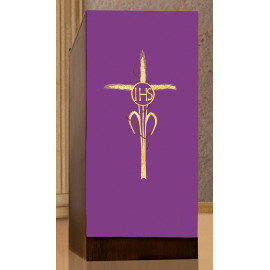


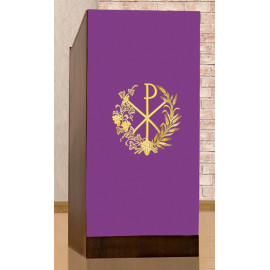


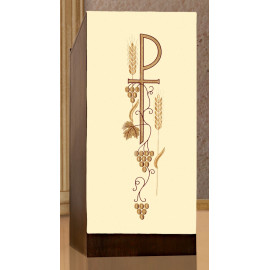

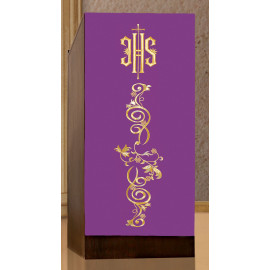
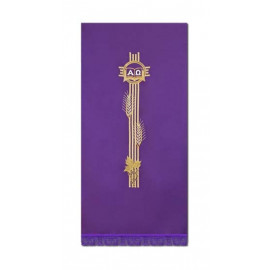


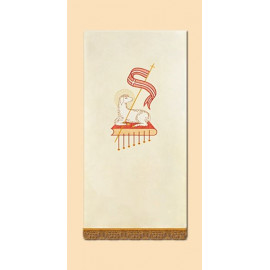
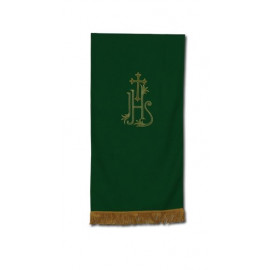


Quick answer: A lectern cover — also called an ambo fall, pulpit fall, lectern fall, or pulpit scarf — is a fabric panel that hangs over the front of the reading desk. It protects the furniture, matches the liturgical color of the day, and carries embroidered symbols. Standard sizes are 50 × 160 cm, 58 × 180 cm, and 55 × 250 cm; custom sizes are available.
What Are Lectern and Pulpit Covers?
Lectern and pulpit covers are decorative fabric panels that drape over the front of the ambo, lectern, or pulpit. They are known by many names — ambo falls, pulpit falls, lectern falls, lectern cloths, and pulpit scarves — and they are a liturgical parament: their color and embroidered symbolism follow the season of the Church year, so the reading desk always matches the vestments and the liturgical calendar. In a Catholic church the ambo is the elevated desk from which the Word of God is proclaimed during Mass, while the pulpit is traditionally the place of preaching. A well-fitted cover protects the wood or stone, hides wear, and gives the sanctuary a unified, dignified look for every celebration.
The cover is not a structural part of the furniture. It is a textile that can be changed with the season, washed, stored, and replaced far more easily than the ambo itself. For a parish, that makes it one of the simplest ways to keep the sanctuary visually coordinated without rebuilding anything.
What Is an Ambo Cover? The Names Explained
The vocabulary around this piece of liturgical furnishing is unusually rich, and the words are not always interchangeable. The table below explains the terms you will see in parish inventories, catalogs, and older liturgical books.
| Term | What it means | Where you see it |
|---|---|---|
| Ambo cover / ambo fall | A fabric panel for the front of the ambo, the desk where the readings are proclaimed. | Catholic parishes, especially since the Second Vatican Council. |
| Pulpit fall | The hanging cloth on the front of a pulpit; often embroidered and seasonal. | Older Catholic inventories, Anglican and Lutheran churches. |
| Pulpit scarf | A narrower scarf-like hanging, often reversible, used in Protestant traditions. | Protestant churches; in Catholic use the word is often a loose synonym for a pulpit fall. |
| Lectern cover / lectern cloth / lectern fall | A cover for a standing reading desk, common in both Catholic and Protestant churches. | Parishes, chapels, schools, and retreat centers. |
| Pulpit hanging | An older, broader term for a hanging on a pulpit; sometimes larger than a fall. | Historic inventories and architectural descriptions. |
| Antependium / altar frontal | A hanging for the front of the altar, not the ambo or pulpit. | Altars; see our altar tablecloths. |
If you are shopping in the United States, the search terms are often mixed: ambo covers, pulpit covers, lectern covers, pulpit falls, pulpit scarves, and podium covers can all lead to the same kind of church textile. The important thing is to match the piece to the furniture you actually have, not to the label in the catalog.
Ambo vs. Lectern vs. Pulpit: What's the Difference?
The three terms describe different pieces of church furniture, and covers are made for each. The ambo is the reading desk in the sanctuary from which the Scripture readings are proclaimed; since the Second Vatican Council it is the standard place of the Liturgy of the Word in Catholic churches. The lectern is a simpler standing reading desk, common in both Catholic and Protestant churches and often used by lectors and cantors. The pulpit is the traditional raised, enclosed stand used for preaching the homily or sermon.
| Furniture | What it is | Typical use | Cover type |
|---|---|---|---|
| Ambo | A dignified, permanent reading desk in the sanctuary. | Readings, responsorial psalm, Easter Proclamation, homily. | Ambo cover or ambo fall. |
| Lectern | A standing desk for reading, often simpler and movable. | Readings, cantor, announcements, school and chapel use. | Lectern cover, lectern cloth, lectern fall. |
| Pulpit | A raised, enclosed stand for preaching. | Homily or sermon; common in older churches. | Pulpit fall, pulpit hanging, pulpit scarf. |
The General Instruction of the Roman Missal treats the ambo as a place of dignity: from it the readings, the responsorial psalm, and the Easter Proclamation are proclaimed, and it may also be used for the homily and the prayer of the faithful (GIRM 309). That is why the ambo is dressed with the same care as the altar — and why the cover should be a deliberate liturgical choice, not an afterthought.
Why Churches Use Lectern and Pulpit Covers
Lectern and pulpit covers serve both practical and liturgical purposes:
- Protection. The cover shields the ambo, lectern, or pulpit from dust, scratches, candle wax, and the wear that comes from weekly use.
- Visual unity. Matching the cover to the vestments and altar frontals makes the sanctuary read as one coordinated space.
- Liturgical catechesis. The color and embroidery tell the congregation what season or feast is being celebrated before a word is spoken.
- Dignity. A well-fitted cover gives a simple wooden or metal desk a finished, noble appearance.
- Flexibility. A parish can change the cover for Advent, Lent, Easter, or a patronal feast without replacing furniture.
Liturgical Colors and When to Use Each
Lectern and pulpit covers are available in all standard liturgical colors, so the ambo always matches the vestments. The general rules are summarized in GIRM 346 and the following paragraphs; local custom and the diocesan calendar always take precedence.
| Color | When it is used | Meaning |
|---|---|---|
| White and gold | Christmas, Easter, solemnities of the Lord and Our Lady, weddings, baptisms, funerals (where customary). | Joy, light, glory, resurrection, purity. |
| Green | Ordinary Time. | Growth, discipleship, hope, the public ministry of Christ. |
| Red | Pentecost, Palm Sunday, Good Friday, feasts of martyrs, apostles, and evangelists. | The Holy Spirit, sacrifice, witness, martyrdom. |
| Violet / purple | Advent, Lent, and requiem Masses where customary. | Preparation, penance, conversion, expectation. |
| Rose | Gaudete Sunday (Third Sunday of Advent) and Laetare Sunday (Fourth Sunday of Lent). | A brief note of joy in the middle of a penitential season. |
| Black | Requiem Masses where local custom permits. | Mourning and prayer for the dead. |
Many parishes order a small set of covers — for example green, violet, red, and white — so the reading desk follows the calendar of the Church year without waiting for new orders each season. If you are unsure which color to choose, match the chasuble and the altar frontals; the whole sanctuary will then read as one. Our embroidered chasubles and altar tablecloths are made to coordinate with these covers.
Standard Sizes and How to Measure
Because ambo, lectern, and pulpit dimensions vary from parish to parish, our covers are available in several standard lengths as well as custom sizes. The size refers to the fabric panel: width across the desk and length (drop) down the front.
| Size | Centimeters | Inches | Best for |
|---|---|---|---|
| Compact | 50 × 160 cm | 19.7 × 63 in | Small lecterns, shorter drops, chapels. |
| Standard | 58 × 180 cm | 22.8 × 70.9 in | Most parish ambos and lecterns. |
| Long | 55 × 250 cm | 21.7 × 98.4 in | Deep ambos and pulpits, long front drops. |
| Custom | Any | Any | Non-standard furniture, curved or slanted fronts. |
How to measure in three steps:
- Measure the width of the desk top or the front panel where the cover will hang. Add a little ease if the fabric must wrap around the sides.
- Measure the drop from the front edge down to where you want the cover to end. A cover that is too long can hide the furniture or brush the floor; one that is too short looks incidental.
- Check the attachment. Note whether the furniture has hooks, a rail, Velcro, or a flat surface, and whether the cover must clear a microphone, book stand, or candle.
If your measurements do not match a standard size, order a custom cover. Send us the width, the drop, the type of furniture, and a photo if possible; we will confirm the size before production.
Materials, Embroidery, and Symbols
Our covers are sewn in Poland from smooth, stain-resistant fabric chosen for church use. The H-series lectern veils are made of an 80% polyester / 20% wool blend that drapes well, resists creasing, and stands up to repeated washing. The classic series uses a stain-resistant tablecloth fabric that holds embroidery well and is easy to iron. The embroidery is dense and color-fast, so the motifs keep their shape and depth for years of liturgical use.
Choose from a wide range of embroidered designs. Each symbol has a long history in Christian art, and the right choice depends on the season and the dedication of the church.
| Motif | Meaning | Best for |
|---|---|---|
| IHS | The Holy Name of Jesus, from the first three letters of the Greek name of Jesus. | Any season; especially the Holy Name and Eucharistic devotions. |
| Alpha and Omega | Christ, the beginning and the end (Revelation 22:13). | Solemnities, Easter, Ordinary Time. |
| PAX | Peace — the greeting of the Risen Christ. | Easter, peace-themed celebrations. |
| Cross | The Passion and victory of Christ. | Lent, Good Friday, general use. |
| Marian symbols | The lily, crown, and monogram of Our Lady. | Marian feasts, May and October devotions, shrines. |
| Christmas motifs | The Nativity, star, and seasonal ornament. | Advent and Christmas. |
| Lenten crosses | The Passion and penitential discipline. | Lent and Holy Week. |
| Sacrificial Lamb | Christ, the Lamb of God who takes away the sins of the world. | Easter and the Easter season. |
| Holy Spirit dove | The Third Person of the Trinity and the gifts of the Spirit. | Pentecost, Confirmations, ordinations. |
| Chalice, grapes, and wheat | The Eucharist and the sacrifice of the Mass. | Corpus Christi, Eucharistic adoration, general use. |
| Sacred Heart | The love of Christ for humanity. | Feast of the Sacred Heart, June devotions. |
How to Choose the Right Cover
Start with the season: choose the liturgical color that matches your vestments and altar linens. Next, pick the embroidery — IHS, Alpha and Omega, and PAX are classic choices for the ambo, while Marian or Christmas motifs suit feast days. Then measure the desk and choose a standard size or a custom fit. Finally, decide on the fabric: the 80/20 wool blend is the most durable for weekly use, while the stain-resistant classic fabric is easier to iron and a practical choice for a busy sacristy.
For a new sanctuary or a parish building its first set, the most useful order is green, white, violet, and red. Add rose for Gaudete and Laetare Sunday, and a Marian cover for the parish patronal feast or a shrine. Prices start at $70 for embroidered pulpit covers and run to $188 for the largest lectern veils, and orders over $100 ship free. If you are furnishing a new sanctuary, see our guide How to Set Up a Catholic Church Sanctuary for the full list of furnishings that work together.
Custom-Made Covers
Covers can be custom-made to fit a specific ambo, lectern, or pulpit. Send us the width of the desk top, the drop you want at the front, the type of furniture (flat, slanted, curved, or wrapped), and the color and motif you prefer. We will confirm the measurements and produce the cover in the same fabrics and embroidery as our standard pieces. Custom orders are made in Poland; allow an additional 3–14 business days for production before dispatch. For questions about a custom size, contact us before ordering.
Care and Cleaning
Wash covers separately in cold water with a mild detergent, and iron them while still slightly damp for a crisp finish. Store them flat or rolled rather than folded tightly, so the embroidery does not crease. Remove candle wax by placing the cover between clean paper towels and pressing with a warm iron; do not scrape the embroidery with a sharp tool. For a complete step-by-step method that also covers corporals, purificators, and altar cloths, read our guide How to Wash Liturgical Linens.
Coordinating with Altar Linens and Vestments
A lectern cover looks best when it belongs to a set. Match the color and embroidery with our embroidered altar tablecloths, chalice linen sets, chalice veils, ciborium veils, and monstrance veils. The same embroidery can run from the ambo to the altar, so the whole sanctuary reads as one design. For the vestments themselves, see our chasubles and stoles.
Common Mistakes to Avoid
- Measuring only the top. The drop down the front is what determines whether the cover looks right; measure both width and drop.
- Buying too short. A cover that ends above the front panel can look like an afterthought. When in doubt, choose the longer standard size or order custom.
- Ignoring the attachment. Hooks, rails, Velcro, microphones, and book stands all affect how the cover hangs.
- Mixing unrelated colors. Match the chasuble and altar frontal; the ambo should support the sanctuary, not compete with it.
- Using a narrow Protestant pulpit scarf on a Catholic ambo. The proportions are different; a Catholic ambo fall is usually wider and longer.
- Washing with bleach or hot water. Both weaken the fabric and dull the embroidery.
Frequently Asked Questions About Lectern and Pulpit Covers
What Is a Pulpit Fall?
A pulpit fall is the decorative cloth that hangs down in front of a pulpit or lectern. It is usually embroidered and made in the liturgical color of the season, and it may also be called an ambo fall or lectern fall depending on the church furniture it covers.
What Is the Difference Between an Ambo and a Pulpit?
The ambo is the desk where the Scripture readings are proclaimed at Mass; the pulpit is the traditional raised stand used for preaching the homily or sermon. In many modern Catholic churches one ambo serves both readings and preaching, while older churches often keep a separate, higher pulpit.
What Do Catholics Call a Pulpit Cover?
The most common names are ambo cover, ambo fall, pulpit fall, and pulpit scarf; in older inventories it is sometimes listed as a pulpit hanging. All of these refer to the same parament — a fabric panel that drapes over the front of the reading desk and matches the liturgical color.
What Colors Do Lectern and Pulpit Covers Come In?
Covers are made in all the liturgical colors: white, gold, red, green, violet, purple, rose, and black. The color follows the season — white and gold for Christmas and Easter, green for Ordinary Time, violet for Advent and Lent, red for Pentecost and feasts of martyrs, and rose for Gaudete and Laetare Sunday.
How Much Do Lectern and Pulpit Covers Cost?
Our embroidered pulpit covers start at $70, and the largest lectern covers cost up to $188. The price depends on the size and the embroidery; custom-made covers are quoted individually. Orders over $100 ship free within the United States.
Can Lectern and Pulpit Covers Be Custom-Made?
Yes. We sew covers to any dimensions — send us the width of your ambo or pulpit top and the drop you need, and we will make the cover in the fabric, color, and embroidery you choose. Custom covers are produced in Poland together with our standard pieces.
How Do I Measure My Ambo or Lectern for a Cover?
Measure the width of the desk top and decide how far the cover should hang at the front; the fabric should fall straight without pulling. Our standard sizes are 50 × 160 cm (19.7 × 63 in), 58 × 180 cm (22.8 × 70.9 in), and 55 × 250 cm (21.7 × 98.4 in); if your desk does not match, order a custom size.
How Do I Clean and Store a Lectern Cover?
Wash separately in cold water with mild detergent, iron while damp, and store flat or rolled so the embroidery stays smooth. Full instructions are in our guide to washing liturgical linens.
Where Can I Buy Lectern and Pulpit Covers?
You can buy them directly from Best Catholic Shop — an online supplier of Catholic liturgical furnishings. Every cover is made in Poland; choose a standard size above or contact us for a custom fit.
What Is a Pulpit Scarf?
A pulpit scarf is a narrow, often reversible hanging used mainly in Protestant churches. In Catholic use the same words are sometimes used loosely for a pulpit fall, but the proportions are different: a Catholic ambo fall is usually wider and longer than a Protestant pulpit scarf.
What Is the Difference Between a Pulpit and a Lectern?
A pulpit is a raised, enclosed stand used for preaching; a lectern is a simpler standing desk used for reading. The lectern may be movable and is common in schools, chapels, and churches of many traditions, while the pulpit is usually a fixed architectural feature.
What Is a Lectern Cloth?
A lectern cloth is another name for a lectern cover — the fabric panel that hangs over the front of the reading desk. It may be plain, embroidered, or made to match the liturgical color of the season.
What Is an Ambo Fall?
An ambo fall is the cover that hangs on the front of the ambo, the reading desk in the sanctuary. It is the Catholic term most closely associated with the place of the Liturgy of the Word, and it usually matches the vestments and altar linens.
Do I Need a Cover for Both the Ambo and the Lectern?
Only if your church uses both pieces of furniture. Many parishes have one ambo that serves all the readings; older churches may have a separate lectern for the cantor or announcements. Measure each piece separately if you want a coordinated set.
What Material Is Best for a Lectern Cover?
For weekly use, an 80% polyester / 20% wool blend is durable, drapes well, and resists creasing. A stain-resistant tablecloth fabric is easier to iron and is a practical choice for a busy sacristy. Both hold embroidery well; the right choice depends on how often the cover is used and how it is cleaned.
What Size Lectern Cover Do I Need?
Measure the width of the desk and the drop you want at the front. Standard sizes are 50 × 160 cm, 58 × 180 cm, and 55 × 250 cm; if your furniture is larger, smaller, curved, or slanted, order a custom size.
Can I Use a Pulpit Cover on an Ambo?
Yes, if the proportions fit. The two terms describe the same kind of textile; what matters is the width, the drop, and the way the cover attaches to the furniture. Measure the ambo as you would a pulpit and choose the closest standard size or a custom cover.
What Is the Difference Between a Pulpit Cover and an Altar Frontal?
A pulpit cover is made for the ambo, lectern, or pulpit; an altar frontal (antependium) is made for the front of the altar. They may coordinate in color and embroidery, but they serve different places in the church and are not interchangeable.
Related Reading
Continue with our guides: What Is a Pulpit Fall? Names, Purpose, and Liturgical Use, Ambo vs. Pulpit vs. Lectern, How to Measure a Lectern or Ambo for a Cover, Pulpit Scarf Colors and Their Meaning, How to Choose a Lectern or Pulpit Cover, and How to Clean and Store Lectern and Pulpit Covers.
