




What Is a Liturgical Holy Oil Stock?
A liturgical holy oil stock (also called a holy oil vessel or holy oil container) is a sacred vessel used to store and dispense the holy oils used in the sacraments of the Catholic Church. There are three holy oils: Oil of the Catechumens (OC), used in baptism and ordination; Oil of the Sick (OS), used in the Anointing of the Sick; and Sacred Chrism (SC), used in baptism, confirmation, and holy orders.
In church tradition this vessel is also called a chrismarium (chrismal or chrismatory) — a container for holy oils that the Church counts among its sacramentals. The word comes from chrism, the consecrated oil used in baptism, confirmation, and ordination. Whatever the name, these holy oil vessels serve the same purpose: to hold each oil reverently, keep it clean, and make sure it is clearly identified.
These oils are blessed by the bishop at the annual Chrism Mass and distributed to parishes for use throughout the year. The oil stock is an essential item in every church sacristy. It keeps the oils clean, properly labeled, and ready for use in baptisms, confirmations, anointing of the sick, and ordinations.
Every parish needs a quality oil stock set. Proper storage of the holy oils shows reverence for these sacred substances and ensures they are readily available when the sacraments are celebrated. Choosing a Catholic oil stock made of durable metal — with tight-fitting caps and clear labels — is one of the simplest ways to protect the oils throughout the year.
Oil Stock vs. Ambry vs. Chrismarium: What's the Difference?
These three terms describe related but distinct things. An oil stock is the portable vessel — the container you can hold and carry. An ambry (from the Latin armarium, "cupboard") is the fixed, usually locked recess or cabinet in the church wall — most often in the sanctuary or sacristy, near the baptismal font — where the holy oils are reserved between celebrations. A chrismarium is simply another name for the vessel itself; the Church counts it among its sacramentals. In older usage "chrismarium" could also mean the place set apart for the administration of confirmation — the sense that today belongs to "ambry."
In daily parish practice the two work together: the oils are reserved in the ambry or a locked sacristy cabinet, and the oil stocks are the vessels the priest takes to the baptismal font, the hospital, or a home visit. Read more in our guide Oil Stock vs. Ambry: Where and How Holy Oils Are Kept.
What Types of Holy Oil Stocks Are Available?
Oil stocks come in different configurations to meet the needs of different parishes:
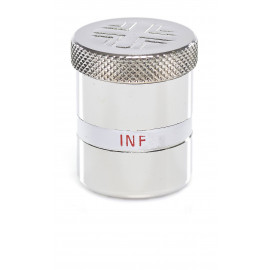
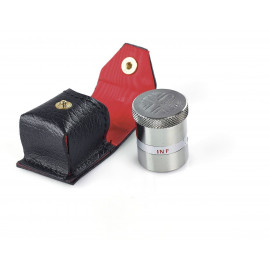
Single oil stock — holds one type of oil. Good for churches that want separate vessels for each oil or need to keep oils in different locations (for example, one in the sacristy and one in the baptismal area).
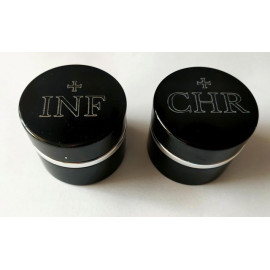
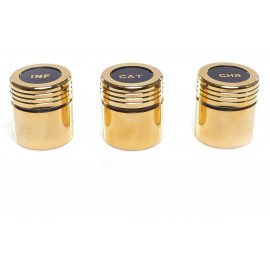
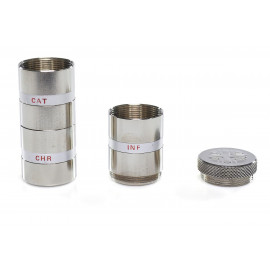
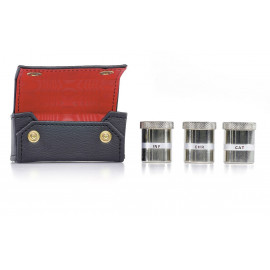
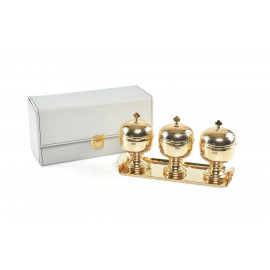
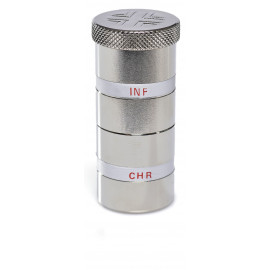
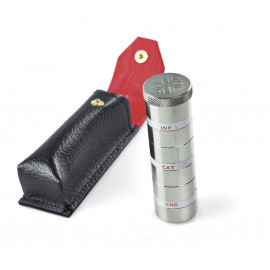
Triple oil stock — a single unit with three compartments, one for each oil (OC, OS, SC). This is the most common and practical setup for parishes because it keeps all three oils together and clearly labeled. A triple oil stock is easier to manage and less likely to result in confusion about which oil is which.
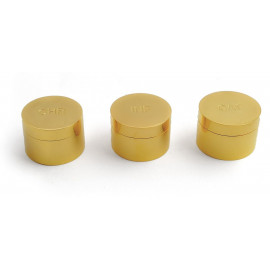
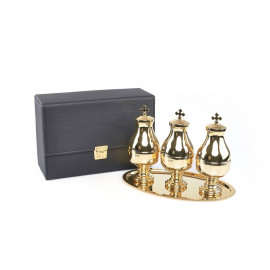
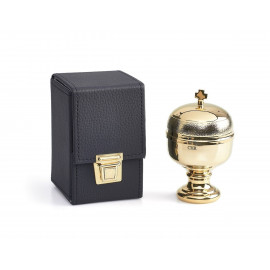
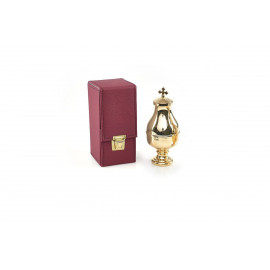
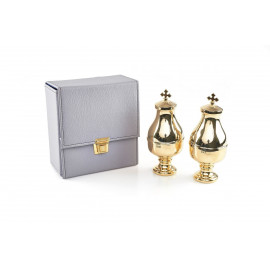
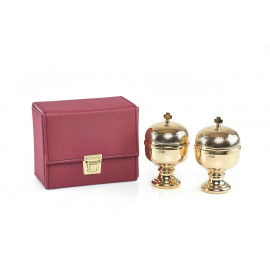
Brass oil stocks — the traditional choice. Durable, attractive, and when gold-plated, they look beautiful on the altar or in the sacristy. Brass oil stocks are the most popular choice for parish use.
Wall-mounted oil stocks — designed to be mounted on the wall near the baptismal font or in the sacristy. These save counter space and keep the oils in a designated, reverent location.
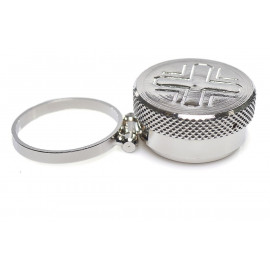
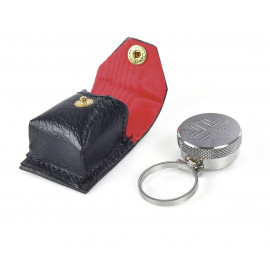
Stocks with a finger ring — many single oil stocks have a ring so a priest can carry the Oil of the Sick on hospital or home visits. Models with a glass cartridge or insert hold the oil in a glass vial inside the metal housing, which makes cleaning and refilling easier.
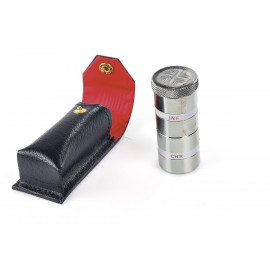
Sets with leather cases and pouches — double and triple stocks are often supplied in a leather case or pouch that keeps the vessels together, protected, and ready for travel and sick calls.
How Do I Choose the Right Holy Oil Stock?
- Triple vs. single. A triple oil stock is more convenient for most parishes. Single stocks are good if you need to keep oils in separate locations or want individual vessels for each oil.
- Check the labels. Each compartment should be clearly marked (OC, OS, SC) to avoid confusion. Using the wrong oil in a sacrament is a serious liturgical error.
- Consider the size. Make sure the stock holds enough oil for your parish's needs throughout the year. Most parishes receive enough oil at the Chrism Mass to last the year, so the stock needs to hold the full amount.
- Look for a secure closure. The caps should fit tightly to prevent spills and contamination. A loose cap can let dust in and cause the oil to spill.
- Consider the material. Brass is the traditional and most durable choice. Glass oil stocks are also available but are more fragile.
| Type | Compartments | Best For | Price Range |
|---|---|---|---|
| Single oil stock | 1 | Individual oil storage, sick calls | $44–$84 |
| Double oil stock | 2 | Baptismal font, two-oil sets | $76–$391 |
| Triple oil stock | 3 (OC, OS, SC) | Parish sacristy — complete set | $76–$592 |
| Travel sets | 2 | Visits and travel | from $32 |
Our current collection includes 25 oil stocks from $32 to $592, in silver, nickel, and gold-plated finishes. Vessels with removable glass cartridges (50 ml) — the easiest to clean — start at $200.
What Do INF, CHR, and CAT (or OI, OC, SC) Mean on an Oil Stock?
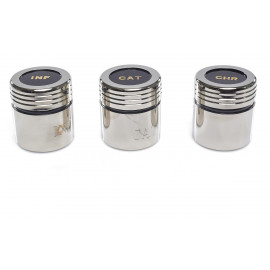
Because the three oils look nearly identical, oil stocks are labeled with abbreviations. Sets made in Italy and Poland traditionally use the Latin: INF — oleum infirmorum, the Oil of the Sick; CHR — chrisma, Sacred Chrism; CAT — oleum catechumenorum, the Oil of the Catechumens. Some suppliers use the initials OI (oil of the sick), OC (oil of catechumens), and SC (sacred chrism) instead. Both conventions are correct — what matters is that each oil is unmistakably identified, because using the wrong oil in a sacrament is a serious liturgical error.
Single, Double, or Triple: How Many Oil Stocks Does a Parish Need?
Most parishes settle on three vessels in three places. A triple oil stock — all three oils in one unit or case — is the standard for the sacristy, where the oils are filled from the bishop's vessels after the Chrism Mass and kept ready for the sacraments. A double oil stock suits the baptismal font, where chrism and the oil of catechumens are both used. A single oil stock, ideally with a finger ring, belongs in the priest's sick call bag with the pyx and stole for visits to the sick.
Capacity matters too. The small pocket stocks hold roughly 10–25 ml — enough for sick calls and confirmations. The larger 50 ml vessels with glass cartridges, sold singly or in double and triple sets, hold a parish's working supply and are the easiest to clean. A large crystal or metal ambry vessel can store the full year's supply where the oils are reserved. Whatever the size, choose models with tight-fitting caps: a loose cap lets dust in, lets the oil spill, and lets the fragrance of chrism escape.
Sick Calls and Hospital Visits: Carrying the Oil of the Sick
The Oil of the Sick is the one holy oil that regularly leaves the church. On hospital and home visits, the priest carries a single oil stock — traditionally a small round vessel with a finger ring so it stays secure while he anoints with the other hand — together with a pyx for Holy Communion, a purificator, and a stole. Many of our single stocks come with a leather case or pouch, and the finger-ring models are made exactly for this purpose.
Before leaving, it is good practice to check that the stock is clearly marked OI or INF, that the cap seals tightly, and that the vessel is filled. After the visit, used oil is never returned to the stock, and the vessel is wiped and kept with the sick call set. For the Communion side of the visit, see our pyxes and the burse for the sick call paten.
Chrism Mass: When Parishes Receive the New Oils
Holy oils are renewed every year. During Holy Week — ordinarily on the morning of Holy Thursday, though many dioceses transfer the celebration to another day close to Easter — the bishop blesses the Oil of the Catechumens and the Oil of the Sick and consecrates Sacred Chrism at the cathedral, in the Mass called the Chrism Mass. Parish representatives receive the oils at the end of Mass and bring them back to the parish, where they are poured into the oil stocks and reserved in the ambry or a locked sacristy cabinet.
The previous year's oils are disposed of reverently — customarily by burning — and never poured down an ordinary drain. For sacristans, the weeks before Easter are the natural moment to check the condition of the parish's stocks: caps that no longer seal, worn labels, or tarnished plating are best replaced before the new oils arrive. Read the full story in our guide Chrism Mass Explained.
How Do You Care for Holy Oil Stocks?
Oil stocks are relatively low-maintenance but require reverent handling. Wipe the exterior regularly with a soft cloth. When refilling, make sure the compartments are clean and dry before adding new oil. Store in a cool, dry place. If the oil becomes discolored or contaminated, it should be disposed of properly — burned, not poured down a regular drain. The sacrarium is the appropriate place for disposing of old oil that has been diluted with water during cleaning.
In many churches the holy oils are kept in the ambry — the locked cupboard or recess in the sanctuary wall reserved for the oils — or in a secure cabinet in the sacristy. Wherever they are kept, the vessels should be clearly labeled (OC, OS, SC) and stored away from direct sunlight and heat.
Frequently Asked Questions About Holy Oil Stocks
Q: How often should holy oils be replaced?
A: Holy oils should be replaced annually, typically at the Chrism Mass when the bishop blesses new oils. Old oil should be burned, not poured down a regular drain. This is a requirement of canon law.
Q: Can I use any container for holy oils?
A: The Church requires that holy oils be stored in proper vessels. A dedicated oil stock ensures the oils are kept clean, labeled, and reverently stored. Using improper containers risks contamination and confusion. Catholic holy oil containers should be dedicated to this purpose and never used for anything else.
Q: Where should holy oil stocks be kept?
A: Holy oil stocks should be kept in a clean, dry, and reverent place — typically in the sacristy, near the baptismal font, or in the ambry (the wall recess reserved for the holy oils). They should be accessible to the priest and deacon but secure from accidental disturbance.
Q: What is a chrismarium?
A: A chrismarium (also called a chrismal or chrismatory) is a container for holy oils — a vessel the Church counts among its sacramentals. The word comes from chrism, the consecrated oil used in baptism, confirmation, and ordination. In practice, "chrismarium" and "holy oil stock" describe the same object: a dedicated vessel for the Oil of the Catechumens, the Oil of the Sick, or Sacred Chrism.
Q: What are the three holy oils in the Catholic Church?
A: The three holy oils are the Oil of the Catechumens (OC), used in baptism and ordination; the Oil of the Sick (OS), used in the Anointing of the Sick; and Sacred Chrism (SC), used in baptism, confirmation, and holy orders. The bishop blesses the first two and consecrates the chrism at the annual Chrism Mass, and parishes receive them from the diocese for the coming year.
Q: Can holy oil be made at home?
A: Holy oils used in the sacraments are not made at home. The bishop blesses the Oil of the Catechumens and the Oil of the Sick, and consecrates the Sacred Chrism mixed with balsam, at the Chrism Mass; parishes then receive the oils from the diocese. In case of true necessity, a priest may bless the Oil of the Sick.
Q: Do oil stocks come with a ring or a case?
A: Many single oil stocks include a finger ring so they can be carried on sick calls, and some hold the oil in a glass cartridge that lifts out for cleaning. Double and triple stocks are often supplied in a leather case or pouch that keeps the vessels together and protected in travel.
Q: Where can I buy holy oil stocks?
A: You can buy holy oil stocks online at Best Catholic Shop — single, double, and triple vessels in silver, nickel, and gold-plated finishes, from $32. We supply the vessels; the holy oils themselves are distributed to parishes by the diocese after the Chrism Mass.
Q: What is an oil stock?
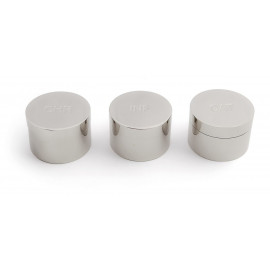
A: An oil stock is a small vessel — usually a cylindrical metal container with a tight cap — that holds one of the three holy oils: the Oil of the Catechumens, the Oil of the Sick, or Sacred Chrism. Stocks are made singly or as sets of two and three, are marked with the oil's abbreviation (INF, CHR, CAT or OI, OC, SC), and are reserved for the holy oils alone.
Q: What oil do Catholics use for baptism?
A: Two oils are used in baptism: the Oil of Catechumens before the baptismal washing, and Sacred Chrism for the post-baptismal anointing of the crown of the head. Both are blessed or consecrated by the bishop at the Chrism Mass.
Q: What is chrism oil used for?
A: Sacred Chrism — olive oil mixed with balsam and consecrated by the bishop — is used in baptism, confirmation, the ordination of priests and bishops, and the consecration of churches and altars. It is the only one of the three holy oils that is consecrated rather than blessed.
Q: How do you clean a holy oil stock?
A: Wash the vessel and any glass cartridge with warm water and mild soap, rinse thoroughly, and dry completely before refilling. Because the wash water has touched the holy oils, it should be poured into the sacrarium rather than an ordinary drain. Never return used oil to the stock.
Q: How much oil does an oil stock hold?
A: Small pocket stocks hold roughly 10–25 ml — enough for sick calls, baptisms, and confirmations. The larger vessels sold with glass cartridges hold 50 ml, and the double and triple sets carry 2 × 50 ml or 3 × 50 ml of the working supply; a large ambry vessel can hold the full year's oils.
Browse Our Holy Oil Stock Collection
Browse our selection of liturgical holy oil stocks (holy oil vessels and holy oil containers) in silver, nickel, gold-plated, and brass finishes — single, double, and triple-compartment designs. Keep your parish's holy oils properly stored and labeled. We also offer pyxes, cruets and trays, and reliquaries for a complete sacred vessel collection.
Related reading: What Is a Chrismarium? The Complete Guide to Holy Oil Containers · The Three Holy Oils of the Catholic Church Explained · Oil Stock vs. Ambry: Where and How Holy Oils Are Kept · Chrism Mass Explained · How to Store Sacred Vessels Safely · The Complete Guide to Catholic Altar Vessels.
