
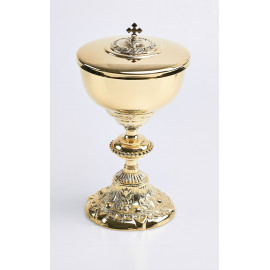
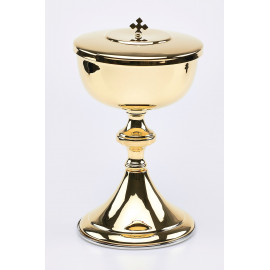
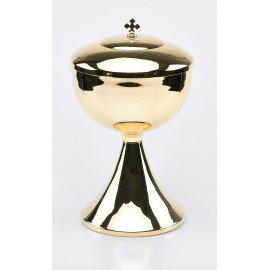
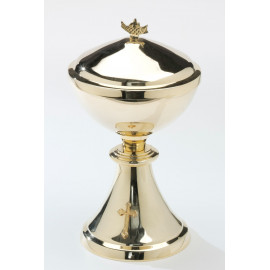
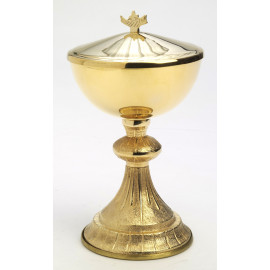
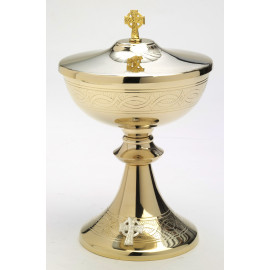
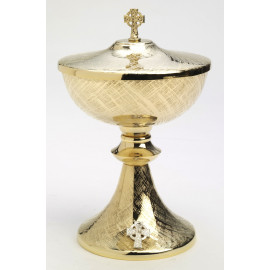
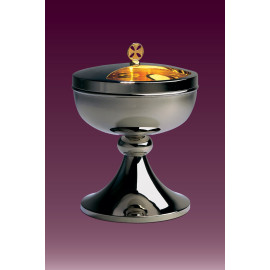
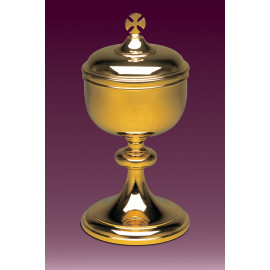
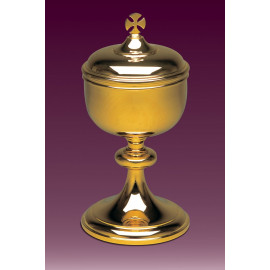
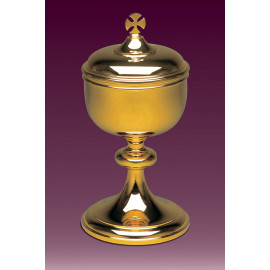
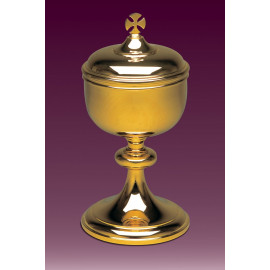
What Is a Liturgical Ciborium?
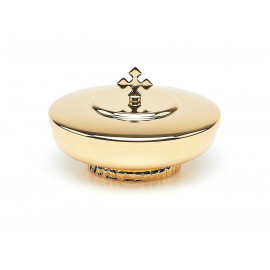
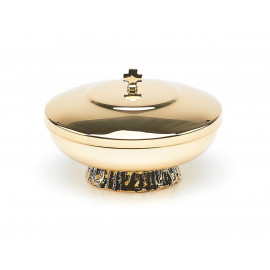
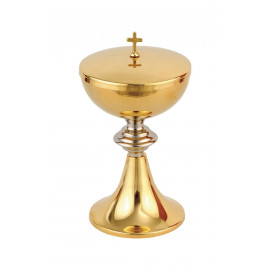
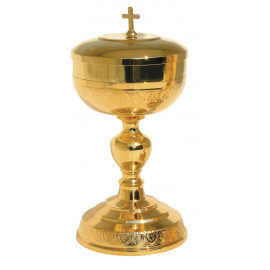
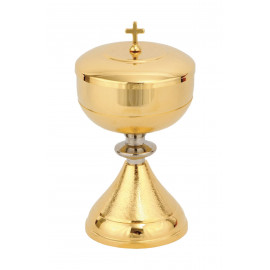
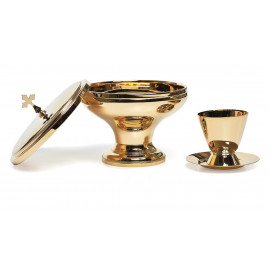
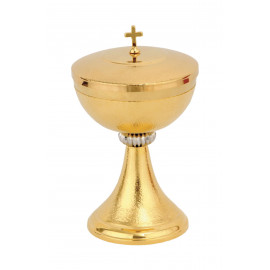
A liturgical ciborium is a covered sacred vessel used to hold the consecrated hosts — the Body of Christ — during and after the celebration of Mass. It looks like a wide chalice but with a lid, and that lid is what sets it apart from other sacred vessels. The cover protects the hosts from dust and shows reverence for the Real Presence of Christ in the Eucharist.
The word "ciborium" comes from the Greek word for cup. In early Christian art, it referred to a canopy over the altar. Over time, the name transferred to the vessel itself. Today, every church that reserves the Blessed Sacrament in the tabernacle uses a ciborium for the distribution and reservation of Holy Communion.
The ciborium serves two main purposes. First, it holds the hosts that will be distributed to the faithful during Holy Communion at Mass. Second, after Mass, any remaining consecrated hosts are placed in the ciborium (or a larger vessel called a custody) for reservation in the tabernacle for adoration and distribution to the sick.
What Types of Liturgical Ciboria Are Available?
Just like chalices, ciboria come in different materials and sizes. Here is what you will find in our collection:
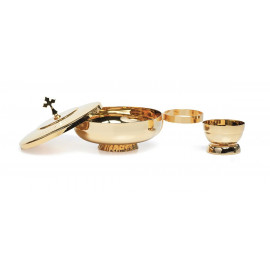
Brass ciboria are the most popular choice for parish use. They are affordable, durable, and when gold-plated, they meet all liturgical requirements for sacred vessels. Most parishes use brass ciboria for daily Mass and regular Communion distribution.
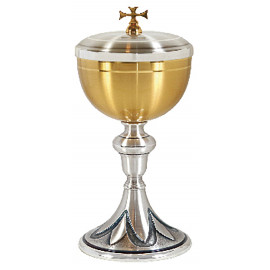
Silver-plated ciboria offer a more elegant and ornate appearance. They are a good choice for churches that want something that looks more elaborate for Sunday Mass, solemnities, and special liturgical celebrations.
Size matters. A mini ciborium might hold 20–50 hosts — fine for a weekday Mass with a small congregation. A large ciborium can hold several hundred hosts for Sunday services or for reserving a significant number of hosts in the tabernacle for adoration and Communion to the sick.
How Do I Choose the Right Ciborium for My Church?
- Consider your congregation size. A small parish might only need a medium ciborium. A large church or cathedral will want a bigger one to accommodate the number of communicants.
- Check the lid fit. The lid should sit snugly without wobbling. A loose lid lets dust in and does not show proper reverence for the Blessed Sacrament.
- Interior must be precious metal. Same rule as chalices — the inside needs to be gold or silver plated to meet canon law requirements.
- Weight and stability. A ciborium that tips over easily during the distribution of Communion is a real problem. Look for a wide, stable base.
- Match your chalices. Many churches choose ciboria that match their chalices in material and finish for a unified look on the altar.
| Size | Capacity | Best For | Price Range |
|---|---|---|---|
| Small | 20-50 hosts | Weekday Mass, small chapels | $87–$222 |
| Medium | 50-150 hosts | Regular parish Masses | $141–$484 |
| Large | 150–600 hosts | Sunday Mass, cathedrals | $484–$1,597 |
What Material Should a Ciborium Be Made Of?
The Church requires that the interior of the ciborium be made of precious metal. Our collection includes:
Brass with gold plating — the most practical and popular choice. Durable, affordable, and meets all liturgical requirements.
Silver-plated brass — more elegant appearance for churches that want a more ornate ciborium for special celebrations.
The Church's liturgical norms — set out in the General Instruction of the Roman Missal — require that the interior of a vessel which holds the Eucharist be precious metal: gold or silver, or at least gilded. That is why every ciborium in our collection is gold- or silver-plated inside, whatever the finish on the outside. Solid sterling silver is an option some churches ask for, but plated brass meets the same requirement at a parish-friendly price.
How Do You Care for a Ciborium?
Ciboria are pretty straightforward to maintain. After Mass, any remaining hosts are reverently placed in the tabernacle. The ciborium itself should be wiped clean with a purificator and stored in a dry place. Avoid harsh chemicals — a soft cloth and mild soap are all you need. If the plating wears thin, have it re-plated by a professional who specializes in sacred vessels.
Browse Our Ciborium Collection
Explore our selection of liturgical ciboria in brass, silver-plated, and various sizes. Every ciborium meets the Church's requirements for sacred vessels. Find the right size for your parish. We also offer matching chalices and custodies for a unified sacristy collection. To veil the ciborium itself, see our embroidered ciborium veils.
Ciborium vs. Chalice vs. Paten
A ciborium, a chalice and a paten are the three vessels at the heart of the Eucharist, and each has a different job. A chalice holds the Precious Blood; it is an open cup with no lid. A paten is the flat, shallow plate that holds the large host offered by the priest at the altar. A ciborium is a wide, lidded cup that holds the many small hosts that will be consecrated and distributed to the faithful — and, after Communion, its lid lets it store the remaining Blessed Sacrament safely in the tabernacle.
The simplest way to remember it: the chalice is for the wine, the paten is for the bread of the offertory, and the ciborium is for the communion hosts of the congregation. Because a ciborium and a chalice are both cup-shaped and often made in matching finishes, parishes frequently buy them as a set so the altar vessels share one look. Browse our matching liturgical chalices and patens.
Ciborium vs. Tabernacle — and What "Ciborium" Means in Architecture
The word "ciborium" carries two distinct meanings, and it is worth telling them apart. In the liturgical sense it is the vessel described on this page: a covered container for hosts. In church architecture, a ciborium (also called a baldachin) is the freestanding canopy supported on columns that stands over the altar — the same name, an entirely different object. Britannica and Merriam-Webster list both senses for a reason.
A ciborium is also not the same as a tabernacle. The tabernacle is the fixed, locked box — usually on or near the altar — in which consecrated hosts are reserved for adoration and for Communion to the sick. The ciborium is the portable vessel that carries hosts at Mass and then is placed, with the remaining Blessed Sacrament, inside the tabernacle. Many churches keep a larger ciborium in the tabernacle and a smaller one for daily Mass. If you reserve for the sick away from church you may also want a liturgical custody, the flat, pocket-shaped vessel made for carrying Communion to the homebound.
Ciborium vs. Pyx: What's the Difference?
A pyx and a ciborium are both vessels for the Blessed Sacrament, but they serve different moments in the life of the Church. A pyx is the small, flat, closable case — usually only a few centimetres across — in which a few hosts are carried to the sick and the homebound, or brought to adoration outside Mass. A ciborium is the larger lidded cup used at Mass itself: it holds the hosts of the whole congregation, stands on the altar or credence table, and afterwards reserves the remaining hosts in the tabernacle. The pyx serves the Communion of the sick — the viaticum, the Eucharist given at the end of life — one of the most treasured works of mercy in the Church.
In older liturgical books a small ciborium was sometimes called a pyx, which is why the two names still get confused. The rule of thumb today: if it is a wide cup with a stem and a knobbed lid, it is a ciborium; if it is a small flat box that fits in a pocket, it is a pyx. Browse our Catholic pyxes for taking Communion to the sick.
Types of Ciboria
Ciboria are usually described by their size, their material and the way they stack. Here is what you will find in our collection:
- Mini ciboria — the smallest vessels, roughly 11–14 cm, holding a modest number of hosts for weekday Mass, small chapels or a priest's travel kit.
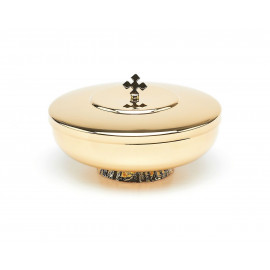
- Stacking (stacked) ciboria — a deep bowl with a close-fitting lid so several can be nested and stacked in the tabernacle, a space-saving choice when a parish reserves a large number of hosts. We stock double and triple stacked models.
- Deep-on-nodus ciboria — a taller body on a clear knob (nodus) for a firmer grip during distribution.
- Field ciboria and custodies — flat, secure vessels designed to carry consecrated hosts to the sick; the field ciborium is the larger variant with a screw or magnetic closure.
- Concelebration ciboria — large, gilded vessels that hold the hosts needed when several priests concelebrate a solemn Mass.
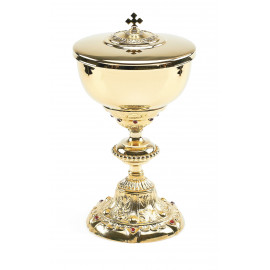
- Ornamental ciboria — Maltese, Baroque and engraved styles, including models with imitation gemstones or grape and cross motifs, for churches that want a more ornate altar vessel.
The Parts of a Ciborium
Every ciborium, from the simplest brass model to an engraved Maltese piece, has the same basic anatomy:
- Bowl (cup) — the wide, shallow interior that holds the hosts; its inside is always gold- or silver-plated because it touches the Eucharist.
- Lid (cover) — the fitted top that protects the hosts; most lids carry a cross.
- Knob — the small grip at the centre of the lid, so the lid can be lifted without touching the rim.
- Nodus — the decorative node on the stem that gives the priest a firm grip during the distribution of Holy Communion.
- Stem — the shaft between bowl and base.
- Base — the wide foot that keeps the vessel stable on the altar.
When choosing, a snug lid and a wide, stable base matter more than ornament: a loose lid lets dust in, and an unstable ciborium risks spilling the Blessed Sacrament during distribution.
Etymology and Pronunciation: How to Say "Ciborium"
The word ciborium comes from the Greek kiborion, the name of the cup-shaped seed pod of the Egyptian water lily, which was imitated as a drinking cup in the ancient world. Latin adopted the word as ciborium, and early Christian writers used it first for the canopy over the altar — the sense that survives in church architecture — and later for the vessel itself.
In English it is pronounced sih-BOR-ee-um (/sɪˈbɔːriəm/): four syllables, with the stress on the second. The plural is ciboria, pronounced sih-BOR-ee-uh. In Spanish a ciborium is a copón, in Italian a ciborio, and in French a ciboire.
Who May Touch a Ciborium?
A ciborium holds the Blessed Sacrament, so it is treated with the highest reverence. Ordinarily it is handled only by an ordained minister — a priest or deacon — or by an instituted acolyte or an extraordinary minister of Holy Communion who has been duly commissioned. An altar server may carry an empty ciborium to the credence table, but should never touch the consecrated hosts. The vessel is always purified after Mass, and a ciborium that has held the Blessed Sacrament is cleansed before it is put away.
How Much Does a Ciborium Cost?
At Best Catholic Shop a ciborium costs between $87 and $1,597, depending on size, plating and ornamentation. Mini ciboria and small gold-plated models start at $87–$222, mid-size brass ciboria for a regular parish Mass run from about $229 to $484, and large gilded or concelebration ciboria and hand-ornamented Maltese and Baroque models reach $700 and above. Complete sets of chalice, ciborium and paten start at $605.
| Type | Typical height | Best for | Price range |
|---|---|---|---|
| Mini ciborium | 11–14 cm | Weekday Mass, small chapels, travel | $87–$222 |
| Standard brass ciborium | 14–18 cm | Regular parish Masses | $141–$484 |
| Large / concelebration | 20–34 cm | Sunday Mass, cathedrals, concelebration | $484–$1,597 |
How Many Hosts Does a Ciborium Hold?
Capacity is the most practical question when choosing a ciborium, and it follows the diameter of the bowl. As a rule of thumb:
| Bowl diameter | Typical capacity | Best for |
|---|---|---|
| 11–14 cm (mini) | 20–50 hosts | Weekday Mass, small chapels, travel kits |
| 14–18 cm | 50–150 hosts | Regular parish Masses |
| 19–26 cm | 150–600 hosts | Sunday Mass, larger congregations |
| 28–34 cm | 600–1,000+ hosts | Cathedrals and concelebration |
The figures depend on how deeply the bowl is drawn and on the size of the hosts, so treat them as guidance rather than a guarantee. Mini ciboria hold a few dozen hosts — enough for a weekday Mass in a small chapel. A standard parish ciborium covers most Sunday congregations. Large and concelebration models are made for cathedral Masses and for parishes that reserve many hosts: our 25 cm gilded ciborium, for example, holds around 600 hosts. If you need to reserve several hundred hosts without using extra shelf height in the tabernacle, choose a stacking ciborium — the bowls nest into one another.
Ciborium Veils and Covers
Many churches keep the reserved ciborium covered with a ciborium veil — a small cloth, traditionally white, laid over the vessel inside the tabernacle. The veil is a sign of reverence: it keeps the eyes of the faithful from fixing directly on the vessel that holds the Blessed Sacrament. On Holy Thursday the ciborium is carried to the altar of repose, often under a white or gold veil, and returned after the Mass of the Lord's Supper. Our workshop makes embroidered ciborium veils in 27 designs from $40, with IHS, PAX, Easter and Marian motifs; for the chalice see chalice veils, and for exposition see monstrance veils.
Cleaning, Polishing, and Storing a Ciborium
After Mass the remaining hosts are reverently placed in the tabernacle and the ciborium is purified. Wipe it with a soft cloth and, if needed, mild soap — never abrasive pads or harsh chemicals, which dull the plating and scratch the gold lining. Store it in a dry place, in a case or a lined cabinet, and handle the lid by its knob so the rim stays true. If the interior gold lining wears thin over years of use, have the piece re-plated by a specialist in sacred vessels so it remains fit for the Eucharist.
Frequently Asked Questions About Ciboria
Q: What is the difference between a ciborium and a tabernacle?
A: A ciborium is a portable vessel that holds hosts. A tabernacle is a fixed, locked box (usually on or near the altar) where consecrated hosts are reserved. After Mass, the ciborium containing remaining hosts is placed inside the tabernacle.
Q: Do I need more than one ciborium?
A: Many churches use a larger ciborium for the tabernacle and a smaller one for daily Mass. It is not required, but it is practical. A larger ciborium (sometimes called a custody) is often kept in the tabernacle, while a smaller one is used at Mass.
Q: Does a ciborium need to be blessed?
A: Yes, like all sacred vessels that hold the Eucharist, a ciborium should be blessed before use. The blessing sets it apart for sacred liturgical use.
Q: What Is the Difference Between a Ciborium and a Chalice?
A: A chalice is an open cup that holds the Precious Blood; a ciborium is a wide cup with a lid that holds the consecrated hosts for distribution. The ciborium's lid is the defining feature — it protects the hosts and allows them to be reserved in the tabernacle.
Q: What Is the Difference Between a Paten and a Ciborium?
A: A paten is a flat, shallow plate that holds the bread during the offertory and the priest's host at the altar. A ciborium is a deep, lidded vessel that holds the many communion hosts of the congregation. Some ciboria are made to sit on top of a paten.
Q: Who Is Allowed to Touch a Ciborium?
A: Because it holds the Blessed Sacrament, a ciborium is normally handled only by a priest, deacon, instituted acolyte or a commissioned extraordinary minister of Holy Communion. An altar server may carry an empty ciborium but should not touch the consecrated hosts.
Q: What Is the Plural of Ciborium?
A: The plural of ciborium is ciboria. A single vessel is a ciborium; two or more are ciboria. The word comes from the Latin and Greek for a cup.
Q: How Do You Pronounce "Ciborium"?
A: In English, ciborium is pronounced sih-BOR-ee-um (/sɪˈbɔːriəm/) — four syllables with the stress on the second. The plural, ciboria, is sih-BOR-ee-uh. The word goes back to the Greek kiborion, a cup shaped like the seed pod of the Egyptian water lily.
Q: Why Is a Ciborium Sometimes Called a Pyx?
A: In older usage a small ciborium — especially one for carrying the Blessed Sacrament to the sick — was called a pyx (in Greek, pyxis). Today "pyx" usually refers to the small flat case for carrying a single host, while a ciborium is the larger lidded vessel used at Mass.
Q: Must the Inside of a Ciborium Be Gold?
A: The Church requires that the cup of a sacred vessel which holds the Eucharist be made of, or lined with, precious metal — in practice gold or silver plating. Our ciboria are gold- or silver-plated inside to meet that requirement.
Related Guides
Go deeper with our guides to the complete guide to Catholic altar vessels, chalice vs ciborium — what's the difference, and monstrance vs. tabernacle vs. ciborium. Practical reading: how to store sacred vessels safely, how to use cruets at Mass, what a paten is used for, and understanding the GIRM.
You can also browse our full range of liturgical ciboria, matching chalices, patens, custodies and pyxes.
Once consecrated, the hosts are reserved in the tabernacle, where a sanctuary lamp burns before the Blessed Sacrament day and night.
Related Reading
For the vessels that hold the relics of saints, see our reliquaries for saint relics.
For the candles on and around the altar, see our altar candlesticks.
