
What Is a Church Offering Basket?
A church offering basket — also called a collection basket, offertory basket, alms basket or money basket — is the receptacle in which the faithful place their gifts during the Preparation of the Gifts at Mass. It is not a sacred vessel. Unlike the chalice, paten, ciborium or pyx, it never touches the Blessed Sacrament; its whole purpose is practical — to gather cash, cheques and offering envelopes with dignity, quickly, and without disturbing the liturgy.
The name changes with the country. American parishes say collection basket or offering basket; older Catholic books say alms basin; parishes that use a shallow dish say collection plate; and the part of the Mass itself is the offertory, which is why offertory basket is equally correct. What matters is not the word but the function: the ushers move through the pews while the Offertory Chant is sung, and the gifts are set aside for the support of the Church and the care of the poor.
The Collection in the Mass
The General Instruction of the Roman Missal treats the collection in a single, sober paragraph (GIRM 73): money and other gifts for the poor or for the Church, "brought by the faithful or collected in the church, are acceptable; given their purpose, they are to be put in a suitable place away from the Eucharistic table." Two practical rules follow. First, the basket is never placed on the altar — it belongs on the credence table, a side table or in the sacristy. Second, the collection is not the offering of the bread and wine; it accompanies it.
The Order of Mass describes the same moment: as the altar is prepared, representatives of the people bring forward the bread and wine, and "in addition to the bread and wine, monetary gifts for the support of the Church and the care of the poor may be brought forward." In many parishes the collection is carried up with the gifts and then set down away from the altar. Where that is not customary, the ushers take it directly to the sacristy or to a locked safe.
The collection is therefore a liturgical act before it is an administrative one. A basket that is clean, quiet and easy to handle lets the congregation give without distraction — which is exactly why the material and the handle matter more than the ornament.
Types of Church Collection Baskets
Parishes in the United States and Europe use seven basic designs. They differ in how the money is held, how far the usher can reach and how secure the collection is between the offertory and the count.
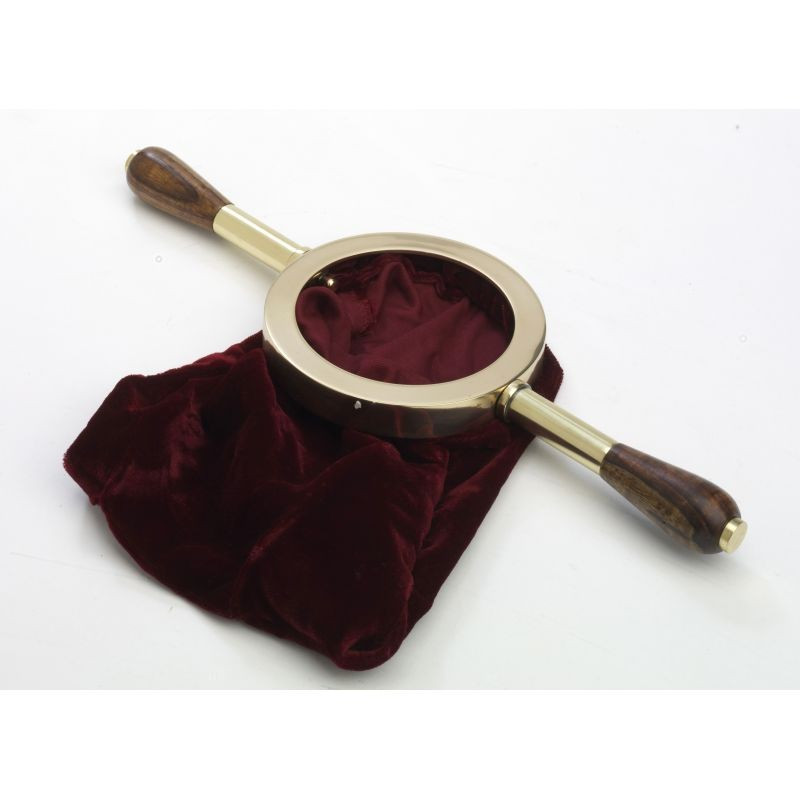
- Velvet-pocket basket — a polished metal ring with a deep fabric pocket beneath it. Light, silent and dignified; the pocket folds flat for storage. This is the classic European style, and it is the design of our brass-toned offering basket with wooden handles.
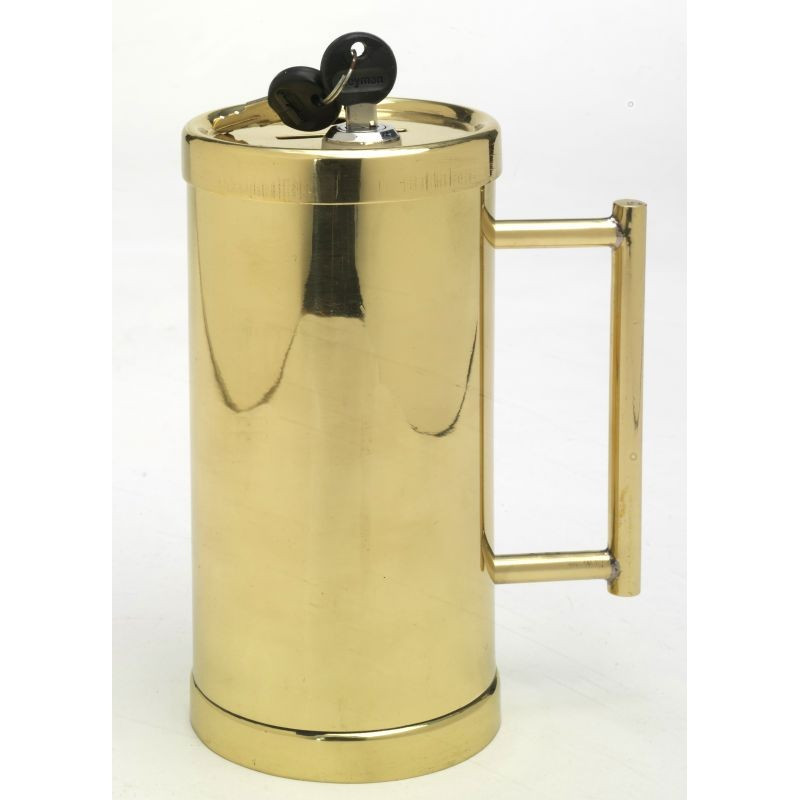
- Locked money basket — a cylindrical box with a coin slot, a hinged lid, a lock and a side handle. The collection stays enclosed until it is counted, which makes this the safer design wherever the basket is not emptied immediately.
- Open metal basket — a rigid bowl or tray in brass or silver plate. Easy to empty, but nothing is covered.
- Wicker or reed basket with a removable liner — the most common American parish basket. Light, cheap and quiet; the liner is washed, the basket eventually replaced.
- Basket with a long handle — the same wicker or metal body on a 35–42 inch (89–107 cm) shaft, so the usher can reach the middle of a long pew without leaning across the congregation.
- Offering plate or tray — a shallow dish, often stacked in twos or fours and carried at the rim.
- Collection bag or pouch — fabric or leather, on a short or long handle; common in Europe and in chapels where a basket would be too bulky.
No single type is "correct". A large parish with long pews usually needs long handles; a small chapel or an adoration chapel is better served by a locked box; a mission church that travels needs something that packs flat. What the Church asks is only that the receptacle be worthy of its purpose and that the gifts be kept apart from the Eucharistic table.
Brass, Silver or Wicker? Materials and Finish
Each material solves a different problem.
- Polished brass is the traditional choice for churches that want the collection to match the sacred vessels. It is heavy enough to sit still, warm in colour and easy to wipe. Unlacquered brass darkens with time and can be brought back with a soft cloth; lacquered brass keeps its shine but must never be polished with abrasives, because the lacquer is what you would be removing.
- Silver plate gives a cooler, more restrained look and suits chapels with silver vessels. It tarnishes faster than brass and needs a tarnish-inhibiting cloth or bag.
- Velvet — cotton velvet or a velvet-like pile — deadens the sound of coins, which is why it appears inside collection pockets and liners. It should never be soaked.
- Wood is used for handles because it stays comfortable in the hand through a long collection and does not feel cold.
- Wicker and reed are light and silent but wear at the rim; a removable liner protects the weave and can be washed.
- Plastic and fabric pouches are the cheapest option and the least durable; they are common in mission territories and for outdoor Masses.
How to Choose Size, Handle and Capacity
Four measurements decide whether a basket works in your church.
- The opening. A ring or basket mouth of roughly 20–25 cm (8–10 in) accepts a standard offering envelope without folding. Smaller baskets fill quickly and force the usher to stop.
- The depth. A pocket or box 10–16 cm deep holds a full pass along a pew; a shallow plate needs two ushers working in tandem.
- The handle. If the pews are longer than about 2.5 m (8 ft), a long handle is not a luxury. Standard long handles run 35–42 inches; a short handle forces the usher to step into the row.
- The closure. If the collection will sit unattended for even a few minutes — at a shrine, in a chapel, during a long procession — choose a locked box rather than an open basket.
Also count the ushers. Two ushers with medium baskets usually clear a nave faster than one usher with a very large one, and the collection stays quieter.
Care and Cleaning
How do you clean a brass offering basket?
Wipe it with a soft dry cloth after every Mass — fingerprints are acidic and etch plated surfaces if they are left for weeks. For a dull film, wash with lukewarm water and a drop of mild washing-up liquid, rinse, and dry immediately with a microfibre cloth. Use a brass polish sparingly and only on unlacquered metal; work in one direction and buff off all residue, because polish left in a seam attracts dust. Never use steel wool, scouring pads or abrasive cream on a plated basket.
How do you clean a velvet collection pocket?
Turn the pocket inside out, brush it with a soft clothes brush and vacuum it on the lowest setting through a net bag. Blot spills immediately with a white cloth; do not rub. Velvet is dry-clean only — water collapses the pile and leaves a tide mark. Between uses, store the basket with the pocket hanging free rather than folded over a hard edge, so the pile does not crease permanently.
What should you never use on plated metal?
Vinegar, lemon juice, salt, ammonia and "home remedies" with baking soda all attack silver plate and lacquer. Toothpaste is abrasive. A dishwasher destroys both the plate and the velvet. If a plated basket has gone black, use a proprietary silver dip for a few seconds only, rinse thoroughly and dry at once — and never dip a basket that has a wooden handle or a fabric pocket.
Prices, Shipping and What Is in the Box
Our range is deliberately small and covers the two designs parishes ask for most often: a velvet-pocket basket for the procession and a locked box for security.
| Style | Material and finish | How the collection is held | Price |
|---|---|---|---|
| Velvet-pocket basket with wooden handles | Brass-toned metal ring, burgundy velvet pocket, wooden handles in brown or black | Open pocket; folds flat for storage | $70 |
| Money basket with lock and coin slot | Polished brass, gold or silver finish | Lockable lid, coin slot, two keys, side handle | $97 |
Both styles are in stock and are dispatched within 72 hours; FedEx delivery to the United States usually takes 2–5 business days. Orders over $100 ship free. Each basket is packed individually — the velvet-pocket basket with its pocket flat, the money basket with both keys secured to the lid.
If you are equipping a new church or replacing a set, our travel Mass kits and sanctuary lamps are often ordered at the same time, and the cruets and trays complete the credence table.
Frequently Asked Questions
Q: What is the church donation basket called?
A: In Catholic parishes it is usually called a collection basket or an offering basket. Older terms are alms basket, alms basin and offertory basket, and "money basket" is common in everyday speech. The part of the Mass during which it is passed is the offertory, so "offertory basket" is equally correct.
Q: What is an offering basket used for?
A: It holds the faithful's gifts — cash, cheques and offering envelopes — while the ushers move through the pews during the Preparation of the Gifts. The GIRM (73) says money and other gifts for the poor or the Church "are to be put in a suitable place away from the Eucharistic table", so the basket is never placed on the altar.
Q: What are the types of offering baskets?
A: Seven designs are common: velvet-pocket baskets, locked money baskets, open metal baskets, wicker baskets with a removable liner, long-handle baskets for deep pews, offering plates or trays, and fabric collection bags. They differ mainly in capacity, reach and security.
Q: What is the difference between a Catholic and a Protestant collection basket?
A: Functionally none — both hold gifts. In Catholic parishes the collection is taken during the Preparation of the Gifts and may be carried forward with the bread and wine; Protestant churches more often take it before or after the sermon, and the shallow offering plate is more typical there. Catholic sacristies usually prefer a basket that matches the metalwork of the vessels.
Q: Why do collection baskets have long handles?
A: To reach the middle of a pew without stepping over the congregation. American parishes with pews longer than about 2.5 m commonly use handles of 35–42 inches (89–107 cm). A long handle also keeps the usher's movement quiet and lets one person serve a whole row.
Q: Do offering baskets lock?
A: Some do. A locked money basket has a hinged lid, a coin slot, a small lock and two keys; it is the right choice where the collection sits unattended — shrines, adoration chapels, weekday Masses with a small congregation. Velvet-pocket and wicker baskets are open by design and are emptied immediately after Mass.
Q: Where does the money from the collection basket go?
A: The Order of Mass says monetary gifts are for "the support of the Church and the care of the poor". In practice that means the parish's worship, utilities, maintenance, salaries and charitable work, together with any diocesan assessment. Parish finance councils normally report the figures to the congregation.
Q: How much should you give at Mass?
A: The Church sets no fixed sum, and no one may be compelled to contribute; each person gives according to their means and in freedom. The Old Testament tithe of one tenth is often quoted as a benchmark, but for Catholics it is a counsel rather than a rule, and the Sunday collection is not a membership fee.
Q: Can a collection basket be used outside Mass?
A: Yes. It is used at Benediction, processions, parish missions, carol services, school Masses and when Communion is brought to the sick. For anything left unattended, use a locked box rather than an open basket.
Q: What size offering basket does my church need?
A: Match the opening to a standard offering envelope (about 20–25 cm / 8–10 in across), the depth to the length of your pews, and the handle to the pew spacing. If the nave is long, two ushers with medium baskets are better than one usher with a very large one.
Q: Is the collection carried in the gift procession?
A: In many parishes, yes — the gifts and the collection are brought forward together. The GIRM requires only that the money be placed in a suitable place away from the Eucharistic table, so the basket is set down on a side table or in the sacristy, never on the altar.
Q: How do you clean a brass collection basket?
A: Wipe it with a soft dry cloth after each Mass, wash occasionally with lukewarm water and a drop of mild soap, dry at once, and use brass polish sparingly on unlacquered metal only. Never use vinegar, lemon, ammonia, toothpaste or abrasive pads, and never put a basket with velvet or wood in water.
Related Reading
- What Is a Church Offering Basket? Names, Types and Use at Mass
- How Ushers Collect the Offering: A Step-by-Step Guide
- Where Does the Collection Money Go? A Parish Guide
- How to Start and Run a Parish Liturgy Committee
- How to Budget for Liturgical Supplies
- How to Use Cruets at Mass
- When to Ring the Bells at Mass
- How to Plan a Parish Mission
