

A Catholic priest wears a Roman collar because it identifies him publicly as an ordained minister and marks his availability for pastoral care. The white band at the throat is the everyday sign of the sacrament of Holy Orders: it reads instantly, in any country and any language, as "a priest is here." The collar is not a rank or a decoration — it is the simplest possible uniform of service, worn by parish priests, bishops, and missionaries alike.
What Is a Roman Collar?
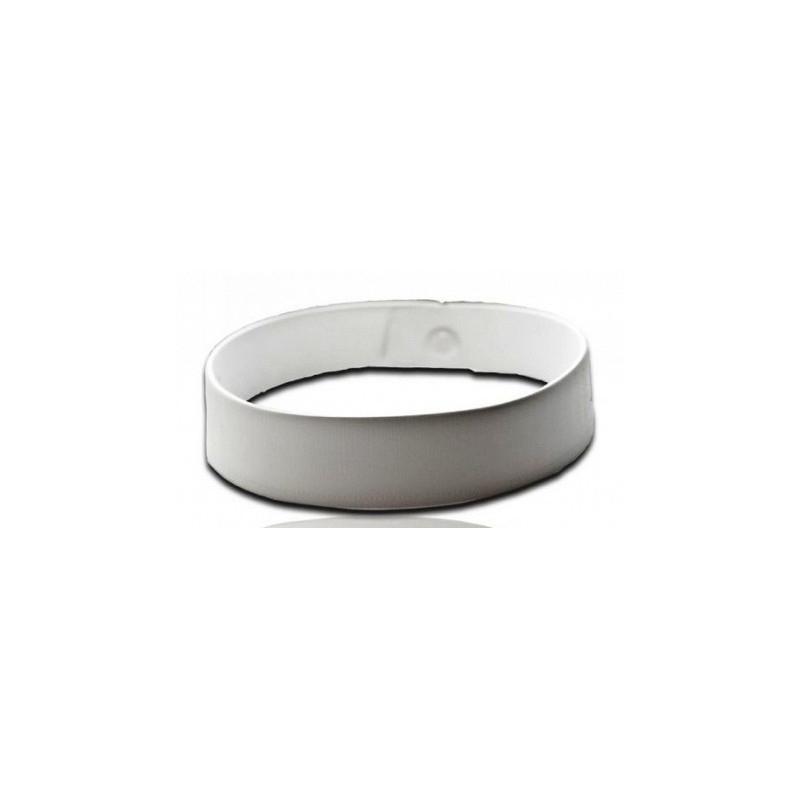
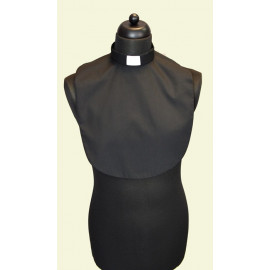
The Roman collar is the white band worn at the throat of a clergy shirt or cassock. It is called the Roman collar because it became standard dress for Catholic (Roman) clergy in the 19th century; it is also known as the clerical collar, clergy collar, priest collar, minister collar, and — informally — the dog collar, after its shape. It fastens in several ways: a tab that clips to the front of the shirt, an insert that slides into a fabric tunnel, a full band that closes at the back, or a separate collarette worn over a regular shirt. Our collarettes and collars collection covers all the everyday styles.
A Short History: How the Collar Became Standard
For most of Christian history, clergy had no distinctive collar. Priests wore the same dark clothing as everyone else, distinguished in public mainly by the cassock. That changed in the 19th century, when a white detachable collar on a dark shirt spread from Anglican clergy to the wider Church. The look was practical — the white band could be laundered separately and replaced when it wore out — and it was unmistakable. By the second half of the 1800s the black shirt with a white collar had become the working dress of Catholic priests, and it has remained so ever since. The detachable collar as we know it dates to around 1865.
What the Collar Means
The collar carries several layers of meaning:
- Ordination. It is worn only by those who have received the sacrament of Holy Orders — bishops, priests, and deacons — and by seminarians preparing for it. It is a sign of office, not of personal holiness.
- Availability. The collar tells people that a priest is present and approachable — for confession, anointing of the sick, a blessing, or simply a conversation. Priests often describe it as the opposite of a "do not disturb" sign: it invites the interruption.
- Identity and witness. In a hospital corridor, an airport, or a street accident, the white band answers the question "who is this?" before a word is spoken. It is public witness to a life given to the Church.
- Symbolism of white. The white color recalls baptismal purity and the light of Christ; against a black shirt it also mirrors the priest's role — a light meant to be visible, not hidden.
Why Priests Wear It Today
Practical reasons keep the collar in use. It signals pastoral availability wherever a priest goes; it gives a public face to the Church in hospitals, schools, and streets; and it unites clergy of every country under one simple standard — a priest from Nigeria, Poland, or Texas is recognizable at a glance. In the United States, the bishops have directed that, outside liturgical functions, priests' usual attire is a black suit with a Roman collar. During Mass, liturgical vestments take over; the collar remains the garment of daily ministry.
Who Wears a Collar — and Who Doesn't
In the Catholic Church: priests, deacons, bishops, and seminarians wear the collar; religious brothers wear it with their habit or clerical shirt. Laypeople do not wear it as ordinary dress. Outside the Catholic Church, the white collar is worn by Anglican and Episcopal clergy, many Lutheran and Methodist ministers, and clergy of other traditions — which is why the garment is often called a minister collar. Women clergy wear the same collars and collarettes in the same neck sizes. Because the collar is a sign of office, wearing it without holding that office can be misleading, which is why it is normally reserved to clergy and candidates for ordination.
The Names of the Collar
One garment, many names: Roman collar (Catholic standard), clerical collar (the formal, ecumenical term), clergy collar and priest collar (common usage), minister collar (Protestant usage), banded or tunic collar (the full Anglican style), and dog collar (informal, from the shape). If you are shopping, they all describe the same white band at the throat — only the fastening system differs. Our guide to clerical collar types explains tab, insert, banded, and tonsure systems in detail.
Frequently Asked Questions
Q: Why do Catholic priests wear black shirts?
A: Black is the traditional everyday color of clerical dress: simple, sober, and practical for work. The white collar stands out against it, which is exactly the point. Under liturgical vestments the color of the shirt does not matter, and bishops' shirts are distinguished by purple or red piping rather than by the collar.
Q: When did priests start wearing collars?
A: The detachable white collar emerged in the mid-19th century (around 1865), spreading from Anglican clergy to the Catholic Church. Within a generation, the black shirt with a white collar had become the standard working dress of Catholic priests around the world.
Q: Can anyone buy a Roman collar?
A: The collar itself is sold openly — anyone can buy one, for costume, film, or study. But as a sign of ordained ministry it is worn only by clergy and seminarians; wearing it without holding that office can be misleading to those who rely on the collar to identify a priest.
Q: What does the white collar symbolize?
A: The white band symbolizes baptismal purity and the light of Christ, and it marks the wearer as a man configured to Christ through Holy Orders. Practically, it also signals availability: the priest is present and can be approached for pastoral care.
Q: Do priests wear the collar all the time?
A: Practice varies. In the United States, priests are asked to wear a black suit with a Roman collar outside liturgical functions; in some countries and contexts — on vacation, at sports, in informal settings — priests may dress without the collar. Under vestments during Mass, the collar is not worn.
Where to Buy a Roman Collar
Our collarettes and collars collection includes replacement tab inserts from $3.00, the Vatican double collar ($22.00), a cotton clergy dickey with velcro ($38.00), and plastic collar buttons ($20.00) — all shipping worldwide, free over $100. Pair your collar with our clergy shirts in tab, insert, and banded systems, and read our guide to collar types before you order.