
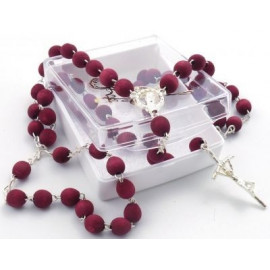
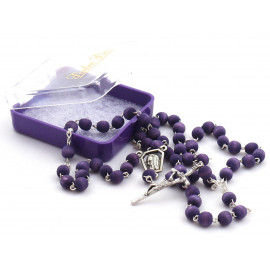
The parts of a rosary have proper names: the crucifix, the centrepiece (the medal), the decades, and the Our Father beads. A standard rosary has 59 beads — 53 Hail Mary beads and 6 Our Father beads — arranged in five groups of ten, plus a short pendant. Here is what each part is called and what it is for.
The Crucifix
Every rosary begins and ends at the crucifix. The Apostles' Creed is prayed while holding it, which is why the crucifix on a rosary is usually small and comfortable in the palm — most often a simple crucifix or a papal cross. On the rosaries in our shop, the beads end in a delicate papal cross.
The Centrepiece (Medal)
The centrepiece — also called the medallion, junction, or centre medal — is the piece that joins the pendant to the loop. This is the "charm" most people mean when they ask about the medallion on a rosary. Traditionally it shows the Virgin Mary (often with the Sacred Heart of Jesus on the reverse), and it is where your thumb rests between decades. Our rosaries carry two classic centrepieces: a medal of Our Lady with the Sacred Heart for the Rose-Scented Rosary, and a St. Padre Pio medal for the Fragrant Rosary of St. Padre Pio.
The Beads: Decades and Our Father Beads
The loop of the rosary is divided into five decades — groups of ten small Hail Mary beads. Before each decade sits a single, larger Our Father bead (sometimes called the Pater bead). The decade is the basic unit of the Rosary: one Our Father, ten Hail Marys, one Glory Be, while meditating on one mystery. Counting: five decades of ten gives 50 Hail Mary beads; three more sit on the pendant below the centrepiece (the opening three Hail Marys), for 53 in total — plus six Our Father beads makes 59 beads.
The Pendant
The short straight section hanging below the centrepiece is the pendant. It holds one Our Father bead, three Hail Mary beads, and the crucifix. The pendant is where the Rosary begins: Creed on the crucifix, Our Father on the large bead, three Hail Marys on the small ones, then the loop through the centrepiece.
The Chain, Cord, or Wire
The beads are joined by a chain (metal links), a cord (knotted string or paracord), or wire (wire-wrapped rosaries). Chain is the classic look and can be repaired; cord is noiseless and nearly indestructible; wire-wrapped is the modern craft style. The type of link affects weight and sound more than anything else — see the types of rosaries comparison.
How the Parts Work Together
Praying the Rosary walks through the parts in order: crucifix (Creed) → pendant Our Father bead → three Hail Mary beads → centrepiece (Glory Be) → first decade's Our Father bead and ten Hail Marys → and so on around the loop five times. If you know the names of the parts, the structure of the prayer makes sense instantly — the beads are simply counters for the two prayers that repeat. For the physical size of all this, see how long is a rosary, and for the prayer itself, how to pray the Rosary.
Frequently Asked Questions
Q: What are the parts of a rosary called?
A: The crucifix, the centrepiece (medal), the pendant, the decades (five groups of ten Hail Mary beads), and the Our Father beads — joined by chain, cord, or wire.
Q: What is the medal on a rosary called?
A: The medal at the junction is called the centrepiece (or centre medal, or junction). Traditionally it depicts the Virgin Mary.
Q: What are the charms on a rosary called?
A: Small pendants attached to a rosary are usually centrepiece medals, devotional medals, or charms added for a saint or devotion. The structural ones are the centrepiece medal at the junction.
Q: How many beads are on a rosary?
A: 59 beads: 53 Hail Mary beads (five decades of ten, plus three on the pendant) and 6 Our Father beads. The crucifix is not counted as a bead.
Q: What is the large bead on a rosary called?
A: The larger beads are the Our Father beads (Pater beads). One sits before each decade, and one on the pendant.
Q: Does a rosary have to have a crucifix?
A: A traditional rosary ends in a crucifix, where the Creed is prayed. Rosary bracelets and some pocket rosaries substitute a small crucifix or cross medal — the essential structure is the five decades.
