

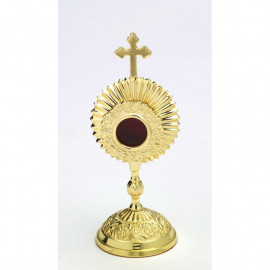
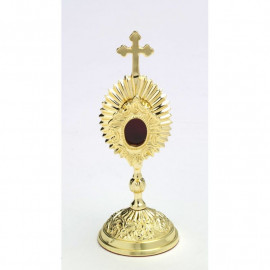
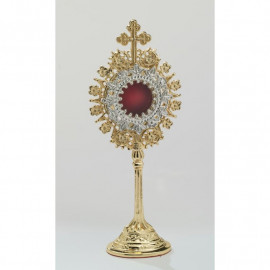
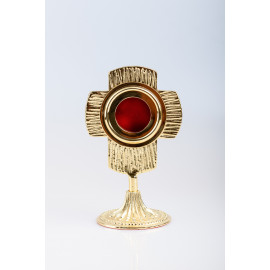
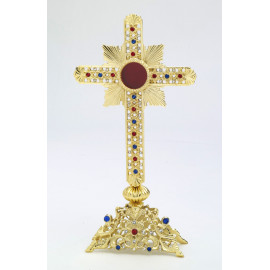
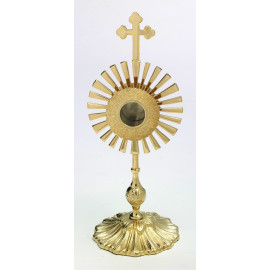
Yes, a Catholic can keep a reliquary at home. Many families keep one on a home altar, in a prayer corner or on a shelf with other devotional objects. The reliquary is a sacred vessel, and the same care that applies in a church applies at home: the relic should be identified, sealed and treated with reverence.
What changes at home is the setting. A domestic reliquary is for private devotion, not for public veneration, and it should be placed where it can be seen and honored without becoming a household curiosity.
Private Devotion and Public Veneration
Private devotion is prayer in the home, in the family or alone. Public veneration is the honor given to a relic in a church or chapel, normally with the permission of the diocese. A home reliquary is for the first, not the second. If you want the relic to be venerated by a congregation, speak to your pastor and the diocese; the relic may need to be transferred to a church or a shrine.
This distinction is not a restriction on devotion. It is a way of keeping the relic’s identity and the Church’s order intact. A family can pray before a home reliquary; a parish’s public veneration belongs in a sacred place.
Where to Place a Home Reliquary
The best place is a home altar or a prayer corner: a stable surface, away from the kitchen, the bathroom and the floor traffic. The reliquary should be visible but not exposed to accidental knocks, pets or small children. A shelf at eye level, a small table with a cloth, or a niche in a wall works well.
If you have a home altar, place the reliquary near the crucifix or the icon, not above them. The relic is a reminder of the communion of saints; it should support the focus on Christ, not compete with it. A candle or a sanctuary lamp can mark the place of prayer, but keep an open flame away from the reliquary and from children.
Choosing the Right Size and Style
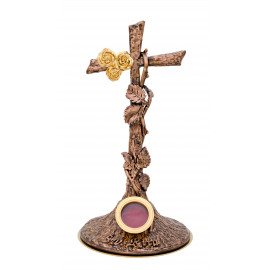
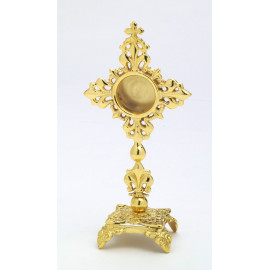
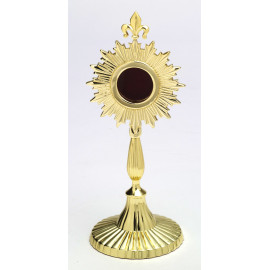
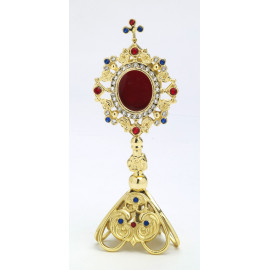
For a home, a reliquary between 10 and 20 cm is usually enough. A small cross reliquary, a compact theca or a modest gilded reliquary with a glass window fits a shelf or a home altar without dominating the room. Larger display reliquaries are made for churches and shrines; they can work in a large home oratory, but they need a secure surface and more space.
Choose a finish that suits the room and is easy to care for. Polished brass and nickel are forgiving; gilded and silver-plated surfaces need a dry cloth and a dry environment. If the reliquary will be handled often, a simple brass or nickel design is more practical than an openwork filigree piece.
Security and Care
- Keep it stable. Choose a surface that will not be knocked, and keep the reliquary away from the edge.
- Keep it dry. Avoid damp walls, bathrooms, kitchens and direct sunlight.
- Dust with a soft dry cloth. Do not use abrasive polishes on gilded or plated surfaces.
- Do not open a sealed relic. If the seal is broken or the glass is damaged, ask the diocese before repairing it.
- Keep the certificate. Store the authentication document with the reliquary, not in a separate drawer.
Children and Pets
A home reliquary is not a toy. Place it high enough that small children cannot reach it, and explain to older children what it is and why it is treated with care. A glass window and a metal edge can be damaged by a fall; a relic can be lost if the vessel is opened. A simple glass-fronted cabinet or a shelf with a guard is a practical solution.
Frequently Asked Questions
Q: Can I keep a reliquary at home?
A: Yes. Many Catholics keep a reliquary at home for private devotion. Treat it as a sacred object, keep it in a secure and dry place, and remember that public veneration of a relic is normally reserved to a church or chapel with the permission of the diocese.
Q: Where should a home reliquary be placed?
A: A home altar, a prayer corner or a stable shelf at eye level is best. Keep it away from the kitchen, bathroom, floor traffic, pets and direct sunlight. Place it near the crucifix or icon, not above them, so that the focus remains on Christ.
Q: Do I need permission to keep a relic at home?
A: A relic obtained lawfully for private devotion can normally be kept at home with its documentation. Public veneration, processions and display in a church require the permission of the diocese. If you are unsure, ask your pastor.
Q: What size reliquary is best for home?
A: A reliquary between 10 and 20 cm is usually enough for a home altar or a shelf. Choose a size that fits the relic and the space, and a finish that is easy to care for. Large display reliquaries are intended for churches and shrines.
Q: Can I pray before a home reliquary?
A: Yes. A home reliquary is a devotional object, and prayer before it is a private devotion. The relic is honored, not worshipped; the prayer is directed to God through the communion of saints.
Related Reading
Read How to Set Up a Home Altar and How to Care for Sacred Icons, or browse our Catholic reliquaries.
