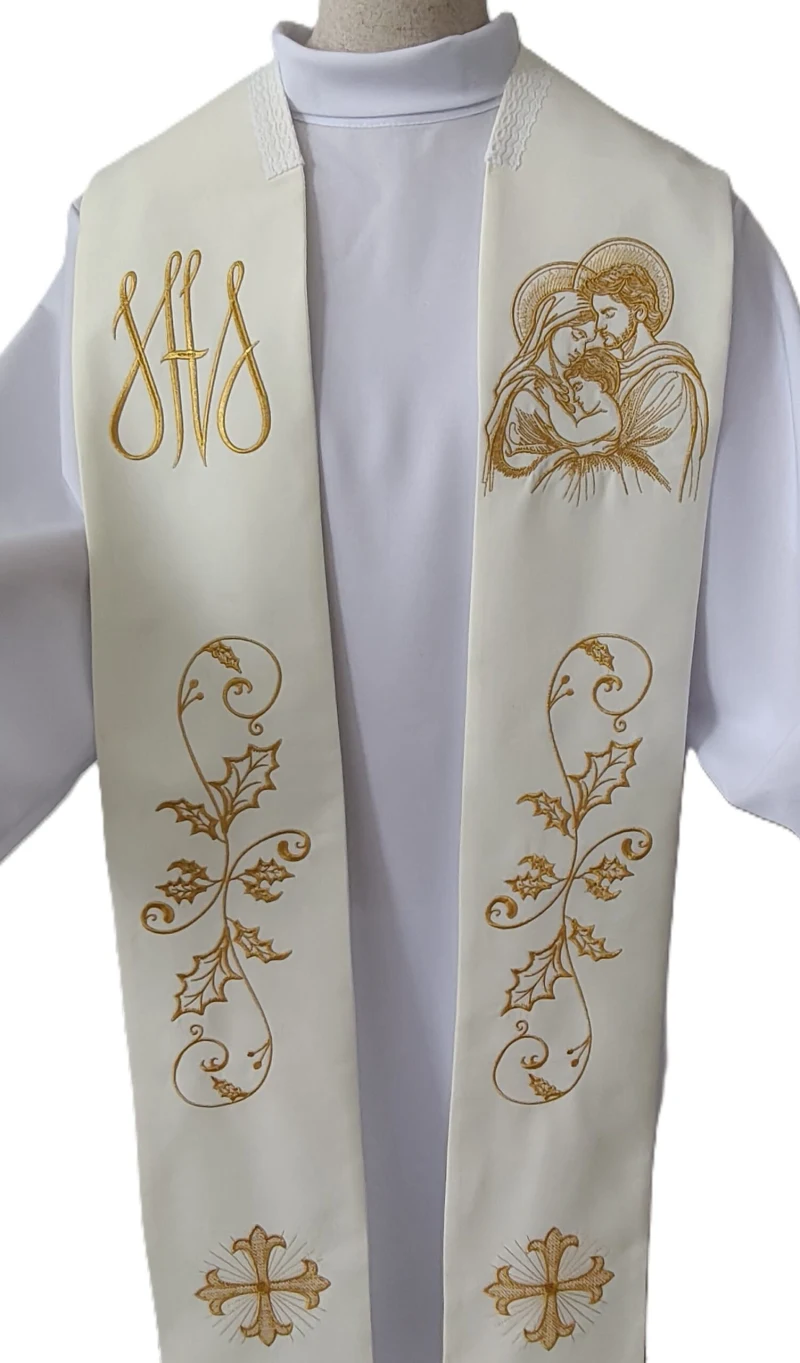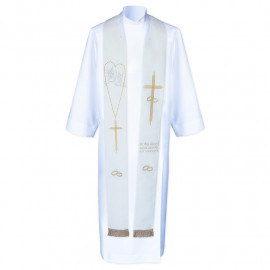
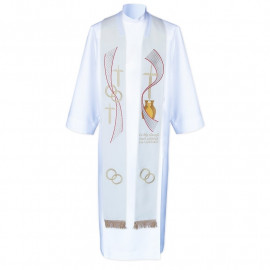


A wedding stole is the liturgical vestment an ordained priest or deacon wears when he administers the Sacrament of Marriage. It is usually white, ecru or gold, and it is worn over the alb for the Nuptial Mass. The stole is not a bridal accessory and not a decorative scarf; it is a sign of ordained ministry.
What a Wedding Stole Is
The stole is a long, narrow band of fabric worn around the neck. In the Catholic Church it is the vestment that most clearly identifies the ordained minister. A priest wears it crossed over the chest; a deacon wears it diagonally from the left shoulder to the right hip. At a wedding, the same stole is worn for the celebration of Holy Matrimony.
A wedding stole may be a plain white stole already in the parish sacristy, or it may be a dedicated stole with nuptial embroidery. The Church does not require a special “wedding stole” as a separate category. What matters is that the stole is a legitimate liturgical vestment in the correct colour.
Who Wears It
A Catholic priest or deacon wears the stole when he witnesses the exchange of consent and gives the nuptial blessing. A priest wears it under the chasuble; a deacon wears it under the dalmatic. A bishop may wear the stole in the manner proper to his office.
Ordained ministers in other Christian traditions also wear stoles at weddings. The shape and decoration vary, but the meaning is similar: the stole marks the minister as the one who leads the rite. If you are looking for a wedding officiant stole, choose one that fits your tradition and the vestments you will wear.
Why White, Ecru or Gold?
White is the colour of joy, purity and resurrection. It is the most common colour for a Catholic wedding, and it is the colour of the Nuptial Mass in the Roman Rite. Gold may replace white on more solemn occasions. A white stole with gold embroidery gives a festive look without changing the base liturgical colour.
Ecru and ivory are softer shades of white. They suit cream flowers, ivory lace and historic churches, and they photograph warmly. Ecru is not a separate liturgical colour; it is a shade of white. Violet and black are not wedding colours, because they are penitential or mournful.
What the Symbols Mean
Wedding stole embroidery often uses a small vocabulary of Catholic symbols. Rings speak of the exchange of vows. Hearts speak of love and fidelity. The Holy Family — Jesus, Mary and Joseph — places the couple's home under the pattern of Nazareth. Marian motifs ask for Our Lady's intercession. Jerusalem crosses add a clear liturgical sign.
Some stoles carry a text. “Behold, I make all things new” is a resurrection text that fits the new life of marriage. The miracle at Cana, when Jesus turns water into wine at a wedding feast, is another common theme. These symbols connect the vestment to the readings and prayers of the marriage liturgy.
How It Is Used at a Nuptial Mass
At a Nuptial Mass, the priest wears the stole under the chasuble throughout the Mass. It is visible at the opening procession, at the Liturgy of the Word, during the exchange of consent and the blessing of rings, and at the nuptial blessing. The stole is part of the vesture that marks the priest as the minister of the sacrament.
In some parishes and cultures, the priest may wrap the stole around the couple's joined hands during the blessing. This is a local custom, not a universal rubric. If the couple hopes for this gesture, they should ask the priest in advance so that the stole is long enough and the gesture fits the local liturgical practice.
Wedding Stole vs Deacon Stole vs Priest Stole
A wedding stole is not a separate order of vestment. It is a stole chosen for the wedding liturgy. A priest's stole is worn crossed over the chest; a deacon's stole is worn diagonally. The difference is the order of ministry, not the fabric or the embroidery.
A priest who already owns a white or gold stole can use it for a wedding. A couple or parish buying a gift may choose a wedding stole with nuptial embroidery to mark the occasion. The embroidery is a legitimate devotional choice, not a liturgical requirement.
How to Choose a Wedding Stole
- Start with the liturgical colour. White, ecru or gold for a wedding; avoid violet and black.
- Check the length. 128 cm or 135 cm are common lengths in our collection; an extended cut helps if the stole will be wrapped around the couple's hands.
- Choose the embroidery for the couple. Rings and hearts for a classic wedding; the Holy Family for a family-centred wedding; the miracle at Cana for a Gospel-focused wedding.
- Coordinate with the chasuble. The stole should relate to the chasuble and altar hangings, not necessarily match them exactly.
- Confirm the fabric. Read the product page rather than assuming silk or brocade.
Frequently Asked Questions
Q: What is a wedding stole?
A: A wedding stole is a liturgical stole worn by a priest or deacon for the Sacrament of Marriage. It is usually white, ecru or gold and may be embroidered with rings, hearts, the Holy Family or other nuptial symbols.
Q: Who wears a wedding stole?
A: A Catholic priest or deacon wears the stole when he administers the Sacrament of Marriage. A priest wears it crossed over the chest; a deacon wears it diagonally from the left shoulder to the right hip.
Q: Should a wedding stole be white or ecru?
A: Both are acceptable. White is the standard liturgical colour of joy and resurrection. Ecru and ivory are softer shades of white that suit cream or ivory wedding palettes.
Q: Is a wedding stole the same as a deacon stole?
A: No. A wedding stole is a stole chosen for the wedding liturgy. A deacon stole is worn diagonally by a deacon. A priest's stole is worn crossed over the chest.
Q: How long should a wedding stole be?
A: The stoles with a published length in our collection are 128 cm (50.4 in) or 135 cm (53.1 in) long. Two models have an extended cut. The right length depends on the wearer's height and the way the stole is worn.
Q: Can a wedding officiant who is not a Catholic priest wear a stole?
A: That depends on the officiant's tradition and the rules of the denomination. Many ordained ministers wear a stole at weddings. Choose a stole that matches your tradition and the other vestments you wear.