



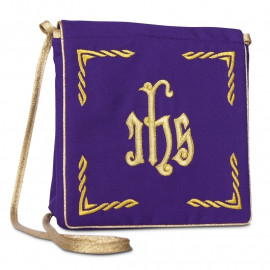
What Is a Liturgical Burse?
A liturgical burse (also called a corporal burse or vesper burse) is a flat, square container used to hold and protect the corporal — the linen cloth on which the chalice and paten are placed during Mass. The word comes from the Greek βύρσα ("hide", "skin"), and the classic burse is a stiffened, envelope-like case, traditionally about twelve inches (30 cm) square, finished to match the chalice veil of the day.
Purpose and Use
The burse serves several important functions:
- Protects the corporal from dust and damage when not in use
- Keeps the corporal flat and wrinkle-free
- Provides a dignified way to transport the corporal to and from the altar
Until the reforms following the Second Vatican Council the burse was carried by the priest to the altar at the entrance of Mass and placed upon the veiled chalice; it is still used this way in the Traditional Latin Mass, and it rests on the altar at Benediction. When the chalice is prepared, the burse sits on top of the veil, keeping the whole chalice set covered and coordinated.
Liturgical Colors
Burses are available in all liturgical colors to match the chasuble and other vestments of the day. The front is typically decorated with an embroidered cross or sacred symbol.
Materials
Our burses are crafted from the same fine fabrics as our chasubles — silk, brocade, and damask — with matching embroidery and stiffened construction to protect the corporal inside.
Special Burses
We also offer specialized burses for specific purposes:
- Burse for sick call paten — used when bringing Viaticum to the sick
- Burse to ailing — designed for pastoral visits to the ill
Both are pyx burses: they carry a pyx with the Blessed Sacrament and hang from a cord around the neck.
What Is a Burse Used For?
A burse is used to carry and protect the corporal — the square linen on which the chalice and paten rest at Mass. Before Mass the folded corporal is placed inside the burse, and the burse is laid on top of the veiled chalice or carried in the hand to the altar. A pyx burse, by contrast, is worn around the neck and carries a pyx with the Blessed Sacrament when a priest, deacon or extraordinary minister brings Holy Communion to the sick. For a deeper look at the linen itself, see our guide What Is a Corporal and How Is It Used?
Burse vs. Pyx: What's the Difference?
A burse is a flat, stiffened case that holds the folded corporal (or, in the sick-call version, a pyx). A pyx is the small round vessel that holds the consecrated hosts themselves. In short: the pyx carries the Blessed Sacrament; the burse carries the pyx — or the corporal. See our Catholic pyxes and sick call paten burses.
Types of Liturgical Burses
We stock three main kinds: the classic chalice burse for the corporal, the pyx burse (burse for the sick) with a neck cord, and complete burse sets that combine the burse and chalice veil with a maniple in one liturgical color. Popular sets include the Burse, Maniple and Veil Set — pale pink, the jacquard and velvet set in purple, and the ecru set.
Sizes and Fabrics of Our Burse Sets
Our chalice veil and burse sets measure 18 cm × 18 cm (7.08 in) for the burse, 51 cm × 51 cm (20.07 in) for the chalice veil and 43 cm (16.92 in) for the maniple. They are made of damask or jacquard with velvet elements, lined and wrinkle-resistant, with golden embroidery worked in metallic thread. Single burses and pyx burses come in every liturgical color — white, red, green, violet, rose and black. To complete the sanctuary, pair the burse with a matching embroidered altar tablecloth.
How Much Do Liturgical Burses Cost?
Single embroidered burses range from $40 to $100, and complete burse–maniple–chalice veil sets cost $133–$141 depending on the fabric (damask, jacquard or velvet). Because every piece is made from the same fabric series as our chasubles, a parish can outfit the whole sanctuary in one liturgical color.
How to Care for a Burse
Hand wash the burse in warm water with mild soap, press it flat while still damp and store it flat or lightly stuffed so the stiffened shape keeps its crisp square. Avoid bleach and machine drying. For a full walkthrough of linens and vestments, see our guide: How to Wash Liturgical Linens.
Frequently Asked Questions About Burses
What is a burse in the Catholic Church?
In the Catholic Church a burse is the square, stiffened case that holds the folded corporal — the linen cloth spread under the chalice and paten at Mass. The same word is used for the pyx burse, the corded case in which a pyx with the Blessed Sacrament is carried to the sick.
What does the word burse mean?
"Burse" comes from the Latin bursa and Greek βύρσα, meaning "hide" or "skin" — originally a bag or purse. In the liturgy the name was given to the stiffened case that carries the folded corporal, and the same root survives in "bursary" and "disbursement".
Is a burse still used at Mass today?
Yes. After the liturgical reforms the burse became optional in the Ordinary Form, but it remains in wide use — especially in the Traditional Latin Mass, where it is carried to the altar and placed on the veiled chalice, and at Benediction. Parishes often keep a burse for each liturgical color to match the vestments.
What color burse should I use?
Match the burse to the liturgical color of the day, exactly like the chasuble and chalice veil: white or gold for solemnities and feasts, red for Pentecost and martyrs, green in Ordinary Time, violet in Advent and Lent, rose on Gaudete and Laetare Sunday, and black where tradition allows for requiems.
