






If you've ever watched a priest prepare the altar for Mass, you've probably noticed him unfold a small white square of linen and place it on the altar cloth. That's the corporal — and it's one of the most important (and most overlooked) liturgical linens in the Catholic Church.
I'll be honest: most people don't know what a corporal is or why it's used. But if you serve in the sacristy, you need to know. Here's everything you need to understand about this simple but essential piece of liturgical linen.
What Is a Corporal?
A corporal is a square piece of linen, typically 14-20 inches on each side, that is placed on the altar during Mass. The consecrated host and the chalice are placed on top of it during the Eucharistic Prayer. The word comes from the Latin "corpus," meaning body — because it's the cloth on which the Body of Christ rests.
The corporal serves a practical purpose: it catches any particles of the consecrated host that might fall during the liturgy. After Mass, the corporal is carefully folded so that any particles are contained within the folds, and it's then cleaned appropriately.
What Does a Corporal Look Like?
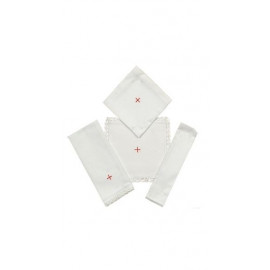
A traditional corporal is a white square of linen, often with a small cross embroidered or woven into the center. The cross helps the priest align the corporal properly on the altar. Some corporals have lace edging; others have a simple hem. The size varies, but 16 inches square is the most common.
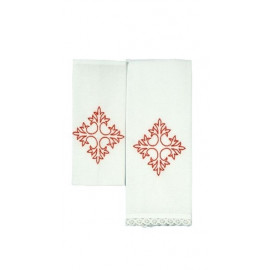
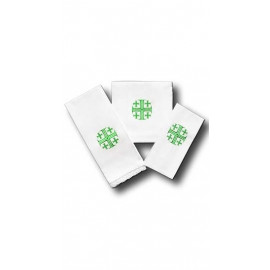
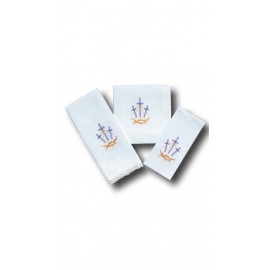
If you're looking for quality corporals for your parish, browse our collection of embroidered corporals, available in traditional linen with embroidered cross and optional lace edging.
| Feature | Standard Corporal |
|---|---|
| Material | 100% linen (traditional) or linen blend |
| Size | 14-20 inches square (16" is standard) |
| Color | White |
| Decoration | Small cross in center; optional lace edging |
| Starch | Lightly starched for easy folding |
How Do You Fold a Corporal?
Folding a corporal properly is important because it ensures that any particles of the consecrated host are contained. Here's the traditional method:
- Lay the corporal flat on the table, cross facing up.
- Fold the bottom edge up to the center (the cross should now be at the top of the folded portion).
- Fold the top edge down to the center (the cross is now enclosed).
- Fold the right side to the center.
- Fold the left side to the center.
The result is a small, neat square with the cross hidden inside. When the priest unfoldss it at the altar, he reverses this process — and any particles that fell on the corporal are now trapped inside the folds.
How Is the Corporal Used During Mass?
At the preparation of the gifts, the priest (or deacon) unfolds the corporal and places it on the altar cloth. The paten with the host and the chalice are then placed on the corporal. After the consecration, the consecrated host and the chalice remain on the corporal until the priest consumes them.
After Communion, the priest folds the corporal (as described above) and places it aside. Any remaining particles are carefully collected and consumed or placed in the tabernacle. The corporal is then taken to the sacristy for cleaning.
How Do You Clean a Corporal?
Because the corporal may have come into contact with the consecrated species, it needs to be treated with reverence during cleaning. Here's the proper process:
- First rinse: Rinse the corporal in a bowl of water (not directly under a running tap). The rinse water should be poured into the sacrarium (the special sacristy sink that drains directly into the earth) or consumed.
- Wash: After the first rinse, the corporal can be washed normally with the other liturgical linen sets. Use warm water and mild soap. Most corporals can be machine-washed on a gentle cycle.
- Starch and iron: After washing, starch the corporal lightly and iron it while damp. This keeps it crisp and easy to fold.
For a complete guide on washing all your sacred linens, see our article on how to wash liturgical linens.
What I Recommend
For most parishes, I recommend buying corporals in packs of 6-12. You'll need at least one for each Mass, plus spares for busy days. Linen is the traditional material and holds up well to repeated washing. Linen-cotton blends are also fine and are often easier to iron.
Look for corporals with a clearly visible cross in the center — it makes alignment much easier. Lace edging is beautiful but adds to the ironing time. If your sacristy volunteers are short on time, a simple hemmed corporal is more practical.
Frequently Asked Questions
Q: Can I use a cotton corporal instead of linen?
A: Yes, cotton is permitted. Linen is traditional because it's durable and doesn't shed fibers. Cotton is softer and easier to iron but may not last as long. Either is fine — it's a matter of preference.
Q: How often should corporals be replaced?
A: A good quality corporal should last 2-3 years with regular use. Replace it when the fabric becomes thin, the cross fades, or the edges start to fray.
Q: Do I need a separate corporal for the ciborium?
A: No, the same corporal is used for both the chalice and the ciborium. They're both placed on the same corporal during Mass. If you're using a large ciborium with many hosts, make sure the corporal is large enough to accommodate both vessels.
Q: What's the difference between a corporal and a pall?
A: A corporal is the square cloth placed on the altar. A pall is a stiff square of cardboard or plastic covered with linen, placed on top of the chalice to keep dust and insects out. They're two different linens with two different purposes. We also carry purificators — the small linens used to wipe the chalice after Communion.
Related Products
In addition to corporals, you may also need other sacred linens for your parish:
- Embroidered Purificators — for wiping the chalice and paten
- Embroidered Palls — to cover the chalice during Mass
- Embroidered Lavabo Towels — for the priest's hand washing
- Embroidered Burses — to carry the corporal to and from the altar
- Embroidered Chalice Cover Veils — to protect the chalice
Conclusion
The corporal is a small but essential part of the liturgy. It catches the Body of Christ, it's folded with reverence, and it's cleaned with care. If you serve in the sacristy, knowing how to prepare, fold, and clean a corporal is a basic but important skill.
If you need corporals for your parish, browse our collection of embroidered corporals. We have linen and linen-blend corporals in standard sizes, with or without lace. You'll also find matching chalice linen sets that include corporals, purificators, and palls in coordinated designs.