







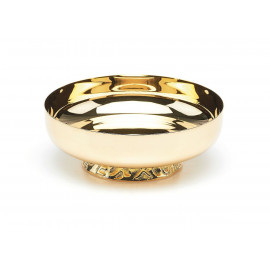
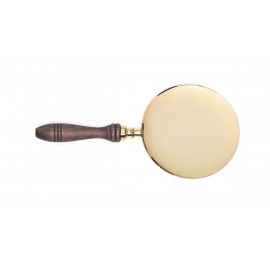
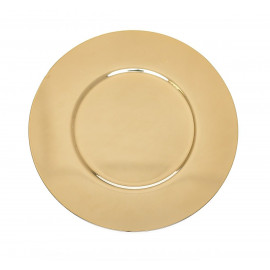
What Is a Liturgical Paten?
A liturgical paten is a small, flat plate used during the celebration of Mass to hold the large host that the priest consecrates for himself. It is one of the essential sacred vessels of the Catholic liturgy and is always used together with the chalice. In fact, the Church's rubrics treat the chalice and paten as an inseparable pair — you will rarely find one without the other.
During the offertory, the priest places the large host on the paten and holds both over the chalice during the consecration. After the consecration, the paten holds the consecrated host until the priest consumes it. Some patens have a small depression in the center to keep the host from sliding off, which is especially helpful during processions or outdoor Masses.
The paten has been part of the Mass since the earliest days of the Church. The General Instruction of the Roman Missal (GIRM) specifies that the paten, like the chalice, should be made of precious metal or at least lined with precious metal on the interior surface that contacts the consecrated host.
What Types of Liturgical Patens Are Available?
Patens are simpler than chalices or ciboria, but there are still important choices to make when selecting the right paten for your parish:
Flat patens are completely smooth with no depression. They are the most traditional style and work well for most churches. The flat surface allows the host to rest securely, and the priest can easily lift it during the consecration.
Depressed patens have a small indentation in the center that holds the host securely. This design is especially helpful during processions, outdoor Masses, or in churches where the altar may not be perfectly level. The depression prevents the host from sliding off during the liturgy.
Matching sets — many churches buy a paten that matches their chalice, with the same material, finish, and decorative style. This gives a unified and professional look on the altar. Our shop offers patens that coordinate with our chalice collections.
How Do I Choose the Right Paten for My Parish?
Here is what I tell people when they are picking out a paten:
- Match your chalice. If possible, get a paten in the same material and finish as your chalice. This creates a unified look on the altar and shows attention to liturgical detail.
- Size matters. The paten should be large enough to hold the large host comfortably but not so large that it is unwieldy. Standard patens are 3-6 inches in diameter.
- Interior must be precious metal. Same rule as chalices — the surface that touches the consecrated host must be gold or silver plated. This is a requirement of canon law and shows proper reverence for the Eucharist.
- Check the weight. A paten that feels too light will feel cheap. Look for something with some heft to it, similar to your chalice.
- Consider the finish. The plating should be even, without bubbles, scratches, or thin spots. Look at both sides — that is where cheaper patens often cut corners.
| Type | Diameter | Best For | Price Range |
|---|---|---|---|
| Flat & contoured patens | 10–15.5 cm (3.9–6.1 in) | Daily and Sunday Mass | $72–$139 |
| Deep patens for concelebration | 10–16 cm (3.9–6.3 in) | Concelebration and large hosts | $104–$209 |
| Communion patens (with handle) | 31 cm (12.2 in) handle | Distribution of Holy Communion | $141–$282 |
| Patens with cover | Large formats (cover included) | Concelebration sets and transport | $463–$830 |
Hand-engraved and decorated patens range from $355 to $593, and the deep paten for a large host with cover is our most complete concelebration piece.
What Material Should a Paten Be Made Of?
Canon law requires that the interior surface of the paten (the part that touches the consecrated host) be made of precious metal. In practice, this means:
Gilded brass patens are the most common and affordable option, and they are what our collection is made of: solid brass with a durable gold plating on the surface that touches the consecrated host. They are durable, easy to keep clean, and meet the Church's requirements. Most parishes choose gilded brass patens for daily use.
The Church allows other precious metals as well — silver, or silver with gold plating, appears in older sacristies and in custom commissions. Whatever the metal, the rule stays the same: the surface that touches the consecrated host must be precious and non-corrosive, so that nothing which contacts the Body of Christ can rust or corrode.
How Do You Care for a Paten?
Patens are easy to maintain. After Mass, wipe it with a purificator. For deeper cleaning, use a soft cloth and mild soap. Avoid abrasive cleaners — they will scratch the plating. Store it with your chalice — many churches keep them together in the sacristy. If the plating wears thin, have it re-plated by a professional. Do not wait until the base metal shows through.
Frequently Asked Questions About Patens
Q: Can I use a regular plate as a paten?
A: The Church requires that patens be made of precious metal (or lined with it). A regular plate does not meet liturgical requirements and does not show proper reverence for the Eucharist. Always use a proper liturgical paten.
Q: Do I need a separate paten for each chalice?
A: No, one paten per chalice is standard. For concelebrations, the main celebrant uses the paten and other concelebrants use the same one. Some churches have a larger paten for concelebrated Masses.
Q: What size paten should I buy?
A: The paten should be large enough to hold the large host comfortably. For most parishes, a 4-5 inch paten is the right size. If you use larger hosts, consider a 5-6 inch paten.
Q: Does a paten need to be blessed?
A: Yes, like all sacred vessels that contact the Eucharist, a paten should be blessed by a bishop or priest before use.
Q: What size host does a paten hold?
A: The large host the priest uses is typically about 7 cm (2.75 in) across, so even our smallest 10 cm (3.9 in) paten holds it comfortably. Parishes that use larger hosts for concelebration choose a deep 14–16 cm paten.
Q: What is the difference between a paten and a communion paten?
A: The altar paten holds the priest's large host on the corporal during the Eucharistic Prayer. A communion paten (chin paten) is the small plate with a handle that an altar server holds beneath each communicant's chin during the distribution of Holy Communion, to catch any falling fragment.
Where Does the Name "Paten" Come From?
The English word paten comes from the Latin patena (also written patina), which in turn derives from the Greek patane, meaning "dish" or "shallow vessel." The same sacred vessel is called a diskos in the Eastern Churches, where it is used together with the chalice at the Divine Liturgy. Whatever the language, the name always points to the same thing: a shallow dish that holds the bread offered and consecrated at the Eucharist.
A Short History of the Paten
The paten has been part of Christian worship since the earliest centuries. In times of persecution, when precious metals were scarce, patens were sometimes made of glass, wood, or copper — the Church adapted to local conditions while keeping the vessel's purpose unchanged. From the Middle Ages onward, liturgical law settled on gold and silver, and the interior of the paten has been made of precious metal ever since. The Liber Pontificalis, the ancient collection of papal records, lists patens among the valuable vessels owned by Roman basilicas, and larger patens were historically used for the communion of the faithful (the so-called calices ministeriales, "ministerial chalices"). Early medieval service books — the Ordines Romani — describe the paten being carried with the other vessels in the offertory procession of the pope's Mass. Today the General Instruction of the Roman Missal continues the same rule: the surface that touches the consecrated host must be gold, silver, or another precious metal.
What Is a Communion Paten?
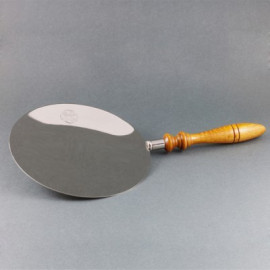
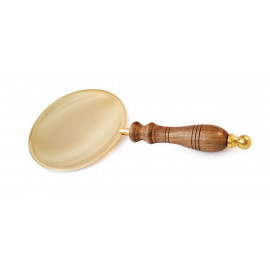
A communion paten (also called a chin paten or communion plate) is a small plate held by an altar server or acolyte beneath the chin of each communicant during the distribution of Holy Communion. Its purpose is to catch any fragment of the consecrated host that might fall — a practical expression of reverence for the Eucharist. Communion patens usually have a handle (ours measures 31 cm / 12.2 in) so the server can hold the plate steady, and they are used only during communion, not on the altar during the Eucharistic Prayer. They are distinct from the altar paten that holds the priest's host on the corporal.
The chin paten has an interesting history: when it was introduced in the United States in the early twentieth century, some considered it an unnecessary novelty — even an impious one — yet it gradually became a familiar sight at parish communions, a quiet sign of care for every fragment of the host. Liturgical writers today note that the paten can and should still be used during the distribution of Holy Communion, whether communion is received on the tongue or in the hand. Browse our communion paten with handle, the classic Communion Paten, and the gold-plated Communion Paten. For a closer look at how altar servers hold it, read our guide What Is a Communion Paten (Chin Paten)?
What Is the Difference Between a Paten and a Ciborium?
Both are sacred vessels made of precious metal, but they serve different moments of the Mass. The paten holds the large host that the priest consecrates for himself and consumes at communion. The ciborium is a deeper, lidded vessel that holds the hosts consecrated for the faithful; after Mass it is placed in the tabernacle. In practice, most parishes need both — a paten for the altar and a ciborium for the communion of the congregation and reservation. We offer matching ciboria that coordinate with our patens.
What Does a Paten Look Like?
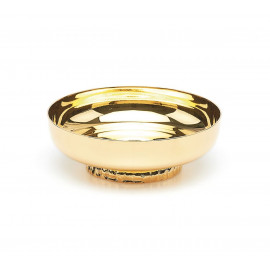
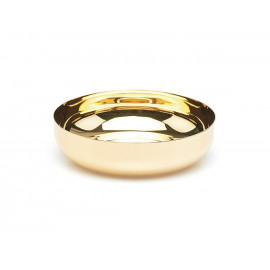
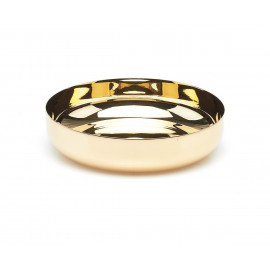
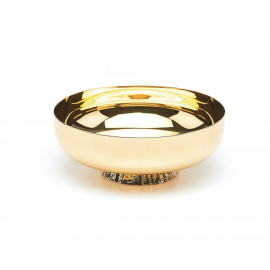
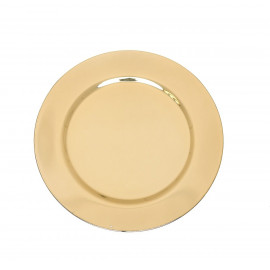
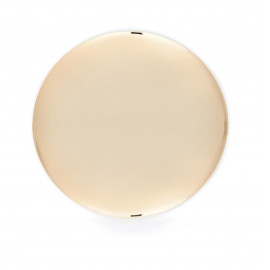
A paten looks like a small, shallow dish or disc — traditionally between 10 cm and 16 cm (about 4 to 6.3 inches) across, with a slight depression in the middle to keep the host in place. Many patens are gilded on the inside, engraved on the underside (IHS, crosses, or floral patterns), and finished with a narrow rim. Our collection includes flat patens from 10 cm (3.9 in) up to 16 cm (6.3 in) deep patens for concelebration, contoured patens 15.5 cm (6.1 in) wide, and communion patens with a 31 cm (12.2 in) handle for distribution.
How Much Does a Paten Cost?
In our shop, liturgical patens currently range from $72 to $830, depending on size, material, and workmanship. A small brass paten with gold plating starts at the lower end; deep patens for concelebration, engraved and decorated models, and large patens with covers sit higher. Matching sets — a chalice with its paten — usually offer the best value for a parish outfitting the sanctuary. Shipping is free on orders over $100.
What Is a Paten for the Sick?
A paten for the sick is a small, often gold-plated paten kept in a sick-call set — together with a pyx and the ritual — so that a priest bringing Viaticum to the dying can celebrate with the same dignity as at Mass. Our gold-plated paten for the sick measures 11 cm (4.3 in) and pairs naturally with the vessels in our travel liturgy and Mass kits and our pyxes for taking Communion to the sick. The Church asks that Holy Communion for the sick be brought with real reverence — and that includes the vessels used to carry it.
How Is the Paten Used During the Fraction?
During the fraction — the breaking of the consecrated host at the Agnus Dei — the priest breaks the host over or on the paten, and the fragments remain on it until a small piece is placed into the chalice. The paten then helps gather the remaining particles, and after Communion it is purified with water or wine over the chalice. This is why the paten's surface must be smooth and unbroken: the Church wants every fragment of the host to be recoverable and consumed.
How Do You Pronounce "Paten"?
Paten is pronounced PAY-tən (IPA /ˈpeɪtən/): the first syllable rhymes with "day," and the second is a soft, unstressed "un," as at the end of "satin." The plural, patens, sounds like "PAY-tənz." The word reached English through Old French patene, from Latin patena and Greek patane — "dish" or "shallow vessel."
How Is a Paten Blessed or Consecrated?
Like every vessel that touches the Eucharist, a paten is set apart for divine worship before it is used. Traditionally the chalice and paten are consecrated together by a bishop — the fullest form of this blessing; the Church also provides a simpler blessing that a priest can give, and a paten is normally blessed only once. After it has been blessed, the paten is treated with special care: it is purified after every Communion by the priest, deacon, or instituted acolyte. If you buy a replacement paten, ask your parish priest to bless it before it is used at Mass.
Browse Our Paten Collection
Shop our full selection of liturgical patens in brass, silver-plated, and various sizes. Find a paten that matches your chalice and meets all liturgical requirements. We offer flat and depressed styles at every price point, from budget-friendly options for daily Mass to ornate patens for Sunday celebrations. Want to learn more? Read our guides: What Is a Paten Used For? and Chalice and Paten: What's the Difference?
Related Reading
For the vessels that hold the relics of saints, see our reliquaries.
