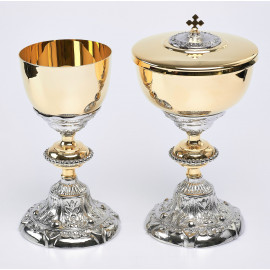
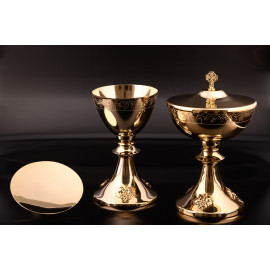
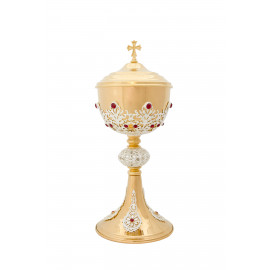
A paten is the small plate that holds the consecrated host at Mass. If you have ever wondered what a paten is used for, why it looks like a simple dish, or how to choose one for your parish, this guide covers it all: what the paten is, how it is used step by step, the different types and sizes, materials, blessing, care, and where the word comes from.
What Is a Paten?
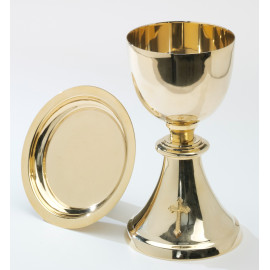
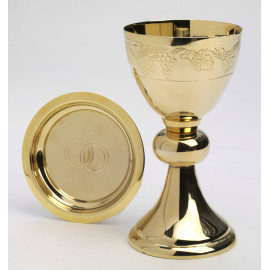
A paten (pronounced PAY-tən) is a small, flat plate — usually a shallow disc of gilded brass or another precious metal — on which the priest places the large host that he consecrates for himself at Mass. It is one of the essential sacred vessels of the Catholic liturgy and is always used together with the chalice; the Church's rubrics treat the two as an inseparable pair.
The word paten comes from the Latin patena (also written patina), from Greek patane, meaning "dish" or "shallow vessel." In the Eastern Churches the same vessel is called the diskos. The Church requires that at least the interior surface of the paten — the part that touches the consecrated host — be made of precious, non-corrosive metal, such as gold or silver; in practice, most parish patens are brass with a durable gold plating.
What Is a Paten Used For?
The paten has three jobs at Mass:
- It holds the host of the priest. At the offertory the priest places the large host on the paten and offers it to God; the paten stays with the host through the Eucharistic Prayer.
- It catches fragments. During the fraction — the breaking of the host — and at Communion, the paten keeps every particle of the consecrated bread in one place, so that nothing is lost.
- It completes the chalice. Paten and chalice together carry the two elements of the Eucharist — the Body and the Blood — which is why they are made to match.
How Is the Paten Used During Mass?
Here is the step-by-step:
- Offertory: the large host is placed on the paten and offered to God; the paten is set on the chalice or on the corporal.
- Consecration: the priest keeps the paten with the host through the words of consecration. The host on it becomes the Body of Christ.
- Fraction: at the Agnus Dei the priest breaks the consecrated host over the paten, and a small piece is placed into the chalice.
- Communion and purification: the priest consumes the host from the paten; afterwards the paten is purified with water or wine over the chalice and dried with a purificator.
Alongside the altar paten, many parishes also use a communion paten — a small handled plate held by an altar server beneath the communicant's chin to catch any falling fragment. We explain it in a separate guide: What Is a Communion Paten?
Types of Patens
| Type | Description | Best For | Typical Price |
|---|---|---|---|
| Flat / contoured paten | Smooth disc, sometimes with a slight profile or IHS engraving; 10–15.5 cm | Everyday and Sunday Mass | $72–$139 |
| Deep paten for concelebration | Deeper center that holds a large host securely; 10–16 cm | Concelebration, large hosts | $104–$209 |
| Communion (chin) paten | Small plate with a long handle (31 cm) | Distribution of Holy Communion | $141–$282 |
| Paten with cover | Deep paten with a fitted lid | Concelebration sets, transport | $463–$830 |
| Paten for the sick | Small gold-plated paten for sick-call sets; 11 cm | Viaticum, Communion of the sick | $262 |
What Size Paten Do You Need?
The large host used by the priest is typically about 7 cm (2.75 in) across, so even the smallest 10 cm (3.9 in) paten holds it comfortably. Sizes to keep in mind:
- 10–11 cm (3.9–4.3 in): compact patens for daily Mass and smaller chalices.
- 14–15.5 cm (5.5–6.1 in): the most common parish size — comfortable with any standard host.
- 16–16.5 cm (6.3–6.5 in): deep patens for concelebration or unusually large hosts.
What Material Should a Paten Be Made Of?
Canon law and the GIRM require that the surface of the paten which touches the consecrated host be made of precious, non-corrosive metal. In practice:
- Gilded brass is the standard choice: durable, affordable, and easy to keep clean. Every paten in our collection is solid brass with gold plating.
- Silver appears in older sacristies and custom commissions — beautiful, but it tarnishes and needs more care.
- Historically, in times of persecution, patens were even made of glass, wood, or copper; the Church adapted to circumstances while never changing the vessel's purpose.
Does a Paten Need to Be Blessed?
Yes. Like every vessel that touches the Eucharist, a paten is set apart for divine worship before use — traditionally consecrated together with the chalice by a bishop, or blessed with the approved blessing that a priest can give. A vessel is normally blessed only once. If you buy a replacement paten, ask your parish priest to bless it before it is used at Mass.
How Do You Care for a Paten?
Patens are easy to maintain: wipe them with a purificator after Mass, wash gently with mild soap and a soft cloth when needed, and avoid abrasive cleaners that scratch the plating. Store the paten with the chalice, and if the plating wears thin, have it re-plated professionally before the base metal shows through.
Where Does the Name "Paten" Come From?
The English word comes from Old French patene, from Latin patena/patina, from Greek patane — "dish." The same vessel is called diskos in the Eastern Churches, where it is used together with the chalice at the Divine Liturgy.
Frequently Asked Questions
Q: What is the purpose of the paten?
A: The paten holds the large host that the priest consecrates and consumes at Mass, and it catches every fragment of the consecrated bread during the fraction and Communion. It is one of the two essential vessels of the Eucharist, together with the chalice.
Q: What is the difference between a paten and a ciborium?
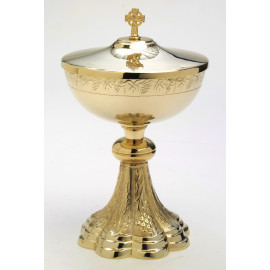
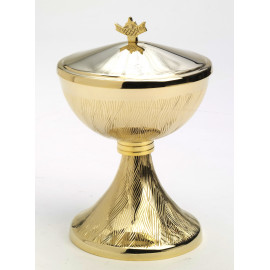
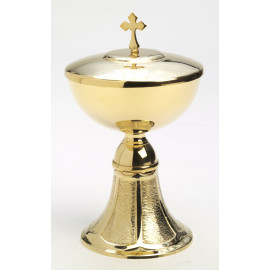
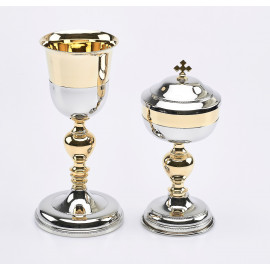
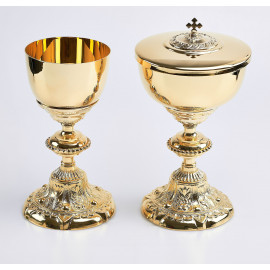
A: The paten holds the priest's large host on the altar; the ciborium is a deeper, lidded vessel that holds the hosts consecrated for the faithful, and after Mass it is placed in the tabernacle. Most parishes need both.
Q: What is a communion paten?
A: A communion paten (chin paten) is a small plate with a handle, held by an altar server beneath each communicant's chin during the distribution of Holy Communion to catch any falling fragment. It is used during Communion only — read our full guide: What Is a Communion Paten?
Q: Can I use a regular plate as a paten?
A: No. The Church requires a paten made of precious, non-corrosive material, blessed for liturgical use. An ordinary plate does not meet that standard and does not show proper reverence for the Eucharist.
Q: What size paten should I buy?
A: For most parishes a 14–15.5 cm (5.5–6.1 in) paten is the right size; choose 10–11 cm for daily Mass with a small chalice, and a deep 16 cm paten for concelebration or large hosts.
Q: How much does a paten cost?
A: In our shop patens range from $72 for a plain gilded 10 cm paten to $830 for a deep concelebration paten with cover; most parish patens fall between $72 and $209.
Q: Is a paten required for Mass?
A: Yes — the General Instruction of the Roman Missal lists the paten among the vessels required for the celebration of Mass, together with the chalice.
Q: How do you pronounce paten?
A: PAY-tən — the first syllable rhymes with "day," the second is a soft "un," as in "satin."
Where to Buy a Paten
Browse our full collection of liturgical patens — flat and contoured patens from $72, deep patens for concelebration, communion patens with handle, and patens with cover. Matching chalices and ciboria are available in the same finishes. For the difference between the two vessels used together at every Mass, see Chalice and Paten: What's the Difference?