



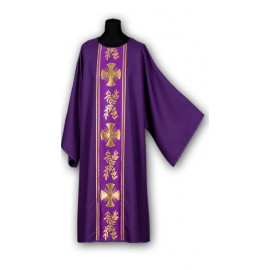
At any solemn Mass you will see two outer vestments: the priest wears a chasuble, the deacon wears a dalmatic. They usually match in colour and fabric — and yet they are two different garments with two different histories. Here is the difference in plain terms.
The Short Answer
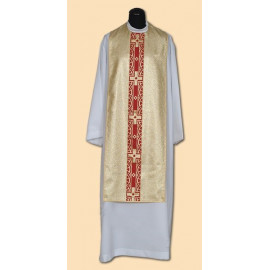
- Chasuble — worn by the priest (or bishop) who celebrates the Mass. Sleeveless, it covers the whole body.
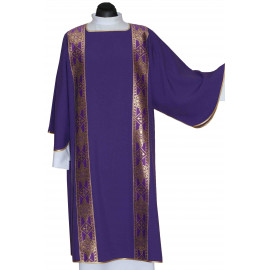
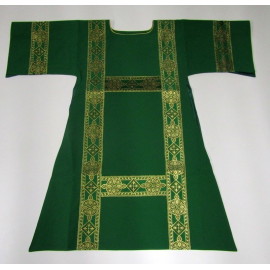
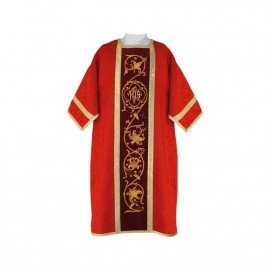
- Dalmatic — worn by the deacon. Wide-sleeved and decorated with orphreys, it is the deacon's counterpart to the chasuble.
- Both are worn over the alb and stole, in the colour of the liturgical day.
What Is a Chasuble?
The chasuble is the outermost vestment of the priest celebrant — the "little house" (casula) that covers the body during the Eucharistic Prayer. It is sleeveless by design: the priest's hands must remain free for the sacred action of the Mass. Our embroidered chasubles come in Gothic and Roman styles, in every liturgical colour.
What Is a Dalmatic?
The dalmatic is the wide-sleeved vestment of the deacon, worn over the alb and the crossed stole. It takes its name from Dalmatia, the Roman province where the garment originated. Its wide sleeves and side openings give the deacon the freedom he needs to carry the Gospel book, prepare the altar and assist the celebrant. Browse our embroidered dalmatics — 45 models from $70.
Side-by-Side Comparison
| Chasuble | Dalmatic | |
|---|---|---|
| Worn by | Priest, bishop | Deacon (bishop under the chasuble at pontifical Mass) |
| Sleeves | Sleeveless | Wide sleeves |
| Shape | Full-length, closed | Tunic-like, side openings |
| Decoration | Orphrey cross or band | Two vertical orphreys, clavi, embroidery front and back |
| Origin of the name | Latin casula, "little house" | Dalmatia, Roman province |
| Colour | Liturgical colour of the day | Matches the chasuble |
Can a Priest Wear a Dalmatic?
Exceptionally, yes — a priest may wear a dalmatic under the chasuble when concelebrating or when serving in place of a deacon, though this is uncommon in ordinary parish life. The dalmatic is primarily the deacon's vestment.
Can a Deacon Wear a Chasuble?
No. The chasuble is the vestment of the priest celebrant; a deacon never wears it. When no dalmatic is available, the deacon wears the alb and stole alone. This is one of the clearest visual signs of the different orders of ministry at the altar.
Why Do They Usually Match?
The practice of priest and deacon wearing vestments from the same set — same fabric, colour and embroidery — is widespread today. The visual unity expresses the unity of the one priesthood of Christ, served by different orders. If you are outfitting a parish, choosing chasubles and dalmatics from the same collection is the simplest way to achieve it — see our dalmatics and chasubles.
How to Choose for Your Parish
Start with the styles your church already uses: if the chasubles are Gothic, choose Gothic dalmatics; if Roman, choose Roman. Then cover the colours you use most — green, white, red and violet — before adding rose and black. A dalmatic with a matching deacon stole is the most practical purchase.
Frequently Asked Questions
Q: What is the difference between a chasuble and a dalmatic in one sentence?
A: The chasuble is the sleeveless vestment of the priest celebrant; the dalmatic is the wide-sleeved vestment of the deacon.
Q: Who wears the chasuble?
A: The priest or bishop who celebrates the Mass. A bishop also wears the dalmatic underneath the chasuble at pontifical Masses.
Q: Does a deacon ever wear a chasuble?
A: No — the chasuble is proper to the priestly order. A deacon wears the dalmatic, or the alb and stole if no dalmatic is available.
Q: Can a priest wear a dalmatic?
A: Only exceptionally, for example when concelebrating in place of a deacon. Normally the dalmatic is reserved to deacons.
Q: Do chasubles and dalmatics have to match?
A: They are not required to, but matching sets are the common practice and look best — same fabric, colour and embroidery for the whole ministry team at the altar.
