



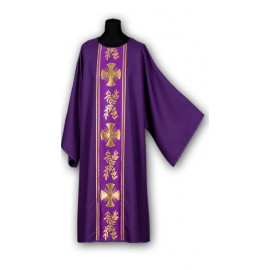
Browse any traditional vestment catalogue and you will find the pair listed together: "dalmatic and tunicle". The two garments look almost identical, yet they belong to different ministers and different moments in the history of the liturgy. Here is what separates them.
The Short Answer
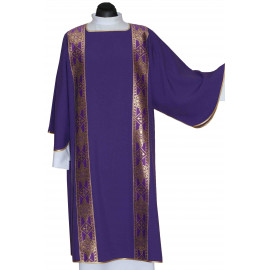
The dalmatic is the vestment of the deacon. The tunicle is a narrower, more simply decorated version of the same garment, historically worn by the subdeacon at solemn Mass in the Traditional Latin Rite — and by a bishop under the dalmatic at pontifical functions. In modern use the two are often indistinguishable; the difference lies in who wears them.
What Is a Tunicle?
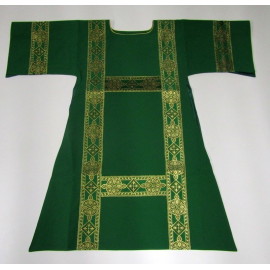
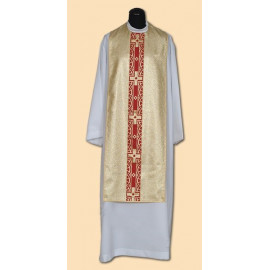
The tunicle (Latin tunicella, "little tunic") is a liturgical vestment of the same family as the dalmatic: a wide-sleeved tunic worn over the alb. Its sleeves are narrower than a dalmatic's and its decoration simpler — traditionally a single orphrey on the front and back. In the Extraordinary Form it was the vestment of the subdeacon; in the Ordinary Form it is rarely seen, though a bishop still wears it between the alb and the dalmatic at pontifical Masses.
What Is a Dalmatic?
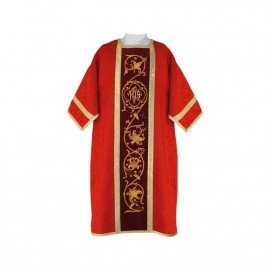
The dalmatic is the outer vestment of the deacon — wider in the sleeves, richer in decoration (two orphreys, clavi, embroidery front and back), and worn at Mass, solemn processions, baptisms and Benediction. Our collection includes 45 dalmatics from $70.
Where the Two Names Come From
Both garments descend from Roman tunics. The dalmatic takes its name from Dalmatia, the province where the style was popular; the tunicle is simply the "small tunic" — a lighter version of the same idea. In the Middle Ages the pair "dalmatic and tunicle" was standard equipment for a solemn Mass, worn by the deacon and the subdeacon respectively.
How to Tell Them Apart
| Dalmatic | Tunicle | |
|---|---|---|
| Worn by | Deacon; bishop (under the chasuble) | Subdeacon (Traditional Rite); bishop (under the dalmatic) |
| Sleeves | Wide | Narrower |
| Decoration | Two orphreys, clavi, rich embroidery | Simpler, often one orphrey |
| Modern use | Every Mass with a deacon | Rare outside the Traditional Rite and pontifical Mass |
Are Tunicles Still Used Today?
In the Ordinary Form, rarely. In Traditional Latin Mass communities the tunicle remains part of the solemn Mass set, and complete sets are still sold as "dalmatic and tunicle". If your parish celebrates the Traditional Rite, the tunicle is the correct vestment for the subdeacon — simpler than the deacon's dalmatic and usually cut from the same fabric as the set.
Can a Tunicle Be Used as a Dalmatic?
In practice, a plain tunicle can pass for a dalmatic — the difference is subtle. For solemn occasions, however, the deacon's dalmatic should be the richer garment. If you serve in the Ordinary Form and need one vestment, choose the dalmatic; the tunicle is a specialist's piece.
Frequently Asked Questions
Q: What is the difference between a dalmatic and a tunicle?
A: The tunicle is a narrower, more simply decorated version of the dalmatic, worn by the subdeacon in the Traditional Latin Rite and by bishops under the dalmatic. The dalmatic belongs to the deacon.
Q: Who wears a tunicle?
A: Historically the subdeacon at solemn Mass in the Extraordinary Form; today it appears mainly in Traditional Rite celebrations and in pontifical vesting.
Q: Why do catalogues list "dalmatic and tunicle" together?
A: Because they were sold as a set for solemn Mass — the deacon and subdeacon wore matching garments from the same fabric.
Q: Do I need a tunicle for a Traditional Latin Mass?
A: For a solemn (sung) Mass with a subdeacon, yes. For Low Mass or the Ordinary Form, no.
Q: Is a tunicle worn over or under the stole?
A: The subdeacon does not wear a stole; the tunicle is worn directly over the alb.
