



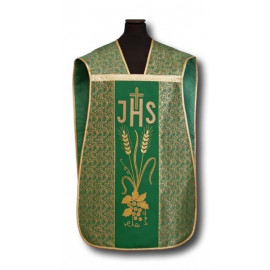
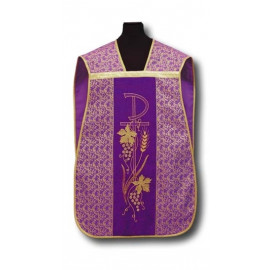
Sacristy vocabulary can be confusing: orphreys, maniples, burses, and veils are all "parts" of the traditional vestment set, but only some are physically part of the chasuble itself. Here is the anatomy, in the order you would actually handle it.
The Chasuble Itself
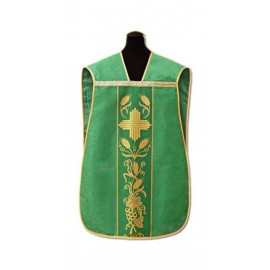
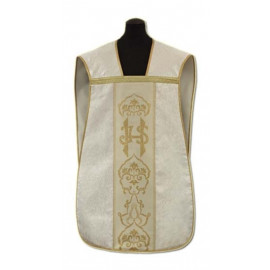
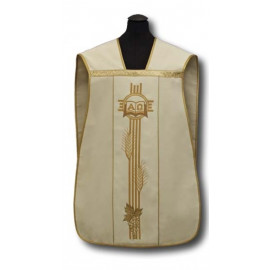
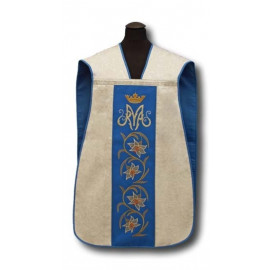
- Front and back panels — the two faces of the vestment, shaped differently in the Roman cut (short front, cross-shaped back).
- Orphreys — the decorative bands, usually embroidered, running over the shoulders and down the front and back. In the Roman chasuble they typically form a cross on the back.
- Cross or image — the centerpiece of the back: a simple cross, an IHS monogram, a rosette, a eucharistic symbol, or an embroidered image such as the Sacred Heart or a Marian motif.
- Collar — the finished opening at the neck; some chasubles have a raised collar, others a simple binding.
- Lining — the inner fabric; on good vestments it matches the outer color and protects the embroidery.
The Matching Set Around the Chasuble
Traditionally, a chasuble is not worn alone. The complete set for a Roman Mass adds four pieces, usually in the same fabric and color:
- Stole — worn around the neck by the priest; required for Mass and confession. Most of our chasubles include a matching stole.
- Maniple — a band worn on the left forearm, historically a mark of rank in procession and at Mass; still used in the Traditional Latin Mass.
- Burse — the flat, folded case that holds the corporal. See our burses.
- Chalice veil — the square cloth that covers the chalice before the Offertory. See our chalice veils.
22 models in our Roman chasuble collection are sold as complete five-piece sets.
What Goes Under the Chasuble
In vesting order: the amice (optional, over the collar), the alb (the long white tunic), and the cincture (the cord at the waist). The stole is crossed over the breast for Mass, and the chasuble goes on last — the vesting prayer describes it as the "yoke of Christ."
Names Sacristans Actually Use
If you are ordering replacements, the words to know are: orphrey (the band), maniple (armband), burse (corporal case), and veil (chalice cover). "Chasuble set" usually means chasuble plus stole, and sometimes all five pieces — always check what is included before buying.
Q: What are the bands on a chasuble called?
A: Orphreys — decorative bands, usually embroidered, running over the shoulders and down the front and back of the vestment.
Q: What is a maniple?
A: A band worn on the left forearm by the priest, historically a rank symbol and still used at the Traditional Latin Mass.
Q: What is a burse?
A: A flat, folded square case, matching the vestment color, that holds the corporal linen.
Q: Does every chasuble include a stole?
A: Most do — our Roman chasubles include a matching stole on most models; check the individual product page for the exact contents.
Q: What is the difference between a stole and a maniple?
A: The stole is worn around the neck; the maniple is worn on the left arm and only at Mass (in the traditional rite).
Q: What is a chalice veil?
A: The square cloth that covers the chalice before the Offertory, matching the color of the day's vestments.
