


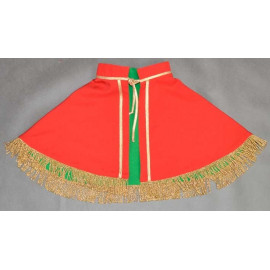
A pellegrina is a short, open-front shoulder cape worn by altar servers over the surplice. It covers the shoulders and upper arms, reaches to about the elbow, and adds the liturgical color of the day to the server's outfit. In English catalogs it is also called a pelerine, a short altar server cape, or simply a shoulder cape.
What a Pellegrina Looks Like
A pellegrina is cut like a small cape rather than a full cloak. It sits on the shoulders, opens down the front, and stops around the elbow so the server's hands stay free for the missal, the cruets or the bell. The neck is usually high enough to sit cleanly over the collar of the surplice, and the hem is finished with a trim — gold ribbon is the most common choice because it matches gold vestments.
Because it is worn over the surplice, the white linen still shows at the neck and below the cape. That contrast is part of the look: the server is visibly dressed in the white baptismal garment, with the liturgical color added on top.
Where the Name Comes From
"Pellegrina" is Italian and is related to pellegrino, a pilgrim. The name describes a short cape associated with travel and outdoor wear, which entered clerical and server dress as a practical covering for the shoulders. French uses pelerine, English uses both "pelerine" and the Italian form, and older catalogs sometimes print "pellerine".
The word is often confused with "mozzetta", which is a different garment. A mozzetta is buttoned across the chest and belongs to the clerical wardrobe of bishops, canons and the Pope. A pellegrina is open in front and is the version normally worn by altar servers.
Pellegrina, Pelerine, Mozzetta, Cope: Sorting Out the Names
| Garment | Closure | Typical wearer |
|---|---|---|
| Pellegrina / pelerine | Open in front | Altar servers, lectors, choir |
| Mozzetta | Buttoned across the chest | Bishops, canons, the Pope |
| Cope | Full-length, with a hood | Priests and deacons |
A Short History
Short capes have been part of Western dress for centuries, and the Church adopted them for both clergy and servers. In the Roman rite the server's pellegrina became a common sight in parishes that kept the older ceremonial: it distinguished the server from the congregation, covered the shoulders, and carried the liturgical color without the cost of a full vestment.
After the reforms of the twentieth century many parishes simplified server dress to cassock and surplice. The pellegrina survived especially in traditional communities, in cathedral and collegiate churches, and in parishes that wanted a solemn look for processions, Benediction and patronal feasts. Today it is again easy to buy, and many parishes keep a set in the sacristy.
Who Wears a Pellegrina?
The pellegrina is worn by altar servers, both children and adults, and sometimes by lectors and choir members. It is not a clerical garment and does not require ordination. A parish may issue one cape per server in the colors it uses most often, or keep a small stock that servers borrow before Mass.
In communities attached to the Extraordinary Form the cape is often part of the standard server outfit. In ordinary parishes it appears mainly at solemn Masses, Corpus Christi processions and Benediction.
One-Sided and Double-Sided Pellegrinas
A one-sided pellegrina has a single color and a single finished face. It is the simplest option and the easiest to match to a parish's existing vestments. A double-sided or reversible cape has two colors and can be turned inside out, which saves storage space and covers two seasons with one garment.
Our altar server shoulder capes are one-sided and come in red, white, violet and green. A reversible green-and-red cloak is available separately for parishes that want two colors in one cape.
The Colors of the Liturgical Year
Red is worn at Pentecost, on Good Friday and Palm Sunday, and on the feasts of martyrs. White covers Christmas, Easter, the feasts of the Lord and Our Lady, baptisms and weddings. Violet marks Advent and Lent. Green is the color of Ordinary Time. Gold and light blue are used for particular feasts but are not part of our current range.
A parish that owns red, white, violet and green capes can dress its servers for the whole year without ordering a new cape for every season.
How to Put On a Pellegrina
Put on the cassock first and close it. Add the surplice and settle the sleeves. Then slip the pellegrina over the head and let it fall evenly over the shoulders. Check that the front opening is straight and the trim is not twisted. If the cape has a closure at the neck, fasten it after the cape is sitting flat, not before.
The cape should cover the shoulders and the top of the arms without pulling. If it rides up at the neck, the cut or the size is wrong; if it slides to one side, the server should reset it before entering the sanctuary.
Choosing the Right Size
Most parish capes are made in a universal size that suits children and adults. The two measurements that matter are the drop — from the nape of the neck to the elbow — and the width across the shoulders. If you are buying for a very small server or for a tall adult, send those measurements before ordering. A cape that is too long will catch on the hands; one that is too short will look like a collar.
Caring for a Pellegrina
Follow the care label. In general, wash on a gentle, cool cycle, avoid bleach, and iron on low heat on the reverse side so the gold trim is not flattened. Store the cape on a padded hanger or folded flat. Keep it away from incense resin, which can stain permanently if it is ironed into the fabric.
Frequently Asked Questions
Q: Is a pellegrina the same as a shoulder cape?
A: Yes. "Pellegrina", "pelerine" and "short altar server cape" describe the same short, open-front garment worn over the surplice.
Q: Is a pellegrina only for traditional parishes?
A: No. It is most common in traditional communities, but any parish can use it for solemn Masses, processions and Benediction.
Q: Can a pellegrina be worn over an alb?
A: Yes, where the parish uses an alb instead of a cassock and surplice. The cape still goes on top of the white garment.
Q: How do I know which color to order?
A: Match the priest's vestments for the season: red for Pentecost and martyrs, white for Christmas and Easter, violet for Advent and Lent, green for Ordinary Time.
Q: How much does a pellegrina cost?
A: Our one-sided altar server shoulder capes are $44 each in all four colors. A double-sided green-and-red cloak is $55.
Q: Can a pellegrina be machine washed?
A: Usually yes, on a gentle cool cycle. Check the care label first and iron on low heat on the reverse side to protect the trim.
Continue with our guides to one-sided vs double-sided capes and pellegrina vs mozzetta, or browse altar server vestments.
