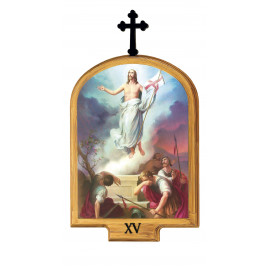
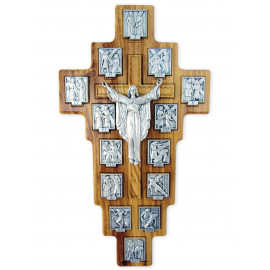
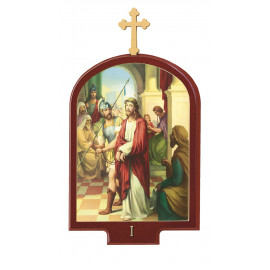
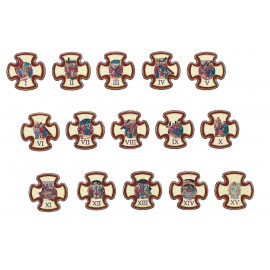
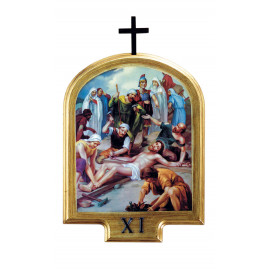
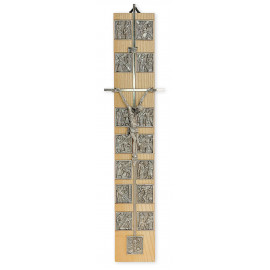
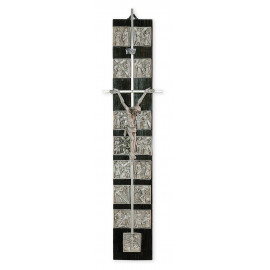
Hanging the Stations of the Cross is part art and part practical planning. The panels need to be visible, evenly spaced, and securely fixed. A layout that looks fine on paper can fail on a wall with a doorway, a radiator, or a low ceiling. The best approach is to plan the sequence before drilling.
This guide covers the standard height, spacing, layout, and hardware for MDF panels and wooden crosses. It is written for a home, chapel, or church, with the caveats that come from real walls.
Plan the Layout First
Start by making a simple paper template for each panel. Cut rectangles to the size of the panels and tape them to the wall. Walk the sequence from station 1 to station 14 (or 15) and check that each one is visible from the place where people will stand or sit. This step catches most problems before you drill.
Decide where the sequence begins and ends. In a church, the stations usually run along the side walls or around the nave. In a home, a hallway, living room, or prayer corner can work. Avoid placing a panel behind a door, above a radiator, or in direct sunlight.
How High Should They Hang?
A common centre height is 150–160 cm from the floor. That puts the panels at eye level for most adults and keeps the sequence readable. In a church with a high ceiling, the panels may need to be higher so they are visible from the pews; in a home, they can be lower for children.
Consistency matters more than a single number. Pick a centre height and keep it for every panel. If the wall has furniture, a window, or a doorway, adjust the sequence rather than breaking the height arbitrarily.
Spacing
There is no universal spacing rule. A practical starting point is 60–90 cm between panel centres, depending on the panel size and the wall length. Smaller panels can be closer; larger panels need more space. The goal is a rhythm that lets the eye move from one station to the next without crowding.
At corners, keep the same height and turn the sequence carefully. If the wall is interrupted by a door or a window, continue the sequence on the other side rather than skipping a station. In a church, the architecture may dictate the spacing; follow the building rather than forcing a perfect grid.
Hardware for MDF Panels
MDF panels are lighter than solid wood but still need a secure fixing. Use the hanging method recommended in the product listing, or a D-ring, sawtooth hanger, or screw eye appropriate to the panel. For drywall, use a drywall anchor rated for the weight; for plaster, use a suitable plug; for brick or stone, use a masonry bit and anchor.
Do not rely on adhesive strips for a panel that could fall. Avoid hanging a panel by a single nail unless the panel has a proper hanger. If you are not confident in the wall type, ask someone who is; a fallen panel can damage the artwork or injure someone.
Hardware for Wooden Crosses
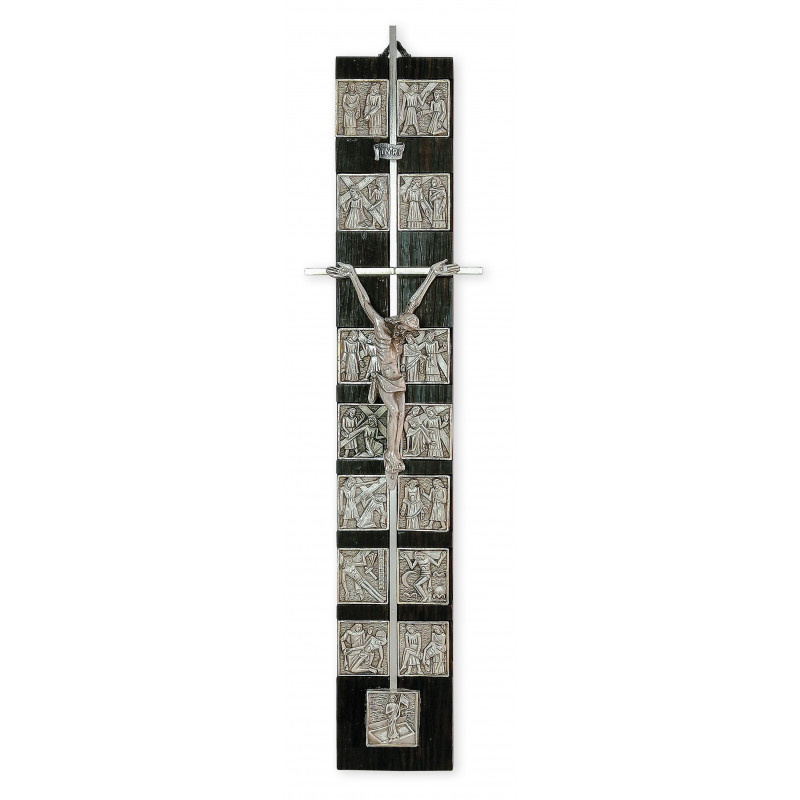
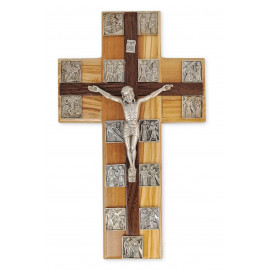
Wooden crosses are heavier and often have a single hanging point. Use a screw long enough to reach a stud or a wall anchor rated for the weight. Check the back of the cross for the hanging hardware; if there is none, add a D-ring or a suitable bracket. Do not hang a heavy cross on a nail in drywall.
For a large cross, two fixing points are safer than one. If the cross is going into a church wall, check the wall construction and use a method approved for the building. When in doubt, use a professional installer.
Church Installation
In a church, the installation may need scaffolding, a lift, or a professional contractor. Do not use a ladder in a crowded nave without proper safety measures. Check the fire regulations and the building’s rules before drilling. If the panels are heavy or the wall is historic, get advice from the parish facilities team.
Make a plan that includes the height, spacing, and sequence, and mark the positions before drilling. A dry run with paper templates is faster than correcting holes in a finished wall.
Frequently Asked Questions
Q: How high should Stations of the Cross be hung?
A: A common centre height is 150–160 cm from the floor. In a church, adjust for visibility from the pews; in a home, adjust for the people who will use them.
Q: How far apart should the stations be?
A: A practical starting point is 60–90 cm between panel centres, depending on panel size and wall length. Keep the spacing consistent.
Q: What hardware should I use for MDF panels?
A: Use the method recommended in the listing, or a D-ring, sawtooth hanger, or screw eye with an anchor rated for the panel weight. Avoid adhesive strips for heavy panels.
Q: Can I hang the stations with adhesive strips?
A: Adhesive strips are not suitable for heavier panels. Use a mechanical fixing that matches the wall and the weight.
Q: How do I hang a wooden cross?
A: Use a screw into a stud or a wall anchor rated for the weight. For a large cross, use two fixing points and check the back of the cross for hardware.
Q: How do I plan the layout?
A: Make paper templates, tape them to the wall, and walk the sequence from station 1 to 14. Check visibility, height, and spacing before drilling.
Q: What if a door or window interrupts the wall?
A: Continue the sequence on the other side at the same height. Do not skip a station; adjust the spacing around the obstacle.
Q: Can I hang the stations outdoors?
A: Our MDF and wooden stations are for indoor wall display. They are not weather-rated for outdoor use.
Q: How do I clean the panels after installation?
A: Dust with a soft, dry cloth. Avoid water, harsh cleaners, and direct sunlight. For deeper cleaning, follow the product care instructions.
Conclusion
Plan the sequence, pick a consistent height, space the panels for the wall, and use hardware rated for the weight. A little planning before drilling saves time and protects the artwork. Browse the Stations of the Cross collection for panel sizes and wooden crosses, read our home display guide for placement ideas, or see the complete guide for the history and prayers.