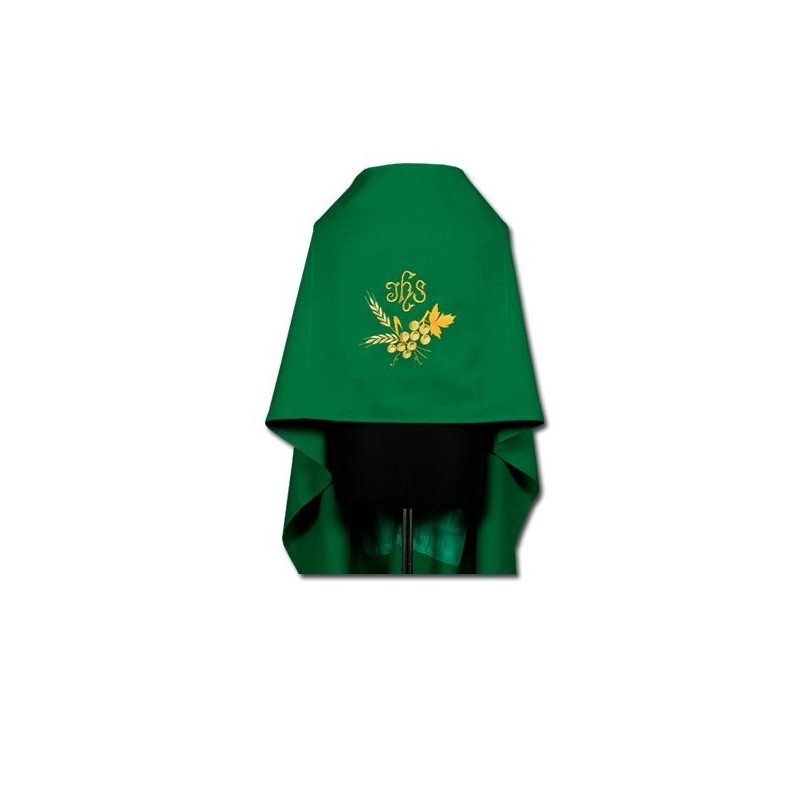
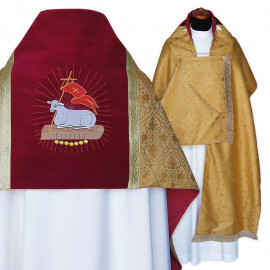
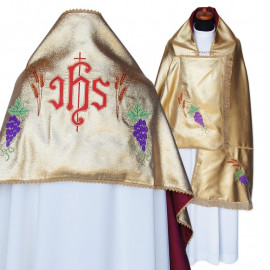
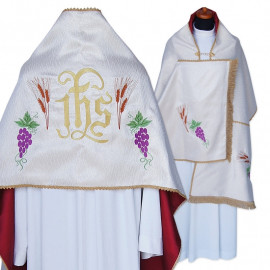
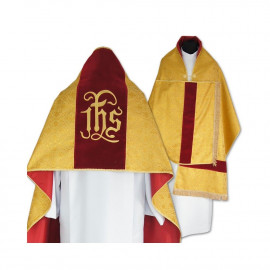

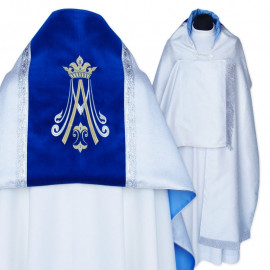
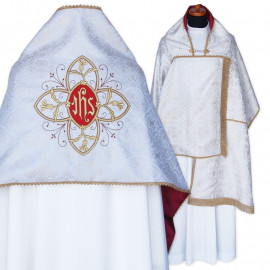
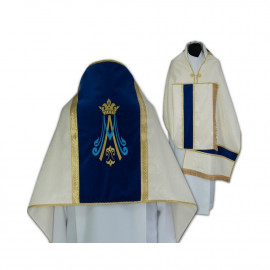
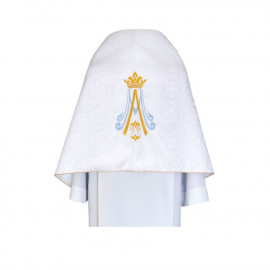
A traditional humeral veil is about 2.75 metres (110 inches) long and 90 centimetres (35 inches) wide. The length lets the two ends come forward over the hands while the middle rests across the back and shoulders. A veil that is too short will not cover the hands comfortably; one that is too wide will bunch around the arms.
This guide explains the standard dimensions, the size range in our collection, how to choose the right length for your monstrance, and how to fold and store the veil without creasing the embroidery.
Traditional Dimensions
The classic humeral veil is a long rectangle, not a cape. The traditional measurements are about 2.75 m × 90 cm. Two ribbon ties or a clasp near the breast keep the veil in place, and the ends hang down in front where they can be crossed or held beneath the monstrance.
Those dimensions are a guide, not a law. A smaller monstrance and a smaller celebrant may suit a shorter, narrower veil; a heavy monstrance or a cathedral ceremony may call for a longer, wider veil with more coverage.
Our Size Range
Our humeral veils run from 250 cm to 300 cm in length and 50 cm to 60 cm in width. The reference number often includes the size — for example, 50 × 270 cm — and every product page lists the exact length and width.
- 250–260 cm — compact veils for a smaller monstrance or a smaller celebrant.
- 270 cm — the most common size in our collection; a good all-round choice.
- 300 cm — longer veils for a large monstrance, a tall celebrant, or a cathedral ceremony.
How to Choose the Right Length
Measure the monstrance and the celebrant, not just the vestment. As a rule, the veil should be long enough that the ends can be brought forward and crossed over the hands while the middle still rests comfortably on the shoulders. If the celebrant is tall, or the monstrance is heavy and needs a firm grip, choose the longer size.
Width matters too: a narrower veil is easier to manage, while a wider veil gives more coverage and a more solemn look. For a heavy monstrance, choose a lined veil with a firm clasp or wide ribbon ties.
How to Fold a Humeral Veil
The veil is usually folded in an accordion style so that it can be put on quickly and without creasing the embroidery. There are two common methods:
- Fold each side individually like an accordion, with the folds either on top of or underneath the centre.
- Offset one side and fold both sides together in an accordion style, so that the folds interleave.
Whichever method you use, keep the embroidered panels on the outside and avoid pressing sharp creases through the metallic thread. If the veil has a clasp, fasten it loosely before storing so the fabric does not take a permanent set.
How to Store and Clean It
Store the veil flat or rolled, away from damp and direct sunlight. Hanging a heavy veil for long periods can stretch the shoulders; folding it loosely is usually better. Many of our brocade and satin veils are described as suitable for standard washing and ironing. Velvet, damask, and heavily embroidered models should follow the care note on the product page; when in doubt, use a specialist liturgical cleaner.
If the veil is part of a matching set, store it with the cope and the chalice veil so that the colors and fabrics age together.
What If the Veil Is Too Long or Too Short?
A veil that is slightly too long is easier to manage than one that is too short. The ends can be crossed once more over the hands, or the middle can be gathered at the shoulders, as long as the fabric still falls in a clean line. Never cut or hem an embroidered veil to shorten it: the embroidered panels and the lining are finished as a unit, and cutting them will damage the balance of the piece.
A veil that is too short cannot be fixed in use. If the ends barely reach the hands, the celebrant has to stoop or grip the monstrance awkwardly, which is both uncomfortable and unsafe. In that case, move to the next size rather than forcing the veil. For a parish that already owns several veils, label the sizes inside the storage bag so the sacristan can choose the right one without unfolding every piece.
Humeral Veil Size FAQ
Q: How long is a humeral veil?
A: The traditional length is about 2.75 m (110 in). Our veils run from 250 cm to 300 cm, with 270 cm the most common size.
Q: How wide is a humeral veil?
A: The traditional width is about 90 cm (35 in). Our veils are 50–60 cm wide, which is easier to manage while still giving good coverage.
Q: How do you fold a humeral veil?
A: Fold each side individually like an accordion, with the folds on top of or underneath the centre, or offset one side and fold both sides together. Keep the embroidered panels on the outside.
Q: How do you store a humeral veil?
A: Store it flat or rolled, away from damp and sunlight. Fasten the clasp or ribbons loosely so the fabric does not take a permanent set.
Q: Can a humeral veil be washed?
A: Many brocade and satin veils are suitable for standard washing and ironing. Velvet, damask, and heavily embroidered models should follow the product care note or be cleaned by a specialist.
Q: How do I measure for a humeral veil?
A: Measure the monstrance and the celebrant. The veil should be long enough to bring the ends forward over the hands while the middle rests on the shoulders. When in doubt, choose the longer size.
Related reading: humeral veils · Benediction vestments · monstrance veils · ciborium veils.