
If you have ever stood in a sacristy listening to two servers debate whether to call the swinging metal vessel a "censer" or a "thurible," you already know the answer is: both are right. But the two words are not quite interchangeable, and knowing the difference makes shopping lists, rubrics, and sacristy conversations much easier.
Censer vs Thurible: The Short Answer
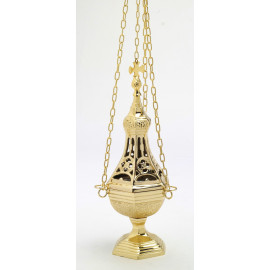
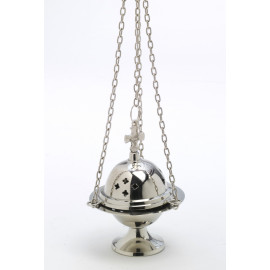
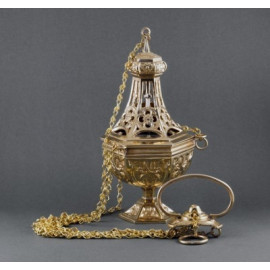
A thurible is a censer. "Censer" is the general name for any vessel made to burn incense — from ancient temple censers to the small resin burners used at home. "Thurible" is the specific liturgical name for the censer that hangs on chains and is swung during Mass, processions, and Benediction.
So every thurible is a censer, but not every censer is a thurible. A censer sitting on a table is a censer. The same vessel on chains, swung toward the altar, is a thurible.
Where the Two Words Come From
"Censer" comes from the Old French censier, from the Latin incensum — "that which is burned," incense. "Thurible" comes from the Latin turibulum, from thus (incense), by way of Old French. Both words entered English through the medieval Church; "thurible" stayed technical and liturgical, while "censer" drifted into general use for any incense burner.
In the Greek East the same vessel is the kadilo, and older English texts sometimes write turibulum.
Censer, Thurible, Thurifer, Boat — Who Is Who
| Word | What it is | Used for |
|---|---|---|
| Censer | Any vessel for burning incense | General term — church or home |
| Thurible | Censer on chains, swung in the liturgy | Mass, processions, Benediction |
| Thurifer | The altar server who carries the thurible | Serving at Mass |
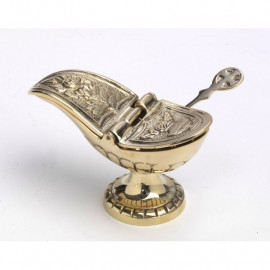
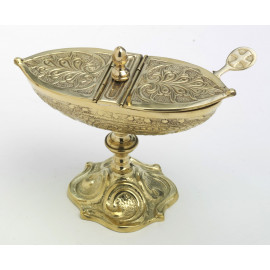
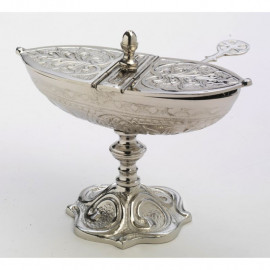
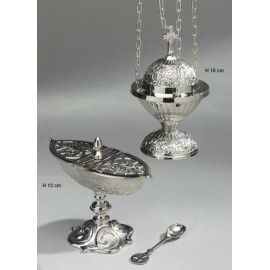
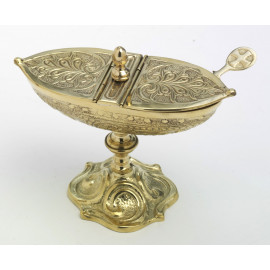
| Incense boat | Lidded vessel holding loose incense | Storing and serving incense grains |
| Boat bearer | Server who carries the boat | Assisting the thurifer |
The most common mix-up is not censer vs thurible but thurible vs thurifer — the vessel and the person. If it hangs on chains, it is a thurible; if it walks, it is a thurifer.
Types of Censers You Will Meet
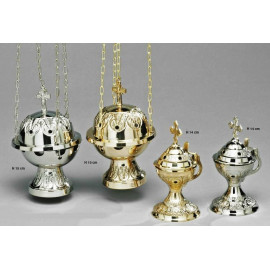
- Hanging censers (thuribles) — the classic swung vessel, 11 cm to 41 cm high, in brass, nickel-plated, or silver-plated finishes.
- Standing or table censers — censers that sit on a stand or table, common in Eastern churches and small chapels.
- Hand censers — censers on a short handle or chain, used for blessings and processions where a full thurible is impractical.
- Home incense burners — small censers for resin or stick incense, often brass with a wooden handle or a perforated lid.
Our incense burners for home use follow the same idea in a smaller format, and our thurible and boat sets cover the full liturgical size range.
When the Distinction Actually Matters
In everyday parish life the words are used interchangeably — "get the censer" and "get the thurible" mean the same errand. The distinction matters in three places:
- Shopping. Searching for a "censer" will surface home burners and Orthodox kadila alongside Catholic thuribles. Searching for a "thurible" narrows the field to liturgical swinging censers.
- Rubrics and training. Liturgical documents speak of the thurible and the thurifer, not the censer.
- Historical reading. Ancient censers (temple, Roman, Egyptian) were not thuribles — the chains and the swinging rite are specifically Christian liturgical developments.
Buying a Censer or Thurible
If you need a vessel for the liturgy, you need a thurible — and usually a matching incense boat and spoon. Complete sets start at $145, and individual thuribles from $97. If you are buying for home prayer rather than the liturgy, a small censer or home incense burner is the better fit; see our guide to using incense at home.
Frequently Asked Questions
Q: Is a censer the same as a thurible?
A: Yes and no — a thurible is a censer, but "censer" is the broader term for any incense-burning vessel. The thurible is specifically the censer suspended on chains and swung in the liturgy.
Q: What is a thurifer?
A: The thurifer is the altar server who carries the thurible, adds incense, and swings it at the proper moments of Mass. The word refers to the person, never the vessel.
Q: What is a censer called in the Catholic Church?
A: In Catholic liturgical usage the censer is called the thurible (Latin turibulum). Both names appear in Church documents, but "thurible" is the standard term.
Q: Can I use a censer at home?
A: Yes. Incense is a sacramental, and burning it privately at home is a longstanding Catholic practice. A small censer or home incense burner with charcoal and resin incense is all you need.
Q: Why is it called a thurible?
A: From the Latin turibulum, a vessel for thus — incense. The same root gives us "thurifer," the incense-bearer.
