
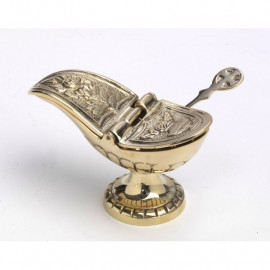
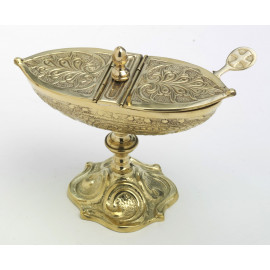
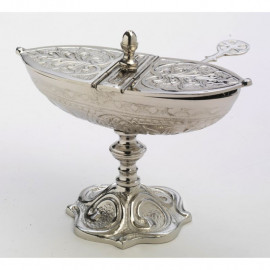
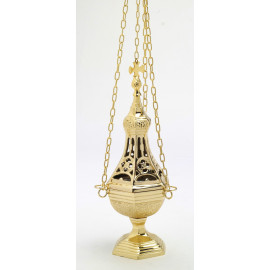
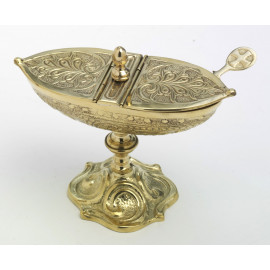
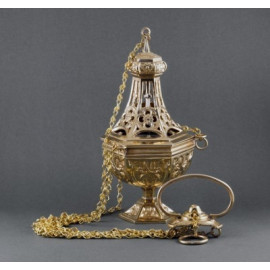
Open any sacristy cupboard that serves a parish with a strong liturgical life and you will find three vessels sitting together: the thurible, the incense boat, and the spoon. The thurible gets the attention — it swings, smokes, and fills the church — but the incense boat is just as essential. Without it, the incense grains would have nowhere to live between Masses.
What Is an Incense Boat?
An incense boat is a small lidded vessel that holds loose incense grains before they are placed in the thurible. Its Latin name is navicula, meaning "little ship," and its traditional boat-like shape is where the English name comes from. In French-speaking sacristies it is still called the navette, and in Italian the navicella.
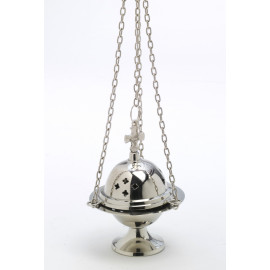
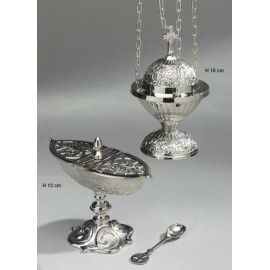
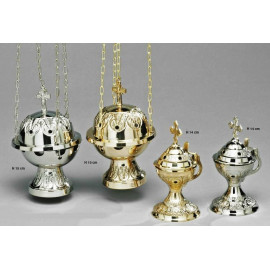
The boat is always used together with two other vessels: the thurible, in which the incense is burned, and the incense spoon, which carries the grains from one to the other. Many parishes buy all three as a matching thurible and boat set so the metalwork and finish are consistent on the credence table.
Why Is It Shaped Like a Boat?
The shape is not purely decorative. A boat's hull is the natural form for a container that must hold small grains, keep them contained, and pour them out in controlled amounts. Medieval silversmiths refined the form into the classic navicula we still recognize — a ship's hull with a lid, often topped with a small cross.
Inside the boat, the incense sits loose. The spoon rests in the boat between uses, which is why so many boats have a small notch for the spoon handle. The lid protects the incense from dust and moisture and keeps the fragrance from escaping into the sacristy.
How the Incense Boat Is Used at Mass
The boat's moment comes during the incensation. Here is the sequence at a typical Mass:
- Before Mass, the thurifer prepares charcoal in the thurible and fills the boat with incense grains.
- At the incensation, the priest or deacon takes the spoon, lifts incense from the boat, and places it on the burning charcoal.
- The priest blesses the incense, and the thurifer swings the thurible.
- When incense is needed again — at the Gospel, the offertory, the consecration — the boat bearer presents the open boat to the priest, who repeats the spoonful.
The boat bearer walks beside the thurifer and holds the boat open with the spoon ready. Our guide to training a thurifer covers the coordination between the two servers, and the step-by-step guide to using a thurible at Mass walks through every incensation.
Types of Incense Boats
Incense boats vary mainly in finish, size, and lid construction:
- Brass boats — the standard for parish use. Durable, easy to polish, and usually the most economical choice. Our brass boats with spoon start at $92.
- Nickel-plated and silver boats — a bright, silver-like finish that matches nickel or silver thuribles. Popular in cathedral sacristies.
- Gothic boats — heavier cast models with tracery and ornaments, often opening on both sides so the spoon can be reached from either hand.
- Boats with trays — a boat and a small tray that keeps the vessel steady on the credence table between uses.
Parish boats typically run from about 12 cm to 16 cm, with larger cast models for cathedrals. The right size holds enough incense for a full Mass without refilling — usually just a few grams for a Sunday Mass.
How to Choose an Incense Boat
Four things matter when buying an incense boat:
- Match the thurible. A brass thurible wants a brass boat; a nickel thurible wants nickel. Mixed metals look accidental on the credence table.
- Check the lid and hinge. The lid should close securely and open smoothly with one hand — the boat bearer may be holding the spoon in the other.
- Decide on one-side or two-side opening. Two-side (Gothic) boats are easier for left-handed servers.
- Make sure the spoon fits. If the spoon does not sit in the boat, it will disappear into a sacristy drawer within a month.
If you are furnishing a sacristy from scratch, our guide to choosing a thurible covers the thurible side of the equation, and incense and charcoal are the two consumables you will reorder regularly.
Caring for an Incense Boat
Incense resin leaves a sticky film on metal. Wipe the boat with a soft cloth after each use, and polish it the same way you care for the thurible — never with abrasive cleaners that strip the finish. Our guide to cleaning and maintaining a thurible applies to boats and spoons as well.
Incense Boat vs. Thurible vs. Censer — Quick Answers
- Thurible / censer: the vessel where incense burns. "Censer" is the general term; a thurible is the censer on chains that is swung.
- Incense boat (navicula): the lidded vessel that stores the incense grains.
- Incense spoon: the small spoon that transfers incense from boat to thurible.
- Boat bearer: the altar server who carries the boat and presents it to the priest.
All three vessels are available in our thurible, boat and spoon collection, in brass, nickel-plated, and silver-plated finishes.
Frequently Asked Questions
Q: What is an incense boat called?
A: The liturgical name is navicula (Latin for "little ship"), also called the navette or navicella in other languages. In English it is simply the incense boat, or occasionally the "incense ship" in older inventories.
Q: What is the difference between a thurible and an incense boat?
A: The thurible is the censer that burns the incense; the incense boat stores the loose grains. The thurible hangs on chains and is swung; the boat sits on the credence table and is carried by the boat bearer.
Q: Who carries the incense boat at Mass?
A: The boat bearer — an altar server who walks beside the thurifer, holds the boat open with the spoon, and presents it to the priest or deacon whenever incense is added to the thurible.
Q: What is an incense boat made of?
A: Most are made of brass, nickel-plated brass, or silver-plated metal. Gothic boats are often cast in solid brass, and gold plating appears on more ornate models for solemn use.
Q: How much does an incense boat cost?
A: In our current collection incense boats range from $92 for a simple brass boat with spoon to $443 for large cast silver-plated models. Complete thurible and boat sets start at $145.
