



A lavabo towel — also called a finger towel or manuterge — is the small white cloth that dries the priest's hands at the washing of hands during Mass. It is one of the most handled linens in the sacristy and one of the least understood. This guide explains what it is, why it has three names, the sizes and fabrics used, how to fold it, and how to care for it.
What Is a Lavabo Towel?
The lavabo towel is a small rectangular cloth, usually white, kept with the altar linens. Its job is narrow and practical: after the Offertory, the priest washes his hands at the side of the altar, and the server holds a towel so he can dry his fingers. The towel never touches the chalice, the paten, or the Blessed Sacrament. It is not a purificator, and it is not the large fair linen that covers the altar.
The name comes from the Latin lavabo, "I will wash" — the first word of Psalm 26:6 in the Vulgate: Lavabo inter innocentes manus meas, "I will wash my hands among the innocent." The same psalm supplies the verses the priest prays quietly during the washing.
Why It Is Called a Manuterge
Manuterge is the older liturgical term. It comes from Latin manus (hand) and tergere (to wipe) — literally "hand-wiper". In older inventories and ceremonial books you will find it alongside "finger towel" and "lavabo cloth". The three names describe the same piece: "manuterge" is the formal term, "finger towel" describes its size, and "lavabo towel" ties it to the rite.
In Polish sacristies the same cloth is called a ręczniczek. In parish supply catalogs you may see "lavabo hand towel" or "Mass finger towel". None of these is a different item.
The Lavabo Rite Step by Step
The lavabo takes place after the Offertory and before the Eucharistic Prayer. The General Instruction of the Roman Missal (no. 76) calls the washing "a rite that is an expression of his desire for interior purification." The practical sequence is simple:
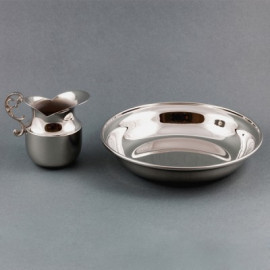
- The server brings the ewer, basin, and folded towel to the priest's left.
- The server pours water from the ewer over the priest's fingers, holding the basin steady.
- The priest prays the lavabo verses quietly while washing his hands.
- The server presents the towel, usually draped over the forearm, with the embroidered side facing out.
- The priest dries his fingers and returns the towel; the server takes it to the linen basket.
A towel that has been used is not put back in the drawer for the next Mass. In a parish with several weekend Masses, that single rule explains why a sacristy needs more than one towel per altar.
What Size Is a Lavabo Towel?
There is no single size required by liturgical law. The three sizes most often stocked are 11 × 17 in (28 × 43 cm), 10 × 14 in (25 × 36 cm), and 20 × 20 in (51 × 51 cm). The 11 × 17 inch towel is the common standard; 10 × 14 is a compact size for small hands or travel sets; 20 × 20 gives a generous drying surface and is often finished with lace.
| Size | Metric | Best for |
|---|---|---|
| 11 × 17 in | 28 × 43 cm | Most parishes; standard finger towel |
| 10 × 14 in | 25 × 36 cm | Small servers, travel Mass kits, tight sacristies |
| 20 × 20 in | 51 × 51 cm | Solemn Mass, large basin, lace-edged sets |
| 20 × 16 in | 51 × 41 cm | Rectangular variant with a deep hem |
Measure the basin and the server's reach before ordering. A towel that is too large can trail in the water; one that is too small leaves the priest's hands damp. If you are buying for a set, match the towel to the corporal and purificator in fiber and shade of white.
Which Fabric Is Best?
Pure linen is the traditional choice: absorbent, lint-free, strong when wet, and softer with every washing. Its drawback is creasing, so it needs pressing. Cotton is softer and less expensive, absorbs well, and is easier to iron, but it can lint. Poly-cotton blends are durable and easy-care, which is why many parishes use them for everyday towels and keep pure linen for solemn occasions.
Whatever the fiber, avoid fabric softener. It coats the fibers and reduces absorbency — the opposite of what a hand towel needs. Wash new towels before first use to remove sizing and lint.
Embroidered or Plain?
A lavabo towel may be plain, hemstitched, edged with lace, or embroidered. The usual motif is a small cross at the center or near one end: a Latin cross, a Jerusalem cross, a Greek cross, an IHS monogram, a fleur-de-lis, or the Alpha and Omega. White-on-white embroidery is discreet and matches any liturgical color; a red cross is a traditional accent; gold thread suits solemn sets but should be smooth so it does not scratch the priest's hands.
For everyday parish use, choose flat, closely worked embroidery and a simple hem. Heavy lace and three-dimensional goldwork are beautiful but require careful laundering.
How to Fold and Present It
Lay the towel flat with the embroidery down. Fold one long edge to the center, then the other long edge to the center, so the towel becomes a long strip. Fold the strip in half or in thirds with the motif facing out. Drape the folded towel over the server's forearm, with the loose edges away from the basin. The priest should be able to take it without unfolding it.
For a step-by-step guide, see How to Fold a Lavabo Towel.
How to Wash and Store It
Wash in cold or lukewarm water with a mild detergent. Do not bleach, and do not use fabric softener. Wash whites separately from colored vestments, and check the embroidery for loose threads before laundering. Tumble dry on low or line dry; remove the towel while it is still slightly damp and press it on the reverse side. Iron around, not directly over, metallic embroidery. Store towels flat or rolled in a dry sacristy drawer; hanging them for long periods can create a permanent crease.
Purificators and corporals that touch the Blessed Sacrament are normally rinsed in the sacrarium before ordinary washing, according to diocesan custom. A lavabo towel touches the priest's hands, not the Eucharist, so it is usually laundered with the other sacristy linens. When in doubt, follow the custom of your diocese and the instructions of the sacristan.
How Many Does a Parish Need?
Most sacristies keep at least two towels per altar so one can be in use while the other is laundered. A parish with several weekend Masses, multiple priests, or a school chapel may keep four to six. Packs of three or twelve are a practical way to build a rotation. Inspect the stock twice a year and retire towels that are thin, stained, or frayed at the hem.
Lavabo Towel vs Purificator vs Corporal
The lavabo towel is often confused with the other white linens on the credence table. The purificator wipes the chalice; the corporal is the square on which the vessels rest; the lavabo towel dries the priest's hands. They are different shapes, different linens, and different parts of the Mass. For a full comparison, see Purificator vs Corporal vs Finger Towel.
Frequently Asked Questions
Q: What is a lavabo towel?
A: A lavabo towel is the small white cloth a priest uses to dry his hands at the lavabo, the ritual washing after the Offertory and before the Eucharistic Prayer. An altar server holds it during the washing and then takes it to the linen basket.
Q: What is a manuterge?
A: Manuterge is the older liturgical name for the lavabo towel. It comes from Latin manus (hand) and tergere (to wipe). It is the same piece as a finger towel or lavabo cloth.
Q: What size is a lavabo towel?
A: Common sizes are 11 × 17 in (28 × 43 cm), 10 × 14 in (25 × 36 cm), and 20 × 20 in (51 × 51 cm). There is no single required size; choose one that suits the basin and the server's hands.
Q: What material is best for a lavabo towel?
A: Pure linen is the traditional choice because it is absorbent, lint-free, and durable. Cotton is softer and less expensive; poly-cotton is easy-care and hard-wearing. Avoid fabric softener, which reduces absorbency.
Q: How do you fold a lavabo towel?
A: Lay it flat with the embroidery down, fold both long edges to the center, then fold the strip in half or in thirds with the motif facing out. Drape the folded towel over the server's forearm so the loose edges stay away from the basin.
Q: How do you wash a lavabo towel?
A: Wash in cold or lukewarm water with mild detergent, without bleach or fabric softener. Dry on low heat or line dry, then press on the reverse side while slightly damp. Store flat or rolled in a dry sacristy.
Q: Is a lavabo towel the same as a purificator?
A: No. A lavabo towel dries the priest's hands at the washing of hands; a purificator wipes the chalice after Communion. They are different shapes, different linens, and different parts of the Mass.
Browse the lavabo towel collection, the lavabo set, and the matching purificators, corporals, and palls.


