
What Is a Liturgical Menorah and How Is It Used in Catholic Worship?
Related Products
| Product | Description | Price |
|---|---|---|
| Liturgical Menorah | Traditional seven-branch brass menorah for church sanctuary | From $340 |
| Brass Church Wall Lamps | Wall-mounted brass lamps for sanctuary lighting | From $185 |
| Sanctuary Lamp Eternal Light | Eternal sanctuary lamps for perpetual lighting | From $95 |
| Liturgical Candlestick Candle Holder | Altar candlesticks in brass and bronze | From $75 |
| Liturgical Candle Snuffer | Brass candle snuffers for liturgical use | From $25 |
Walk into an old European basilica or a cathedral with rich Jewish-Christian heritage, and you might notice something curious — a seven-branched candlestick standing near the altar or in the sanctuary. It looks like the Jewish menorah, but it's clearly part of a Catholic church. What is it, and why is it there?
I've been asked this question dozens of times by visitors, sacristans, and even priests. The answer is a beautiful example of how the Church honors its roots in the Old Testament while proclaiming the fulfillment of those symbols in Christ.
What Is a Liturgical Menorah?
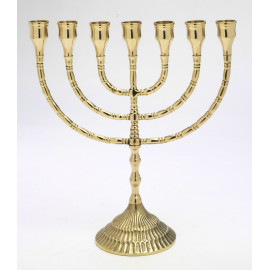
A liturgical menorah is a seven-branched candelabrum used in some Catholic churches for decorative, ceremonial, or devotional purposes. It closely resembles the menorah described in Exodus 25:31-40 — the golden lampstand made for the Tabernacle and later placed in the Temple of Jerusalem.
The original menorah was made of pure gold and had seven branches: a central stem with three branches extending on each side. It was lit with pure olive oil and burned continuously in the Holy Place, symbolizing the presence of God and the light of divine wisdom.
In the Catholic tradition, the menorah is not a liturgical requirement, but it is a permitted and meaningful decorative element. It serves as a visual reminder of the Church's continuity with the Old Testament and the fulfillment of Temple worship in the Eucharistic sacrifice.
How Is the Catholic Menorah Different from the Jewish Menorah?
While they share the same form and symbolism, there are important differences:
| Feature | Jewish Menorah | Catholic Liturgical Menorah |
|---|---|---|
| Primary use | Religious symbol of Judaism and Hanukkah | Decorative/ceremonial in churches |
| Lighting | Traditionally lit with olive oil or candles | Usually lit with candles or electric lights |
| Location | Synagogue or home | Church sanctuary, chapel, or museum |
| Theological meaning | God's eternal covenant with Israel | Fulfillment of the Old Covenant in Christ |
| Number of branches | Seven (or nine for Hanukkah) | Usually seven |
The key difference is theological. For Judaism, the menorah represents the divine presence in the Temple and the miracle of light. For Catholicism, the menorah points forward to Christ, the true Light of the World, and to the seven gifts of the Holy Spirit.
What Does the Menorah Symbolize in a Catholic Church?
The seven branches are rich with Christian meaning:
1. Christ the Light of the World The Gospel of John calls Jesus "the true light that enlightens every man" (John 1:9). The menorah's seven lamps represent the perfection of that light — the completeness of Christ's revelation.
2. The Seven Gifts of the Holy Spirit In Isaiah 11:2-3, the Messiah is described as possessing seven gifts: wisdom, understanding, counsel, fortitude, knowledge, piety, and fear of the Lord. The seven branches of the menorah have been interpreted by Christian tradition as symbols of these gifts.
3. The Seven Sacraments Some theologians and artists have associated the seven branches with the seven sacraments — the means by which Christ's grace flows to the Church.
4. The Old Testament Roots of the Church The menorah visibly proclaims that the Catholic Church is the fulfillment of Israel. The promises made to Abraham, Moses, and David are completed in Christ and His Church. The menorah says: we have not forgotten where we came from.
Where Is the Menorah Used in Catholic Worship?
The liturgical menorah is most commonly found in:
Basilicas and Cathedrals with historical or artistic connections to Jewish-Christian heritage. Rome's Basilica of Santa Maria Maggiore, for example, features mosaic depictions of the menorah from the Old Testament.
Ecclesia Mater Churches — parishes and communities that emphasize the Jewish roots of the faith. These churches often include menorahs, showbread tables, and other Temple imagery to teach the faithful about typology.
Monastic Chapels, particularly Benedictine and Carmelite communities with a strong emphasis on Old Testament spirituality.
Processions and Ceremonies. Some churches use a large menorah as part of the decoration for Holy Week, Easter Vigil, or Corpus Christi. The seven lit candles can represent the seven gifts of the Spirit or the fullness of Christ's light.
How to Choose a Liturgical Menorah for Your Church
If your parish is considering adding a menorah to its sanctuary, here are the factors to consider:
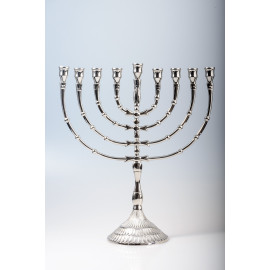
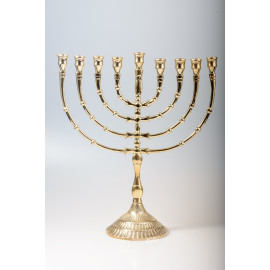
Material. Brass and bronze are the most common and durable. They develop a beautiful patina over time and complement other liturgical brassware. Silver-plated menorahs are stunning but require more maintenance. Some modern menorahs are made of wrought iron for a rustic look.
Size. Menorahs range from small tabletop models (12-18 inches) to large floor-standing versions (4-6 feet tall). For a sanctuary, a floor-standing model makes the strongest visual statement. For a chapel or side altar, a medium-sized model is more appropriate.
Style. Traditional menorahs follow the ancient design: a central stem with curved branches. Some modern versions have straight branches or more abstract forms. Choose a style that matches your church's existing furnishings and architectural style.
Candle type. Most liturgical menorahs use wax candles, but electric versions are available for safety and convenience. If you plan to leave the menorah lit for extended periods (such as during adoration or a triduum), electric candles may be practical.
What I Recommend
For most parishes, I recommend a medium-to-large brass menorah with seven candle sockets. Brass is durable, beautiful, and coordinates with most sanctuary furnishings. Choose a model with a stable base — tall candelabra can tip easily if bumped.
If your church has a strong teaching mission focused on biblical typology, a custom menorah with engraved symbols (the seven gifts, the sacraments, or Old Testament scenes) can be a powerful catechetical tool.
For daily use in a monastery or chapel, consider an electric menorah with LED candles. It provides the visual symbolism without the fire risk or maintenance of wax candles.
Frequently Asked Questions
Q: Is the menorah a Catholic symbol? A: It is not a required liturgical symbol, but it is permitted and meaningful. The Church has used menorah imagery since the early Christian catacombs, where it appeared alongside fish, anchors, and chi-rho symbols.
Q: Can we use a menorah during Mass? A: The menorah is not used in the liturgy of the Mass itself. It is a decorative and devotional object, not a liturgical vessel like the chalice or ciborium. However, it may be lit during adoration, processions, or devotional services.
Q: What's the difference between a menorah and an altar candelabrum? A: An altar candelabrum (usually with two branches) holds the candles that are lit during Mass. A menorah has seven branches and is not used in the Mass rubrics. They serve different purposes.
Q: How much does a liturgical menorah cost? A: Entry-level brass menorahs start around $300-$500. Mid-range models with better detail run $600-$1,200. Large custom or historically accurate reproductions can cost $2,000 and up.
Related Liturgical Items
Enhance your sanctuary with these complementary pieces:
- Sanctuary Lamp Eternal Light — Perpetual lighting for your church
- Brass Church Wall Lamps — Wall-mounted sanctuary lighting
- Liturgical Candlestick Candle Holder — Altar candlesticks for Mass
- Liturgical Crosses and Crucifix — Processional and altar crosses
- Processional Canopies Baldachins — For ceremonies and processions
Conclusion
The liturgical menorah is a bridge between the Old and New Testaments — a golden reminder that the Church is the fulfillment of Israel's hope. Whether it stands in a cathedral basilica or a small parish chapel, it proclaims the same truth: Christ is the Light of the World, and His Church is the new Temple where God's presence dwells.
If you're looking for a liturgical menorah for your church, browse our collection. We offer traditional seven-branch models in brass and bronze, crafted to honor this ancient and beautiful symbol.