








The Short Answer
The chalice veil is the large square cloth that covers the chalice and paten before the Eucharistic liturgy. The burse is the stiffened case that holds the folded corporal. They are both part of the chalice set, but they do different jobs and have different shapes.
What Is a Chalice Veil?
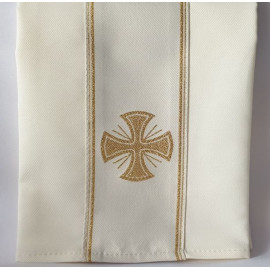
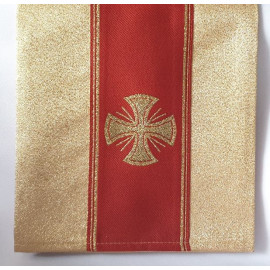
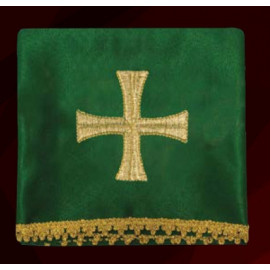
A chalice veil is a square textile, usually 50–60 cm across, made of synthetic fabric, satin, or another suitable material. It covers the chalice and paten before Mass and may be replaced after Communion. The veil is often embroidered with a cross or a liturgical symbol and finished with lace.
The veil is the outer cover of the veiled chalice. It is removed at the Offertory so the priest can prepare the chalice. See our guide to what a chalice veil is for the full definition and GIRM 118.
What Is a Burse?
A burse is a square, envelope-like case, usually about 18 × 18 cm, made of fabric that matches the veil. It holds the folded corporal — the large square linen on which the chalice and paten rest during Mass. The burse is carried to the altar and opened so the corporal can be spread out.
The burse is not a cover for the chalice. It is a case for the corporal. A parish that confuses the two will either leave the corporal unprotected or put the burse on the chalice, which is not its purpose.
Side-by-Side Comparison
| Feature | Chalice veil | Burse |
|---|---|---|
| Purpose | Covers the chalice and paten before the Eucharistic liturgy | Holds the folded corporal |
| Shape | Large square cloth | Square case, envelope-like |
| Typical size | 50 × 50, 51 × 51, or 60 × 60 cm | About 18 × 18 cm |
| Material | Synthetic fabric, satin, embroidered fabric | Fabric matching the veil, with a stiffener |
| When used | Before Mass and, if desired, after Communion | Carried to and from the altar; opened for the corporal |
How They Work Together
The veil and burse are often made from the same fabric. The burse may rest on top of the veiled chalice when the set is carried to the altar. At the altar the burse is opened, the corporal is spread out, and the veil is removed at the Offertory. The pall is then placed over the chalice during the Canon.
A complete chalice linen set usually includes the veil, burse, pall, corporal, and purificator. If you are buying for a parish, buy the pieces as a set so the colors and fabrics match.
Common Mistakes
- Using the burse as a chalice cover. The burse holds the corporal; it is not shaped for the chalice.
- Using the veil as a purificator. The veil is not absorbent altar linen and should not touch the Precious Blood.
- Buying a veil without checking the chalice size. A veil that is too small will not cover the paten.
- Storing the burse empty and the corporal loose. The corporal should be folded and kept in the burse.
How to Store the Veil and Burse
Store the burse flat with the folded corporal inside, so the corporal does not lose its creases and the burse keeps its shape. Roll the veil around a padded tube or lay it flat in a drawer; do not hang it on a sharp hook that can pull the embroidery or leave a crease in the satin.
Keep the veil and burse together as a set. If your sacristy has several chalices, label the storage sleeve with the color and the chalice it belongs to. A matching set that is stored together is easier to prepare and less likely to be mismatched on a busy Sunday.
Before Mass, check that the burse contains the corporal and that the veil is clean and pressed. After Mass, refold the corporal, place it in the burse, and return the veil to its sleeve. This small routine protects both pieces and keeps the chalice set ready for the next celebration.
Frequently Asked Questions
Q: Is a burse the same as a chalice veil?
A: No. The veil covers the chalice and paten; the burse holds the folded corporal. They are different pieces with different shapes.
Q: What size is a burse?
A: A typical burse is about 18 × 18 cm. The size should fit the folded corporal comfortably.
Q: Does the burse have to match the veil?
A: It should match the vestments and, where possible, the veil. A coordinated set looks intentional and is easier to store.
Q: Can I use a burse without a veil?
A: Yes, the burse can be used on its own, but the veil and burse are usually bought together as part of the chalice set.
Q: Where does the burse go during Mass?
A: The burse is carried to the altar, opened, and the corporal is spread out. The empty burse is placed aside until the corporal is folded again.
