
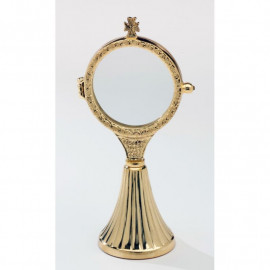
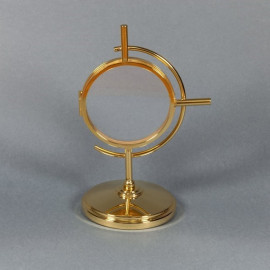
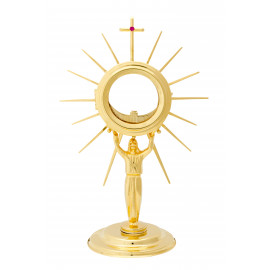
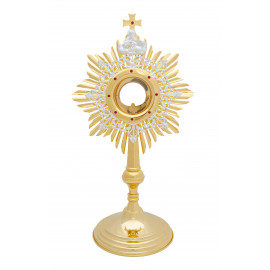
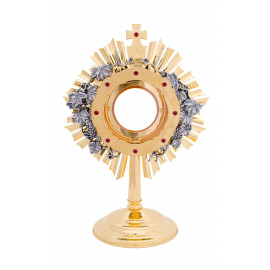
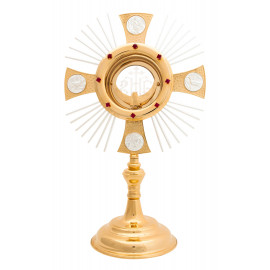
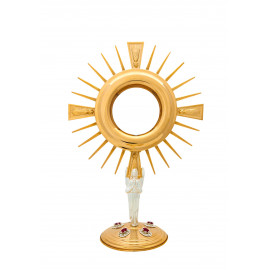
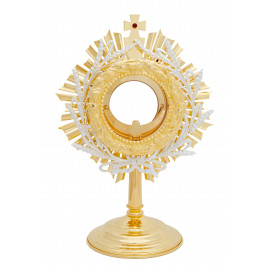
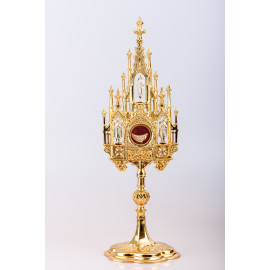
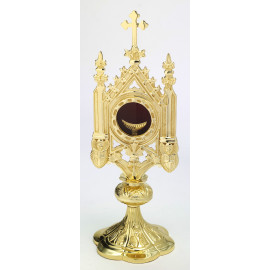
A monstrance is one of the most visible vessels in the church — and one of the most varied in price. Chapel models and large church pieces can differ by a factor of ten, and it helps to know what you are actually paying for before you compare offers.
What Determines the Price of a Monstrance?
Five factors drive the cost:
- Size and weight. A 17 cm chapel monstrance uses far less brass than a 52 cm church piece with a heavy cast base.
- Material and finish. Cast brass with a galvanic gold finish is the standard; 24-carat gold gilding and silver elements raise the price.
- The luna (host size). Oversized lunas for large exposition hosts require more complex, reinforced construction.
- Ornamentation. Hand-finished details — stone-set rings, patinated figures, engraved bases — add cost at every level.
- Where it was made. European workshop production with traditional methods costs more than mass-market imports.
Real Price Ranges: What You Get at Each Level
These are real prices from our current collection of 14 monstrances, so you can calibrate any other offer you see:
| Level | Price | What you get |
|---|---|---|
| Entry chapel | $242–$479 | 17–38 cm monstrances in gilded brass for a traditional host — home oratories and small chapels |
| Mid-range | $629–$1,045 | Neo-Gothic 40 cm, the 30 cm church model, and the 18–20 cm large-host monstrances |
| Church size | $1,349–$1,827 | 31–40 cm pieces with richer bases and detailing; also the 52 cm model |
| Large ornate | $2,698 | The 45 cm monstrance for a large host — our largest and most ornate design |
As a rule of thumb: under $500 buys a solid, dignified chapel monstrance; $600–$1,000 adds gothic detailing or large-host capability; above $1,300 you are paying for church-scale presence and craftsmanship.
Why Large Host Monstrances Cost More
A large host monstrance is built around an oversized glass ring — our models take hosts of 12.5 cm and 14.5 cm. The larger luna needs a reinforced frame and a wider sunburst to keep the host stable and visible, which is why these designs start around $964 even at chapel height.
What Else to Budget For
- Humeral veil — needed for Benediction and processions; ours run $23–$68.
- Tabor or throne — the stand for exposition; $262–$1,117 depending on size and style.
- Shipping — free on all orders over $100 at our shop.
- Blessing — a new monstrance should be blessed by a priest before liturgical use; there is no charge for the blessing itself.
New vs. Used vs. Antique
Used and antique monstrances can cost less than new ones, but they carry risks: a missing luna, chipped glass, worn gilding or an unstable base. If you are considering a second-hand piece, run through our checklist first: Antique and Used Monstrances.
Frequently Asked Questions
Q: How much does a Catholic monstrance cost?
At our shop, monstrances cost between $242 and $2,698. Chapel-size gold-plated brass monstrances start at $242; church-scale designs of 40–52 cm range from about $1,500 to $2,698.
Q: What is the cheapest monstrance suitable for a chapel?
The 18 cm gilded monstrance at $242 is fully suitable for a small chapel, adoration room or home oratory. If the chapel seats a larger congregation, the 38 cm monstrance at $479 gives more presence for little more money.
Q: Why are some monstrances so expensive?
Price follows size, host size and handwork. A 45 cm monstrance for a large host combines a heavy cast base, an oversized reinforced luna and extensive finishing — that is why it costs several times more than a chapel model.
Q: Do I need to buy a veil and tabor with my monstrance?
Only if you will use the monstrance for Benediction, processions or long exposition. Adoration in a small chapel often needs just the monstrance; Benediction requires a humeral veil, and a tabor makes longer exposition more visible.
Conclusion
A monstrance is a lifetime purchase for a parish, so it pays to compare like with like: size, host, finish and handwork. Our full collection runs from $242 to $2,698 — and if you tell us the space and the host you use, we will point you to the right model.
