
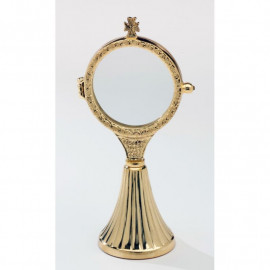
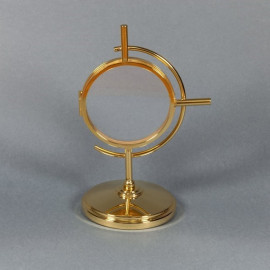
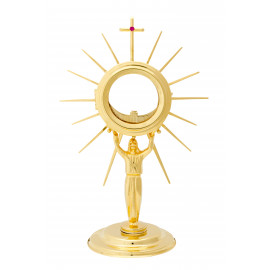
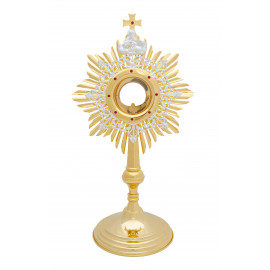
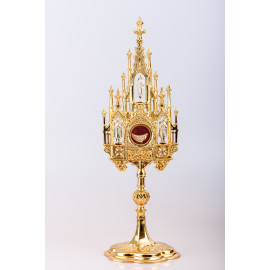
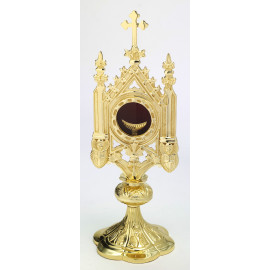
An antique monstrance carries decades of parish history — and sometimes decades of hidden problems. If you are considering a used or antique piece for your church, this checklist will save you from the expensive mistakes.
Why Consider a Used or Antique Monstrance?
Three reasons: price (antique pieces can cost less than a new church-size monstrance), character (hand-chased metalwork and patina that modern production rarely matches), and sustainability (giving a beautiful vessel a second life of service). But unlike new stock, every antique piece is unique — so the inspection matters more than the price tag.
The Checklist: What to Inspect
- Luna present and correct size. The luna (lunette) is the glass holder; if it is missing or sized for a different host, the monstrance cannot be used until a replacement is made.
- Glass condition. Look for chips, cracks and clouding — glass is hard to replace on older pieces because sizes are not standard.
- Gilding wear. Light rubbing on the rays is normal; flaking down to the base metal on the luna frame means the host area will look dull and may need re-plating.
- Base and stem stability. A wobbly base cannot be fixed by tightening — check for cracks, solder repairs or a bent stem. Stability is critical if the monstrance will be carried.
- The luna clip mechanism. It should hold the host firmly and release it without strain; worn or missing springs are a repair job for a silversmith.
- Previous repairs. Honest repairs are acceptable if stable; poorly done solder work often fails with use.
Reading the Style: What the Era Tells You
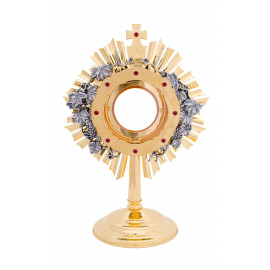
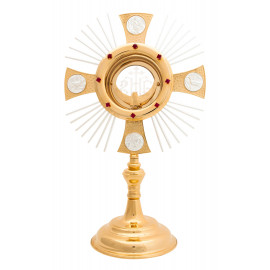
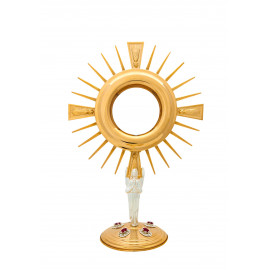
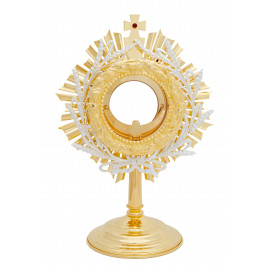
Gothic tower forms with tracery point to 19th-century revival workshops; sunburst designs with rich scrollwork and figures suggest the Baroque tradition or its later copies. The style tells you which church interiors the piece was made for — and whether its proportions will suit yours. For a wider look at styles, see our monstrances and the style guide in How to Choose a Monstrance.
Blessing and Restoration
A second-hand monstrance should be blessed by a priest before it is used liturgically — sacred vessels are blessed for their sacred purpose. If restoration is needed, use a silversmith experienced with liturgical metalwork, and resist over-restoration: heavy polishing and re-engraving destroy the patina and the piece's character. A gentle clean and mechanical repair is usually enough.
When to Buy New Instead
- Large host sizes. If you expose a 12.5 cm or 14.5 cm host, a new large-host monstrance guarantees the luna fits.
- Exact host fit. New stock is rated for specific host sizes — no guesswork.
- Condition certainty. No hidden cracks, no missing lunas, no repair surprises.
- Price certainty. Our new monstrances start at $242 with free shipping over $100 — often less than a restored antique of comparable size.
Frequently Asked Questions
Q: Can an antique monstrance still be used for adoration?
Yes — if it is structurally sound, the luna is present and sized for your host, and the vessel has been blessed. Many parishes use carefully maintained antique monstrances for Benediction and processions.
Q: What should I look for in a used monstrance?
Check the luna and glass first, then the gilding on the luna frame, the stability of the base and stem, and the clip mechanism. Ask about repairs and provenance.
Q: Do used monstrances come with a luna?
Not always — a missing luna is one of the most common defects. Since lunas are sized to the host and not standardized across makers, a missing luna can be expensive to replace.
Q: Are antique monstrances cheaper than new ones?
Sometimes, but not reliably: rare pieces and restored silver monstrances often cost more than new stock. Compare like with like — our new monstrances run from $242 to $2,698; see How Much Does a Monstrance Cost?
Conclusion
An antique monstrance is worth buying when the luna is present, the glass is clear, the gilding is sound and the base is stable — and when the price reflects the risk. If any of those checks fails, a new monstrance from $242 is the safer, often cheaper path. Browse our full range of new monstrances.
