
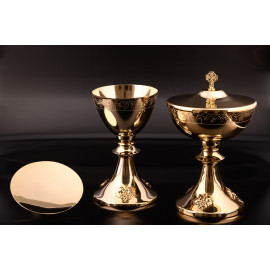
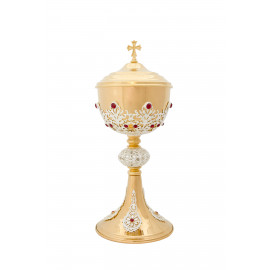
Five vessels, five jobs — and they are easy to mix up. Here is the difference between a monstrance, a tabernacle, a ciborium, a custody and a pyx, and when each one is used.
The Short Answer
- Monstrance — shows the Blessed Sacrament (adoration, Benediction, processions)
- Tabernacle — keeps the Blessed Sacrament (reservation between liturgies)
- Ciborium — distributes the Blessed Sacrament (Holy Communion at Mass)
- Custody / luna — holds the host inside the monstrance
- Pyx — carries the Blessed Sacrament to the sick
What Is a Monstrance For?
A monstrance (also called an ostensorium) is the vessel of exposition: a single consecrated host is placed in its glass luna and the vessel is set on the altar or a throne so the faithful can see and adore it. It is used for Eucharistic adoration, Benediction of the Blessed Sacrament, Forty Hours devotion and Corpus Christi processions. Read more: What Is a Monstrance and How Is It Used?
What Is a Tabernacle For?
The tabernacle is the locked receptacle — usually fixed, often at the center of the sanctuary — in which the Blessed Sacrament is reserved between liturgies. It is not a display vessel: the door stays closed, and the consecrated hosts inside are kept for adoration, for Communion of the sick, and as the center of the church's prayer. The word means "dwelling place."
What Is a Ciborium For?
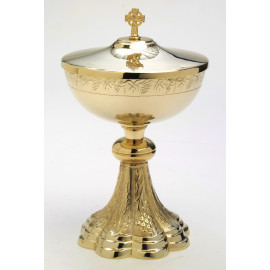
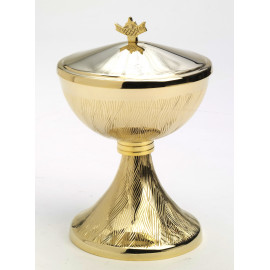
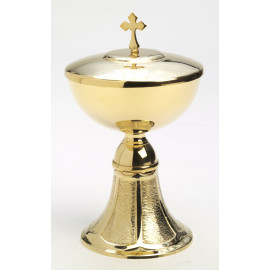
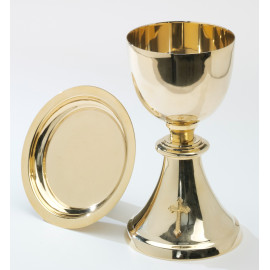
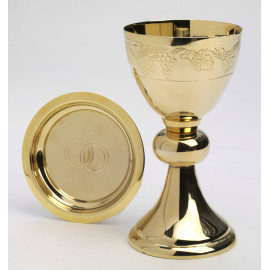
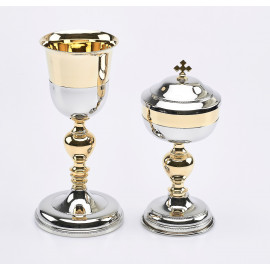
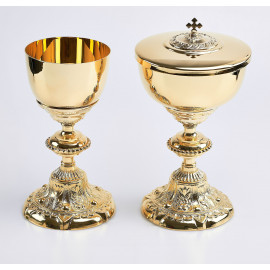
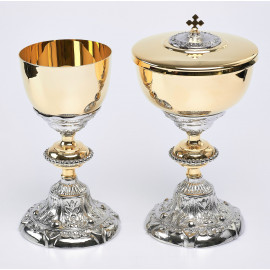
A ciborium is the covered bowl that holds many consecrated hosts during Mass for distribution in Holy Communion. It looks like a chalice with a lid. After Communion, remaining hosts are reserved in the tabernacle — not in the ciborium itself on the altar, and never in a monstrance.
Custody and Luna: The Monstrance's Inner Holder
Inside the monstrance's glass window sits the custody or luna — a crescent-shaped metal ring that clips the host upright. Without the luna, a monstrance cannot hold a host. Smaller custodia vessels (mini monstrances) are used to expose or carry a single host where a full monstrance is not needed; see our liturgical custody collection.
What Is a Pyx For?
A pyx is a small, pocket-sized vessel — usually round, gold-plated — in which a priest or extraordinary minister carries the Blessed Sacrament to the sick and housebound. It is a vessel of transport and communion, not of exposition: it is opened only to give Communion.
Side-by-Side Comparison
| Vessel | Holds | Used for | Where it is kept |
|---|---|---|---|
| Monstrance | One host (in the luna) | Adoration, Benediction, processions | Sacristy or safe |
| Tabernacle | Reserved hosts | Reservation of the Blessed Sacrament | Fixed in the sanctuary |
| Ciborium | Many hosts | Distribution of Holy Communion | Sacristy (or on the altar during Mass) |
| Custody / luna | One host | Holding the host inside the monstrance | Inside the monstrance |
| Pyx | One or a few hosts | Communion for the sick | Sacristy, carried in a burse |
Frequently Asked Questions
Q: Is a monstrance the same as a ciborium?
No. A monstrance is a display vessel for a single host; a ciborium is a covered bowl that holds many hosts for Holy Communion. They are different vessels for different parts of the liturgy.
Q: Can the Blessed Sacrament be kept in a monstrance?
No — the Blessed Sacrament is reserved in a tabernacle. The monstrance is used only for exposition and Benediction; afterwards the host is reposed in the tabernacle.
Q: What is the difference between a tabernacle and a ciborium?
The tabernacle is the fixed, locked receptacle where the Blessed Sacrament is kept between liturgies. The ciborium is the vessel that holds hosts for distribution during Mass and is then emptied into the tabernacle.
Q: What is a custody in the Catholic Church?
A custody (custodia) is a vessel for displaying or carrying a single consecrated host. In a monstrance, the inner holder is called the luna or lunette; smaller standalone custodia vessels serve for simple exposition and transport.
Conclusion
Monstrance to show, tabernacle to keep, ciborium to distribute, custody to hold, pyx to carry — once you know the verbs, the vessels never get confused again. If you are equipping a chapel for adoration, start with the monstrance; everything else follows from how you will use it.
