

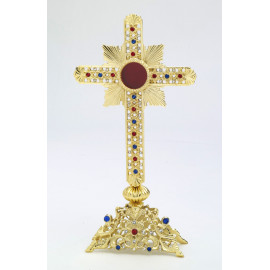
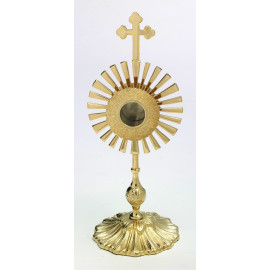
Reliquary, tabernacle and monstrance are often confused because all three are sacred vessels, all three can be made of gilded metal, and all three may stand in the sanctuary. They are not interchangeable. Each is made for a different content, and using the wrong vessel is not a matter of style — it is a liturgical mistake.
Here is the short version: a reliquary holds the relic of a saint; a tabernacle reserves the Blessed Sacrament; a monstrance exposes the Blessed Sacrament for adoration and Benediction.
Quick Comparison
| Vessel | What it holds | Typical use | Where it stands |
|---|---|---|---|
| Reliquary | A relic of a saint | Veneration in a church, chapel or home | Altar, side chapel, shrine, home oratory |
| Tabernacle | The reserved Blessed Sacrament | Reservation for the sick and for adoration | Fixed in the sanctuary, often on the altar or in a wall niche |
| Monstrance (ostensorium) | The Blessed Sacrament in a lunette | Eucharistic adoration and Benediction | Altar of exposition |
| Ciborium | Hosts for Communion | Distribution and reservation of Communion | Altar, then tabernacle |
| Pyx | A small number of hosts | Carrying Communion to the sick | Carried by the minister |
What a Reliquary Holds
A reliquary holds a relic: a fragment of a saint’s body, an item the saint owned or used, or an object touched to a first-class relic. The relic is normally sealed in a theca or capsule, and the reliquary is the vessel that presents it for veneration. Relics are honored, not worshipped; the Church venerates the saint and, through the saint, gives glory to God.
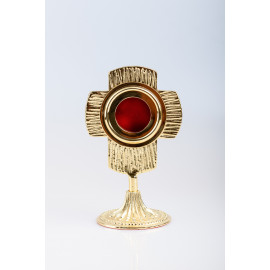
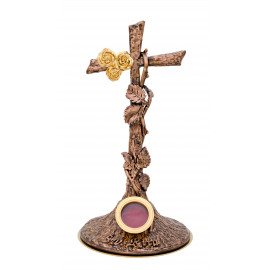
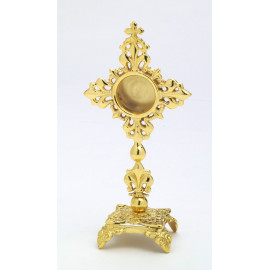
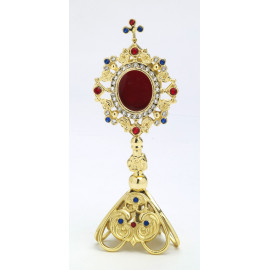
Reliquaries can be small capsules, cross-shaped vessels, gothic towers, chasses or large display pieces. They are often placed on a side altar or in a shrine, and they may be used in a home oratory. Canon 1237 requires that the altar of a church contain a relic, usually in a sealed cavity in the altar stone.
What a Tabernacle Holds
A tabernacle holds the reserved Blessed Sacrament — the consecrated hosts kept for Communion to the sick and for adoration. It is the heart of the sanctuary, and its design and placement are governed by liturgical norms. A tabernacle is not a reliquary, even when it is decorated with a relic or a reliquary-like medallion. Its content is the Eucharist, not a saint’s relic.
Because the Blessed Sacrament is reserved there, the tabernacle is normally fixed, secure and marked by a sanctuary lamp. It is not moved for a procession in the way a monstrance is.
What a Monstrance Holds
A monstrance — also called an ostensorium — holds the Blessed Sacrament in a lunette so that it can be seen by the faithful during Eucharistic adoration and Benediction. The sunburst or tower form is designed to frame the host and direct the gaze toward it. A monstrance is used at the altar of exposition and is returned to the tabernacle or the place of reservation after adoration.
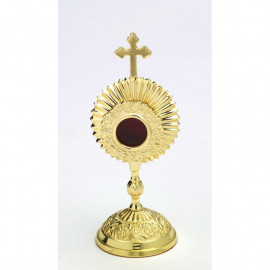
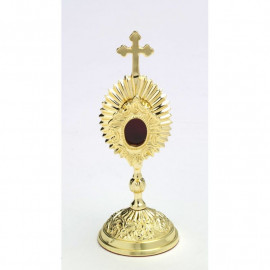
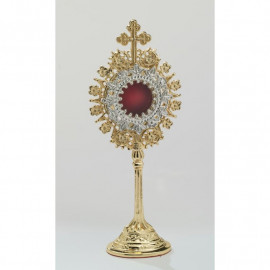
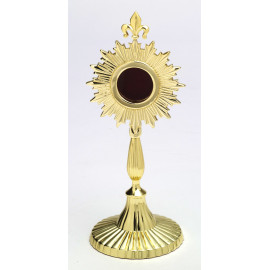
An ostensorium-style reliquary can look like a monstrance, but it is made for a relic. The resemblance is historical: both forms use a glass window and a decorated frame. The difference is the content and the blessing.
Ciborium and Pyx
A ciborium is a vessel for hosts, used for Communion and for reservation. A pyx is a small vessel for carrying Communion to the sick. Neither is a reliquary, although all three may be made of brass or gilded metal and may have a lid. If you are choosing a vessel for the Eucharist, start with a ciborium or a pyx, not a reliquary.
Why They Get Confused
The confusion is partly visual and partly historical. Medieval reliquaries were often shaped like shrines, towers or sunbursts, and the same goldsmiths made both reliquaries and Eucharistic vessels. In older inventories, a “reliquary tabernacle” may mean a tabernacle that also contains a relic, or a reliquary shaped like a tabernacle. The words overlap, but the liturgical purpose does not.
The practical rule is simple: look at what the vessel is made to hold. If it is a relic of a saint, it is a reliquary. If it is the Blessed Sacrament, it is a tabernacle, a ciborium, a pyx or a monstrance, depending on how the Sacrament is being used.
How to Choose
For a saint’s relic, choose a Catholic reliquary that fits the relic and the place of veneration. For the reservation of the Eucharist, choose a tabernacle. For adoration and Benediction, choose a monstrance. For Communion, choose a ciborium or a pyx.
If you are unsure, ask the diocesan liturgy office before you buy. A vessel that is beautiful but wrong for its content is not a bargain.
Frequently Asked Questions
Q: Is a reliquary the same as a tabernacle?
A: No. A reliquary holds the relic of a saint; a tabernacle reserves the Blessed Sacrament. They can look similar and may both be made of gilded metal, but they are made for different contents and are not interchangeable.
Q: Can a relic be kept in a tabernacle?
A: A relic may be placed in or near a tabernacle as part of the decoration or the history of a church, but the tabernacle’s purpose is the reservation of the Eucharist. A relic should normally be kept in a reliquary, and the Blessed Sacrament should not be stored in a reliquary.
Q: What is the difference between a monstrance and a reliquary?
A: A monstrance holds the Blessed Sacrament in a lunette for adoration and Benediction. A reliquary holds the relic of a saint. An ostensorium-style reliquary may look like a monstrance, but its content and purpose are different.
Q: What is an ostensorium?
A: Ostensorium is another word for a monstrance — the vessel used to expose the Blessed Sacrament. The word comes from the Latin ostendere, “to show.” Some reliquaries are described as ostensorium-style because they borrow the same sunburst or tower form.
Q: Which vessel is used for Benediction?
A: A monstrance is used for Benediction. The Blessed Sacrament is placed in the lunette, exposed for adoration, and used to bless the faithful. A reliquary is not used for Benediction.
Related Reading
Read What Is a Monstrance and How Is It Used in Eucharistic Adoration? and Monstrance vs. Tabernacle vs. Ciborium, or browse our Catholic reliquaries.

