


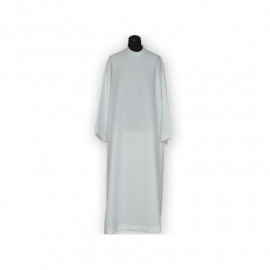

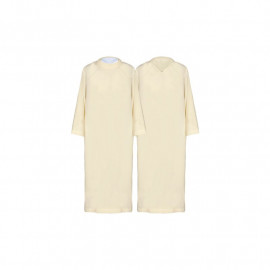
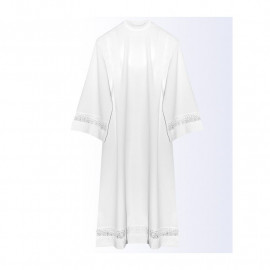
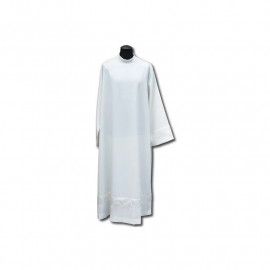
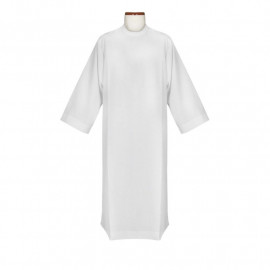

If you've ever been in a Catholic sacristy, you've seen them hanging side by side — the alb and the surplice. They look similar at first glance. Both are white, both are worn over other garments, and both are used in the liturgy. But they're not the same thing, and knowing the difference matters.
I remember the first time I helped set up for Mass and the sacristan asked me to lay out the albs. I grabbed the surplices instead. She smiled and said, "Close, but not quite." That was my first lesson — and I'm here to save you the same embarrassment.
What Is an Alb?
An alb is a long, white tunic that reaches from the neck to the ankles. It's the foundational liturgical garment — the base layer that priests, deacons, and altar servers wear under their other vestments. The word comes from the Latin "alba," meaning white.
The alb represents the garment of baptism — the white robe given to the newly baptized. It symbolizes purity and the new life in Christ. Every ordained minister wears an alb at Mass, and it's the one vestment that's truly universal across all ranks of the clergy.
Traditionally, the alb is made of linen and has long, fitted sleeves. Modern albs can be made of cotton, polyester, or blends, and some have shorter or wider sleeves for comfort. The key feature is the length — it should reach the ankles.
What Is a Surplice?
A surplice is a shorter, white tunic with wide sleeves, worn over a cassock or other garment. It's typically knee-length or mid-thigh length, not ankle-length like the alb. The word comes from the Latin "superpelliceum," meaning "over fur" — because it was originally worn over fur garments in cold European churches.
The surplice is worn by altar servers, lectors, acolytes, and sometimes by priests and deacons outside of Mass (for example, at Benediction or processions). It's not the primary vestment for Mass — that's the alb. But it's the standard garment for many lay liturgical ministers.
Key Differences at a Glance
| Feature | Alb | Surplice |
|---|---|---|
| Length | Ankle-length | Knee-length or mid-thigh |
| Sleeves | Long, fitted | Wide, flowing |
| Worn by | Priests, deacons, altar servers | Altar servers, lectors, acolytes |
| Worn over | Nothing (or an amice) | Cassock or clerical clothing |
| Used at Mass? | Yes — primary vestment | Usually not (alb is preferred) |
| Symbolism | Baptismal garment, purity | Service, ministry |
When Is Each Used?
The alb is worn at Mass by priests, deacons, and altar servers. It's the base garment under the chasuble (for priests) or dalmatic (for deacons). If you're serving at the altar, you should be wearing an alb — not a surplice.
The surplice is worn by altar servers, lectors, and acolytes when they're not serving at the altar. It's also worn by priests and deacons for non-Eucharistic liturgies like Benediction, processions, and the Liturgy of the Hours. In some parishes, servers wear surplices over cassocks instead of albs — this is a local custom, not the universal norm.
What About the Cincture?
Both the alb and the surplice are typically secured with a cincture — a rope or fabric belt tied around the waist. The cincture keeps the garment from dragging and adds a finished look. For albs, the cincture is usually white. For surplices, it can be white or match the liturgical color of the day.
How Do I Choose Between an Alb and a Surplice?
Here's the simple rule: if you're serving at the altar during Mass, wear an alb. If you're serving in a non-Eucharistic role (lector, usher, Benediction), a surplice is fine.
For altar servers, many parishes are switching from surplices to albs because the alb is the proper Mass vestment. It also looks more unified when servers, deacons, and priests are all wearing the same base garment.
What I Recommend
For parishes outfitting altar servers, I recommend investing in albs rather than surplices. They're more versatile (you can wear an alb at Mass and at Benediction, but not the other way around), and they create a more unified look at the altar.
If you already have surplices, there's no need to throw them out — they're perfectly fine for non-Mass functions. But for new purchases, albs are the way to go.
For priests and deacons, you should already have at least one alb. Make sure it fits properly — ankle-length, not dragging on the floor, with sleeves that don't cover your hands. A well-fitted alb makes all the difference in how you look and feel at the altar.
Frequently Asked Questions
Q: Can an altar server wear a surplice instead of an alb?
A: Yes, it's permitted, but the alb is preferred for Mass. The General Instruction of the Roman Missal (GIRM 336) states that the alb is the proper vestment for all ministers. Some parishes use surplices out of tradition or budget, but the alb is the norm.
Q: Do I need an amice with my alb?
A: Not necessarily. The amice is a rectangular cloth worn around the neck under the alb. It was originally used to cover street clothes, but modern albs are designed to be worn without one. If your alb has a high collar, you don't need an amice.
Q: How do I clean an alb?
A: Most modern albs can be machine-washed on a gentle cycle with cold water. Linen albs may need hand-washing or dry cleaning. Always check the care label. White albs can be bleached if needed, but avoid bleach on any embroidered or decorated areas.
Q: What size alb do I need?
A: Albs are sized by height. Measure from the base of the neck to the ankle, and choose the corresponding size. Most suppliers offer sizes from XS (under 5 feet) to XXL (over 6'2"). The alb should reach the ankle without dragging on the floor.
Conclusion
The alb and the surplice are both important liturgical garments, but they serve different purposes. The alb is the primary vestment for Mass — ankle-length, white, and universal. The surplice is shorter, worn over other garments, and used for non-Eucharistic functions. Knowing the difference helps you serve with confidence and dignity.
If you're looking for albs or surplices for your parish, browse our collection. We have options for priests, deacons, and altar servers in every size and budget.
Looking for the garment itself? Shop our altar server surplices — white Roman-cut cottas in 15 sizes, from $22.
Do Female Altar Servers Wear a Skirt or an Alb?
Both are used. A skirt is the base garment in a two-piece outfit and is worn with a surplice or cotta; an alb is a single white robe. Parishes that vest female servers in skirts can shop our altar server skirts in five liturgical colors and sizes 128–194 cm.