

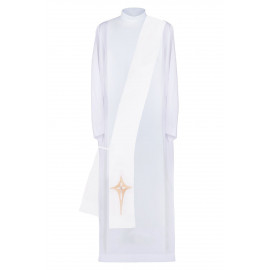
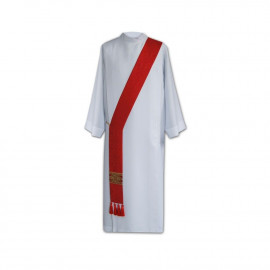


A deacon stole and a priest's stole are often the same width, fabric, and color. The difference is how they are worn: a deacon wears the stole diagonally from the left shoulder to the right hip, while a priest wears it crossed over the chest. That difference in position expresses two different orders of ministry.
The short answer
A deacon stole is a single band worn over the left shoulder and across the body to the right hip, under the dalmatic. A priest's stole is worn around the neck and crossed over the chest, under the chasuble. The deacon's stole is the sign of the diaconate; the priest's stole is the sign of the priesthood. Both are stoles, and both are conferred at ordination — but they are worn in the way proper to each order.
How a deacon wears the stole
The deacon puts the stole on over the alb. The band goes over the left shoulder, across the chest, and down to the right hip. At Mass the dalmatic is worn over the stole, so only the front and hip portions of the stole are visible. For Baptism, weddings, funerals, and Eucharistic services outside Mass, the deacon may wear the stole over the alb without the dalmatic. Some deacon stoles have a clasp that fastens the two ends at the front; others are worn loose.
How a priest wears the stole
The priest puts the stole around the neck and crosses the two ends over the chest. The stole is then covered by the chasuble at Mass. The crossed position is traditional in the Latin Church and distinguishes the priest's stole from the deacon's diagonal stole. A priest may also wear the stole outside Mass for confessions, blessings, and processions.
Why the difference exists
The stole is the vestment that marks Holy Orders. In the Latin Catholic tradition it is conferred at the ordination of a deacon and again at the ordination of a priest. The way it is worn shows the order of the minister: the deacon's diagonal stole points to his ministry of service, while the priest's crossed stole points to his role as celebrant. The difference is not a matter of fashion; it is a liturgical sign.
Can a deacon wear a priest's stole?
No. A deacon wears the stole in the diaconal manner — diagonally, under the dalmatic. A deacon does not wear the priest's crossed stole, and a priest does not wear the deacon's diagonal stole. If you are sacristan or vestment coordinator, keep the two types separate and label them by order.
Colors, fabrics, and length
Both deacon and priest stoles follow the liturgical colors: white or gold for Christmas, Easter, and solemn feasts; red for Pentecost, Good Friday, and martyrs; green for Ordinary Time; purple for Advent and Lent; rose for Gaudete and Laetare Sunday; black where customary for funerals. Deacon stoles are often made in jacquard, damask, brocade, or wrinkle-resistant cloth and embroidered with a cross, IHS, TAU, or Jerusalem cross. The standard length in our collection is 130 cm (51.2 in) with a 12 cm (4.7 in) width; two models are 13.5 cm wide.
Frequently asked questions
Q: Is a deacon stole the same as a priest stole?
A: No. They may look similar, but the deacon stole is worn diagonally and the priest's stole is crossed over the chest. The deacon's stole is worn under the dalmatic; the priest's stole is worn under the chasuble.
Q: Why is the deacon stole worn diagonally?
A: The diagonal position distinguishes the deacon from the priest and expresses the deacon's ministry of service. The band runs from the left shoulder to the right hip.
Q: Does a deacon wear a stole at every Mass?
A: A deacon who is assisting at Mass wears the stole under the dalmatic. The stole is also worn for Baptism, weddings, funerals, and other liturgical celebrations led by a deacon.
Q: Can a deacon wear a stole without a dalmatic?
A: Yes, for services outside Mass. The dalmatic is the deacon's outer vestment at Mass; for other celebrations the stole may be worn over the alb without it.
Q: What color stole should a deacon wear?
A: The color follows the liturgical calendar, not personal preference: white or gold for feasts, red for Pentecost and martyrs, green for Ordinary Time, purple for Advent and Lent, rose for Gaudete and Laetare Sunday, black where customary for funerals.
