

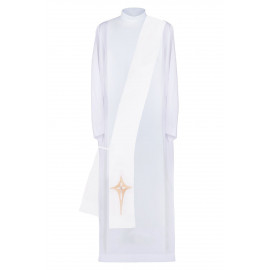
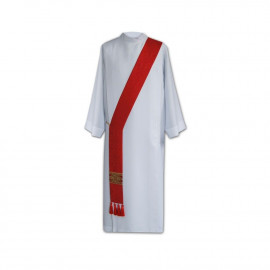


The deacon stole is more than a strip of cloth. In the Latin Catholic tradition it is the vestment that marks Holy Orders, and for the deacon it is a sign of service — the Greek word diakonia lies behind the word deacon. The diagonal position, the color, and the moment of ordination all carry meaning.
The word deacon means servant
The English word deacon comes from the Greek diakonos, a servant or minister. The New Testament uses the word for those who serve at table and in the community. The deacon's stole expresses that identity: the man who wears it is ordained to serve the Church, the liturgy, and the poor. The stole is not a badge of rank but a sign of service.
The stole as a sign of ordination
In the Latin Catholic Church the stole is the vestment that marks recipients of Holy Orders. It is conferred at the ordination of a deacon, and the newly ordained deacon wears it for the first time at the ordination Mass. The same band is worn by priests and bishops, but in the way proper to their order. For the deacon, the stole is a personal reminder of the promise made on the day of ordination.
Why the deacon stole is worn diagonally
The diagonal position distinguishes the deacon from the priest. A priest wears the stole crossed over the chest; a deacon wears it over the left shoulder and down to the right hip. The diagonal line is a visual sign of the diaconate — a ministry that stands at the altar but is oriented toward service. The stole is worn under the dalmatic, so the diagonal is visible at the front and at the hip.
Service and the poor
The diaconate has always been linked to charity. In the early Church deacons distributed the gifts of the community and cared for the poor. The stole keeps that connection visible: the deacon who stands at the altar is also the deacon who serves the people. The color of the stole follows the liturgical season, but the meaning of service remains constant.
A short history
The stole developed from a practical garment into a liturgical vestment. By the early Middle Ages it was worn by deacons, priests, and bishops as a sign of office. The diagonal position for deacons and the crossed position for priests became the Western custom. Today the deacon stole is made in the liturgical colors, often in jacquard, damask, or brocade, and embroidered with a cross, IHS, TAU, or Jerusalem cross. The standard length in our collection is 130 cm (51.2 in) and the width is 12 cm (4.7 in).
Frequently asked questions
Q: What does the deacon stole symbolize?
A: It symbolizes the order of deacon and the ministry of service (diakonia). It is conferred at ordination and marks the deacon's role in the liturgy.
Q: Why is the deacon stole worn diagonally?
A: The diagonal position distinguishes the deacon from the priest and expresses the deacon's ministry of service. The band runs from the left shoulder to the right hip.
Q: Is the deacon stole a sign of ordination?
A: Yes. In the Latin Catholic tradition the stole is the vestment that marks Holy Orders and is conferred at the ordination of a deacon.
Q: What does the word deacon mean?
A: Deacon comes from the Greek diakonos, meaning servant or minister. The stole expresses that identity of service.
Q: Does the color of the deacon stole have a meaning?
A: The color follows the liturgical season: white or gold for feasts, red for Pentecost and martyrs, green for Ordinary Time, purple for Advent and Lent, rose for Gaudete and Laetare Sunday, black where customary for funerals.

