

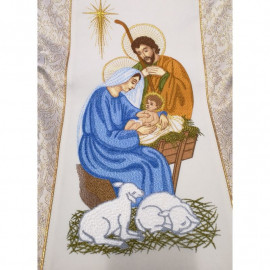


What Is a Holy Family Chasuble?
A Holy Family chasuble is a liturgical vestment embroidered with Jesus, Mary, and Joseph. It is a type of Christmas chasuble, worn for Masses of the Nativity and for other celebrations of the Holy Family. The image usually appears on the front band or the central orphrey, where it remains visible during the entrance procession and the Liturgy of the Eucharist.
The Holy Family is not a decorative extra. The feast of Christmas celebrates the Incarnation — the Son of God taking flesh in a human family. The embroidered image makes that mystery visible at the altar. For a parish, it is one of the safest traditional choices for a first Christmas vestment because it is immediately legible to the congregation and fits both solemn and simple liturgies.
Why the Holy Family Belongs to Christmas
The Gospel of Luke places the birth of Jesus in Bethlehem, with Mary and Joseph at the center of the story. The family is not a background detail: Joseph is named as the legal father, Mary as the mother, and the child as the promised Messiah. Christian art has shown the three together since the early centuries, and the feast of the Holy Family later gave the image its own liturgical day.
On a Christmas chasuble, the Holy Family usually sits within a wider Nativity scene: the stable, the manger, the star, and sometimes the ox and the ass. The composition can be simple — three figures in a medallion — or more elaborate, with gold thread, a brocade background, and a border of floral or geometric ornament. The best designs keep the faces and the child readable from the nave, not only in a close-up photograph.
What the Embroidery Usually Shows
The most common composition places the child Jesus at the center, Mary on one side and Joseph on the other. Mary is usually veiled; Joseph may hold a staff or a lily. The stable and the manger frame the group, and the Star of Bethlehem may appear above them. In some designs the Holy Family is shown in a domestic scene rather than at the crib, which emphasizes the hidden life of Nazareth rather than the birth itself.
Gold thread is traditional because it catches the light of candles and stained glass. On a white or ecru ground, gold embroidery reads as a subtle glow; on a gold brocade, the figure may be outlined in a darker thread so that it does not disappear into the background. The quality of the embroidery matters more than the number of stitches: the faces should be clear, the hands should be legible, and the border should not compete with the central image.
Roman, Gothic, and Semi-Gothic Cuts
A Holy Family chasuble can be cut in several styles. The Roman cut is shorter and more fitted, with a strong central ornament; it is the classic choice for a solemn, formal sanctuary. The Gothic cut is wider and falls in a fuller curve, which gives more room for a large embroidered scene and is often more comfortable for a priest who moves during the liturgy. The semi-Gothic cut sits between the two: a little more room than the Roman, a little less volume than the full Gothic.
The cut should follow the architecture and the sacristy's existing vestments. A Roman set in a church with a wide Gothic chancel can look undersized; a full Gothic in a small chapel can overwhelm the space. If you are buying a single chasuble, the semi-Gothic is the most adaptable, but the Roman remains the most formal. Our Roman chasubles collection shows the fitted option, while the Christmas chasubles collection includes several cuts and fabrics.
Fabrics and Colors
White and gold are the liturgical colors of Christmas. White signifies purity, joy, and the light of Christ; gold signifies royalty and the solemnity of the Nativity. A Holy Family chasuble is most often white, ecru, or gold, but some designs are available in other liturgical colors for different feasts. Check the product description before assuming a color is available.
The fabric affects both the drape and the care. Polyester is lightweight and practical; brocade is stiffer and more ornate; wool blends drape well and are comfortable in cool churches; silk and viscose blends have a soft sheen but need more careful handling. In our Christmas collection, the fabrics include Italian tropical, Honeycomb-Favi, Papal Gold, Satinowool, and a viscose/linen/silk blend. Each product page lists the exact composition and the recommended care.
How to Choose a Holy Family Chasuble
Start with the liturgical color and the cut, then check the measurements and the stole. A chasuble that is too short or too narrow will restrict the priest's arms; one that is too long will trip him on the steps. The standard measurements in our collection are 125–130 cm in length and 158–160 cm in width, with the newer Urbanowicz models at 128 cm from shoulder to hem. Confirm the exact figures on the product page rather than relying on a general size label.
Next, check what is included. Most chasubles in the collection list a matching inner stole; the two Satinowool models (10U and 12U) are described without one. If you need a complete set, compare the chasuble with the Christmas stoles and the gold chasubles before you order. Finally, set a budget that includes care and storage: a vestment that is dry-cleaned and stored correctly will last for decades.
Care and Storage
Treat an embroidered Holy Family chasuble like a sacred textile. Spot-clean promptly with a soft cloth and cool water; do not rub. Dry cleaning is the safest option for brocade, gold thread, and dense embroidery. Store the vestment on a padded hanger in a breathable garment bag, away from direct sunlight and damp, and avoid folding the embroidered panel. For a full storage guide, see How to Store Liturgical Vestments.
Frequently Asked Questions
Q: Is a Holy Family chasuble only for Christmas?
A: The Holy Family is most closely associated with Christmas, but it can also be worn on the feast of the Holy Family and other occasions when the mystery of the Incarnation is celebrated. Check the liturgical calendar and diocesan norms for the specific day.
Q: What color is a Holy Family chasuble?
A: Most are white, ecru, or gold, because those are the Christmas colors. Some designs are available in other liturgical colors; the product description lists the available options.
Q: Does a Holy Family chasuble include a stole?
A: Most chasubles in our Christmas collection list a matching inner stole. The two Satinowool models (10U and 12U) are described without one, so check the product page before ordering.
Q: What is the difference between a Holy Family chasuble and a Nativity chasuble?
A: A Holy Family chasuble focuses on Jesus, Mary, and Joseph. A Nativity chasuble may show the wider scene: the stable, the manger, the star, the Magi, and the shepherds. The two categories overlap, and many Christmas chasubles combine both.
Q: How much does a Holy Family chasuble cost?
A: In our Christmas collection, chasubles range from $206 to $1,089. The price depends on the fabric, the amount of embroidery, and the construction. See the chasuble price guide for a broader comparison.
Q: How should I store a Holy Family chasuble?
A: Use a padded hanger and a breathable garment bag, keep it away from sunlight and damp, and avoid folding the embroidered image. Dry cleaning is safest for brocade and gold thread.
Related: For the full Christmas range, see embroidered Christmas chasubles. For the wider season, read Christmas vestment colors.


