

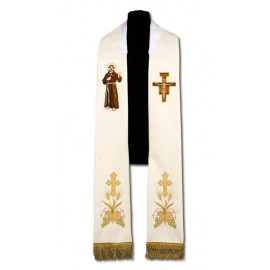


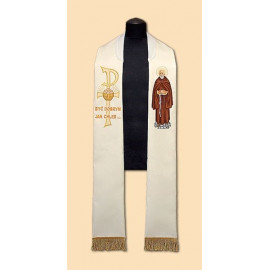
Choosing a patron saint stole comes down to six decisions: the saint, the liturgical color, the cut, the technique, the size and the budget. The order matters. The saint and the color are the two decisions that cannot be corrected later; the rest can be adjusted.
1. Start With the Saint
The first question is whose image the stole should carry. For a priest, the natural choice is his own patron saint or the patron of the parish where he serves. For a parish, it is the titular saint of the church. For a gift, it is the patron of the priest who will wear it.
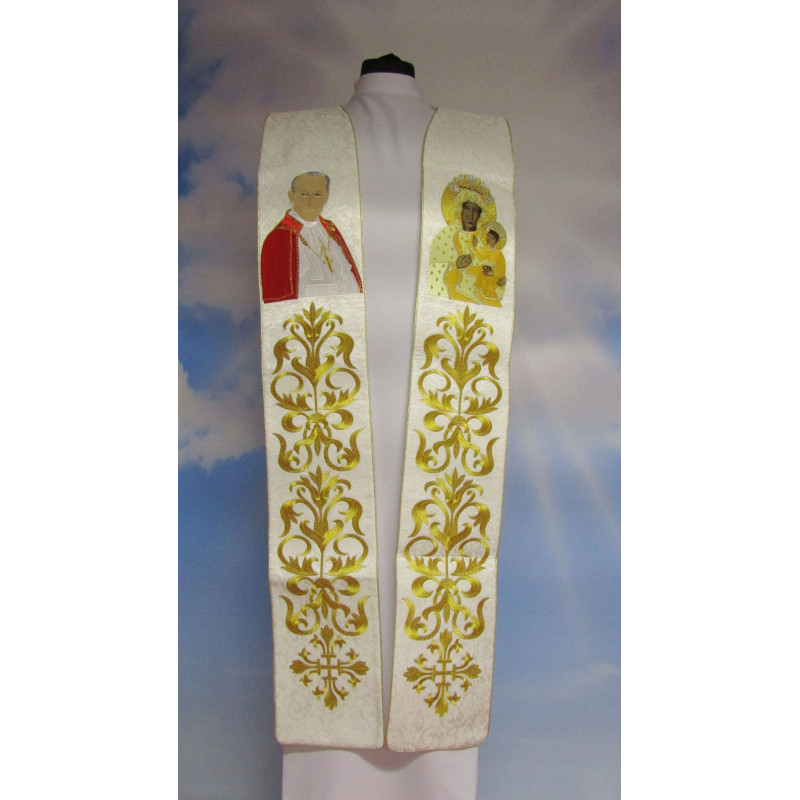
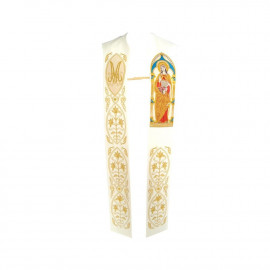
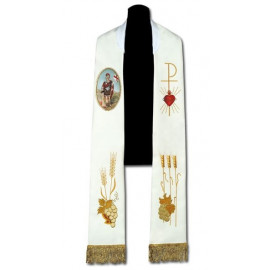
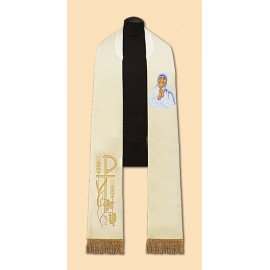
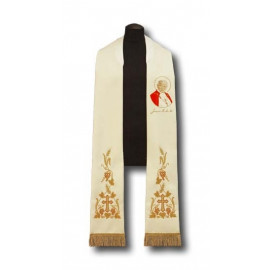
If the patron is not known, choose a saint with a broad devotion: St. Joseph, the patron of the universal Church; St. Francis of Assisi; St. Anthony of Padua; St. John Paul II; or St. Michael the Archangel. Our stoles with saints include these and many others.
2. Match the Liturgical Color
The color of the stole follows the liturgical color of the day. White and gold are used for solemnities, for feasts of saints who are not martyrs, and for Christmas and Easter. Red is used for Pentecost, the Passion, martyrs and the Holy Spirit. Green is worn in Ordinary Time, violet in Advent and Lent, rose on Gaudete and Laetare Sunday, and black may be used for funerals where local custom permits.
If the stole is a gift, choose a color the priest will wear often: white or green are the safest. If the stole is for a specific feast, choose the color of that feast first and then the saint whose image fits.
3. Choose the Cut: Roman or Gothic
The Roman stole is narrower and is crossed on the chest. The Gothic stole is wider and hangs straight. Both are valid. The choice depends on the style of the chasuble and on the preference of the priest. Our Roman stoles show the narrower, crossed style.
4. Decide Between Embroidery and Print
Most stoles with saints are embroidered, often with metallic threads. Selected designs use a printed image, which can reproduce a detailed face at a lower cost. Each product page states the technique for that stole. Embroidery is more durable and more textured; a print can be sharper and less expensive.
5. Check the Measurements
Our stoles are listed with a length between 116 cm and 156 cm and a width between 15.5 cm and 18 cm. Some listings give the total length; others give the arm's length, measured from the neck to the end of one side. For a crossed Roman stole, the arm's length is the more useful measurement. Always check the product page before ordering.
6. Set a Budget
Stoles with saints start at $100; most designs are between $127 and $204. The price depends on the density of the embroidery, the use of metallic threads, the fabric, the number of sides and the finish, such as tassels or a double-sided construction. A parish buying several stoles should ask for a quote rather than order one at a time.
Frequently Asked Questions
Q: How do I choose a patron saint stole?
A: Choose the saint first, then the liturgical color, then the cut and the technique. Check the measurements and set a budget last. The saint and the color are the decisions that cannot be changed later.
Q: Which liturgical color should I choose?
A: Match the color of the day when the stole is for a specific feast. For a gift, choose white or green, which are worn most often. A stole with a martyr is normally worn in red.
Q: Should I choose embroidery or a printed image?
A: Embroidery is more durable and more textured; a printed image can be sharper and less expensive. Each product page states which technique is used, so the choice is explicit.
Q: What size stole should I order?
A: Most priest stoles are between 130 cm and 150 cm long and about 16 cm wide. Check whether the listing gives the total length or the arm's length, and compare it with a stole the priest already uses.
Q: Can I order a custom patron saint stole?
A: Yes. Contact us with the name of the patron, the color, the number of stoles and the date needed. We confirm the design, the price and the lead time individually.
Related Reading
See the full collection of liturgical stoles, the Marian stoles and the deacon stoles. For the difference between the Roman and Gothic cut, read deacon stole vs priest stole.