



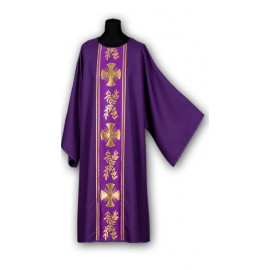
Vesting for Mass is not just dressing — it is a small liturgy of its own, and the order matters. For a deacon, the dalmatic is the last garment to go on and the first to come off. Here is the full vesting order, step by step, with the details that trip people up.
The Deacon's Vesting Order
- Wash your hands.
- Alb — the white tunic worn by all ministers.
- Cincture — the cord that gathers the alb at the waist.
- Stole — worn diagonally, crossed over the left shoulder.
- Dalmatic — over everything, in the colour of the day.
The principle is simple: vestments go on in order of proximity to the body, from innermost to outermost — so the dalmatic always covers the stole.
Step 1: The Alb
The alb is the common garment of all ordained and instituted ministers. Put it on first, over street clothes or the cassock, and make sure it hangs evenly — a twisted alb will pull all the other vestments off-centre.
Step 2: The Cincture
The cincture is the cord that gathers the alb. Tie it at the waist, slightly to the side, and check that the alb falls evenly above and below. Our liturgical cinctures are available in matching colours.
Step 3: The Deacon Stole
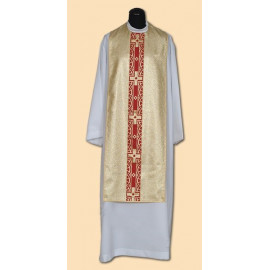
The stole is the sign of the deacon's order, and for a deacon it is worn diagonally across the body, from the left shoulder to the right hip — the mirror image of the priest's stole. Check that it lies flat, with the embroidered ends hanging level. A stole worn over the dalmatic instead of under it is the most common vesting mistake in parish sacristies — it belongs underneath. Browse our deacon stoles.
Step 4: The Dalmatic
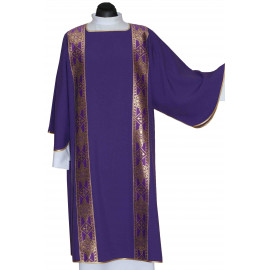
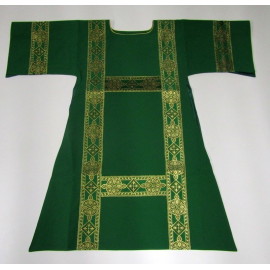
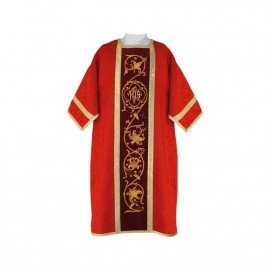
Finally the dalmatic goes on over the head, over the alb and the stole. Straighten the sleeves and let the garment settle on the shoulders; the side openings should fall naturally at the hips. Check the length — a dalmatic should reach roughly to the knees. Our dalmatics measure 123–127 cm in length; lining and size adjustment are available on request.
Common Mistakes to Avoid
- Stole over the dalmatic. The stole goes under the dalmatic, crossed over the left shoulder.
- Wrong colour. Match the deacon's dalmatic to the priest's chasuble — the colour of the liturgical day.
- Twisted alb. Check the alb before adding layers; fixing it later means starting over.
- Forgetting the stole entirely. If no dalmatic is available, the alb and stole are still required.
Before and After Mass
Before vesting, lay the vestments out in order; after Mass, remove them in reverse order (dalmatic first), check for damage or wax stains, and store them on wide hangers or folded flat with tissue paper. Our guide to storing liturgical vestments covers the details.
Frequently Asked Questions
Q: Does the stole go over or under the dalmatic?
A: Under. The deacon's stole is crossed over the left shoulder and the dalmatic is worn over it.
Q: Which shoulder does a deacon's stole cross?
A: Over the left shoulder, crossing to the right hip — the opposite of the priest's stole.
Q: Can a deacon wear a dalmatic without a stole?
A: The stole is the sign of the order, so it should always be worn at Mass. If no dalmatic is available, the alb and stole are the minimum vesting.
Q: How should a dalmatic fit?
A: It should reach roughly to the knees, allow free arm movement, and hang evenly from the shoulders. Our models run 123–127 cm in length, with size adjustment on request.
Q: Can you wear a dalmatic outside of Mass?
A: Yes — at processions, Benediction, baptisms, weddings and funerals where the deacon has a formal role. Outside liturgical functions, deacons wear clerical dress.
