


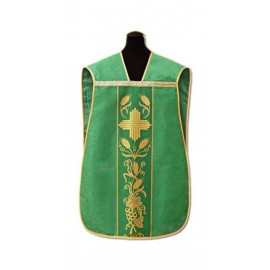

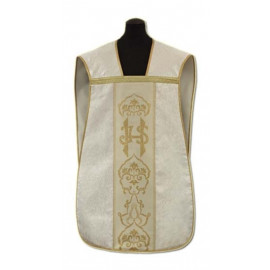
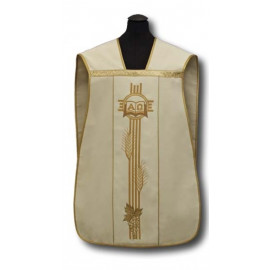
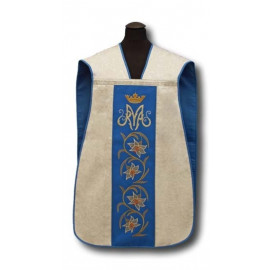
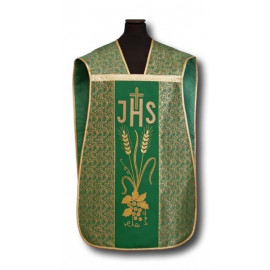
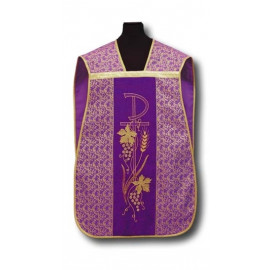
Almost every chasuble question ends at the same fork in the road: Roman or Gothic? Both are legitimate Catholic vestments, both are worn at Mass, and both come in every liturgical color — but they are cut very differently and each suits particular celebrations.
The Short Answer
The Roman chasuble is tailored and close-fitting, with a shorter, narrower front and a cross-shaped back — the classic vestment of the Traditional Latin Mass. The Gothic chasuble is wide and flowing, with a full-length front panel and a broad yoke — the everyday vestment of most modern parishes.
Cut and Shape Compared
- Roman: short, narrow front; fitted shoulders; back shaped into a cross or fiddleback; arms completely free; often sold with maniple, burse, and chalice veil.
- Gothic: full-length front and back panels; broad shoulders; heavy drape that may need to be gathered over the arms; frequently worn with just the stole.
- Semi-Gothic: the middle ground — a full front panel with a lighter, more tailored drape. See our semi-Gothic chasubles.
A Little History
The chasuble began as a large conical cloak — in Latin, casula, "little house." Over the centuries it was gradually cut back: the Roman style emerged in Rome and was progressively tailored until, by the 18th–19th century, the fiddleback had reduced it to a narrow, richly embroidered vestment. The Gothic revival of the 19th and 20th centuries restored the older, fuller shape, which the liturgical reform made standard in most parishes.
When Each Is Worn
In practice, most Roman chasubles are worn at the Traditional Latin Mass and at solemn celebrations where the priest prefers the traditional silhouette. Gothic chasubles are worn at Novus Ordo Masses, concelebrations, and wherever a fuller, more forgiving drape is preferred. Neither choice is a statement about doctrine — both are proper Mass vestments.
Which Should You Buy?
Ask three questions: Which form of the Mass does the priest usually celebrate? Does he prefer complete arm freedom (Roman) or a fuller drape (Gothic)? And are you building a single vestment or a traditional set with maniple, burse, and chalice veil (which pairs naturally with the Roman cut)?
If you need both, many parishes keep a Roman set for the Latin Mass and Gothic vestments for daily Mass. Browse the full range in our embroidered chasubles category or go straight to the Roman chasubles, and read our complete choosing guide for a step-by-step checklist.
Q: What is the difference between a Roman chasuble and a Gothic chasuble?
A: The Roman cut is fitted with a short front and cross-shaped back; the Gothic cut is wide and flowing with a full-length front panel.
Q: Which chasuble is more traditional?
A: Both descend from the same ancient garment. The Roman (fiddleback) cut dominated from the 18th century until the 20th; the Gothic restores the fuller medieval shape.
Q: Can a Gothic chasuble be worn at the Latin Mass?
A: Yes — any proper chasuble may be worn; the Roman cut is simply the customary choice for the Traditional Latin Mass.
Q: Can a Roman chasuble be worn at a Novus Ordo Mass?
A: Yes. The chasuble is the proper vestment of the priest celebrant at any Mass, whatever its cut.
Q: What is a semi-Gothic chasuble?
A: A middle style between Roman and Gothic — full-length front with a narrower, lighter drape.
Q: Which cut is more comfortable for concelebration?
A: The Gothic, because its fuller drape moves with the arms; concelebrants often wear only the stole when chasubles are limited.
