
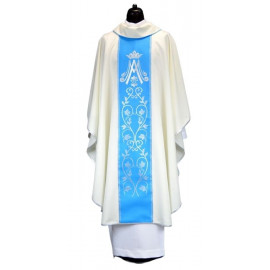
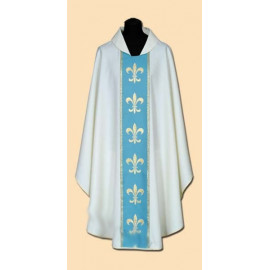
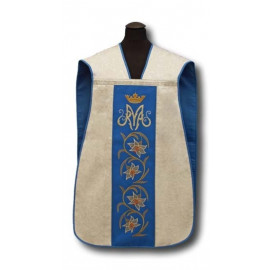
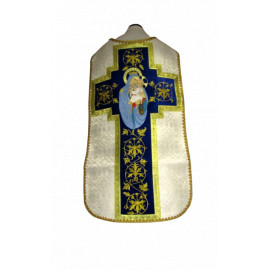
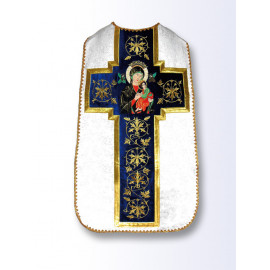
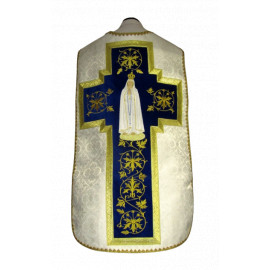
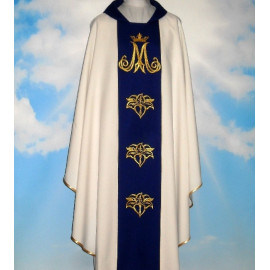
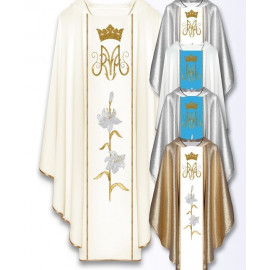
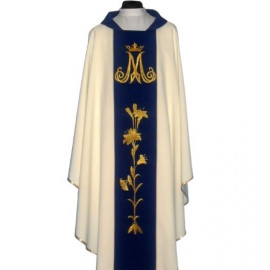

A Marian chasuble is the outer vestment a priest wears at Mass when the celebration is offered in honour of the Blessed Virgin Mary. It is an ordinary chasuble — the outermost garment over alb and stole — distinguished by its decoration: embroidery of Our Lady herself, or of her symbols, worked on the front and back of the vestment. Everything else about it follows the normal rules for Mass vestments: it is worn with a stole, it comes in the liturgical colours, and its cut follows the local custom of the church where it is used.
What makes the Marian chasuble interesting is that it combines two things the Church keeps distinct: the liturgy's colour code, which assigns seasons and feasts their colours, and the freedom of sacred art, which clothes those colours in the imagery of devotion. This guide explains both halves — what a Marian chasuble is, how to read its symbols, and how to choose one for a parish sacristy.
What Makes a Chasuble "Marian"?
The word "Marian" describes the decoration, not the shape. A chasuble is Marian because it carries Marian imagery: a portrait of the Virgin under one of her titles, the Immaculate Heart, a crowned monogram, or a band of liturgical embroidery with roses, lilies or stars. The same chasuble could equally be described as Gothic, semi-Gothic or Roman — those words describe the cut — and a Marian chasuble is usually one of those three cuts with Marian embroidery applied to it.
Because the imagery is applied to the vestment rather than printed on it, a Marian chasuble is normally hand-embroidered: the motif is outlined and then filled, in thread or in gold-toned metal thread, so that it reads clearly from the nave as well as close up. On our own Marian chasubles, every model is hand-finished in Poland by embroiderers working in the traditional centres of ecclesiastical textile art.
The Symbols You Will See
Marian embroidery is a small visual catechism. The most common symbols, and what they mean:
- The Immaculate Heart of Mary — the heart pierced by a sword, encircled by roses: Our Lady's love and her share in the Passion of her Son.
- The Marian monogram — "AM" for Ave Maria, or an "M" under a cross, one of the oldest Marian signs in Christian art.
- Roses and lilies — the lily for purity, the rose for the "Mystic Rose" of the Litany of Loreto.
- The crown of twelve stars — from the woman clothed with the sun in the Book of Revelation; a crown or crowned monogram also proclaims Mary's queenship.
- The portrait — Our Lady of Guadalupe, Fatima, Perpetual Help, Lourdes, Częstochowa or another title, embroidered on the front and often repeated on the back.
None of these symbols is merely decorative. Each one condenses a doctrine — the Immaculate Conception, the Assumption, the queenship of Mary — into an image a congregation can read from across the church.
The Colours of a Marian Chasuble
Marian chasubles are most often blue, the colour Western devotion gives to Our Lady, or white and gold for her great solemnities. Ecru and ivory suit the quieter memorials. Strictly speaking, blue is not one of the standard liturgical colours of the Roman Rite; by a long-standing privilege it is worn in Spain and at certain Marian sanctuaries, and elsewhere a blue Marian chasuble belongs to the devotional life of the parish — May and October devotions, Saturday Masses of Our Lady, pilgrimages. On a Marian feast that falls inside Advent or Lent, the seasonal violet or rose is worn instead. You can read more in our guide to the meaning of blue vestments.
When a Marian Chasuble Is Worn
A Marian chasuble is worn for Masses in honour of the Mother of God: her solemnities and feasts — the Immaculate Conception (8 December), the Assumption (15 August), Our Lady of Guadalupe (12 December), Our Lady of Fatima (13 May), Our Lady of the Rosary (7 October) — her memorials, Saturday votive Masses of Our Lady, May and October devotions, and parish or wedding Masses offered under her patronage. Our guide to when to wear Marian vestments lists the full calendar.
Which Cut: Gothic, Semi-Gothic or Roman
The three cuts used today each suit a different church. The Gothic chasuble is full and rounded, with embroidery that is highly visible from a distance. The semi-Gothic is a narrower version of the same cut — lighter to wear through a long Mass. The Roman or fiddleback chasuble is shorter, with decorated front and back panels framing the image of Our Lady. A Marian chasuble can be made in any of the three; most of our models are available in more than one.
What a Marian Chasuble Costs
At Best Catholic Shop, Marian chasubles run from $139 to $600. Gothic and semi-Gothic models with embroidered bands start at $139–$161; fuller models with matching sets sit around $250–$300; the large Roman chasubles with a portrait of Our Lady embroidered front and back reach $443–$600. Every price includes the matching stole. For the wider market context, see our guide to chasuble price ranges.
Frequently Asked Questions
Q: What is a Marian chasuble?
A: A Marian chasuble is a Mass vestment decorated with embroidery of the Blessed Virgin Mary or her symbols — the Immaculate Heart, a Marian monogram, roses, lilies, stars, or a portrait of Our Lady under one of her titles. It is worn by a priest or bishop for Masses offered in Mary's honour.
Q: What is the difference between a Marian chasuble and a Gothic chasuble?
A: "Marian" describes the decoration and "Gothic" the cut. A Marian chasuble can be Gothic, semi-Gothic or Roman — the Marian imagery is applied to whichever shape the parish prefers.
Q: What colour is a Marian chasuble?
A: Most often blue, the colour of Marian devotion, or white and gold for her solemnities; ecru and ivory are used for quieter feasts. Blue is worn by privilege in Spain and at Marian sanctuaries, and devotionally elsewhere.
Q: When can a priest wear a Marian chasuble?
A: On any day the Mass is offered in honour of Our Lady: her feasts and memorials, Saturday votive Masses, May and October devotions, and parish celebrations under her patronage. On penitential days the seasonal colour normally takes precedence.
Q: Does a Marian chasuble come with a stole?
A: Yes — every Marian chasuble in our collection is supplied with a matching stole in the same fabric and embroidery, and matching chalice veils and burses can be added in the same Marian fabric.
Browse the full collection of 92 hand-embroidered Marian chasubles — in blue, white, gold and ecru, in every cut, from $139.
