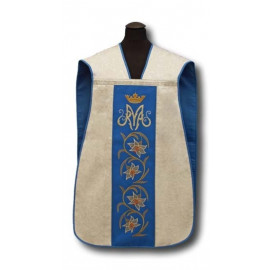
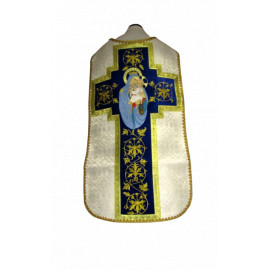
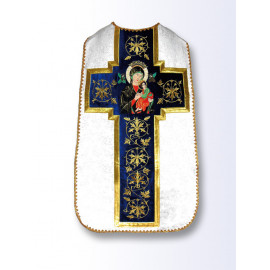
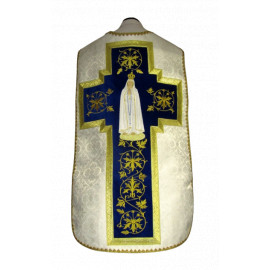
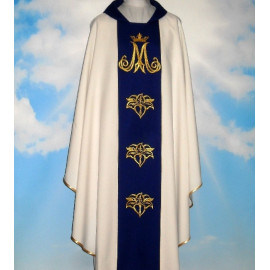
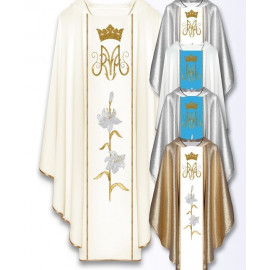
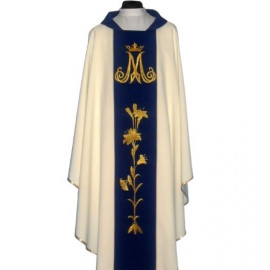

Marian vestments are worn on the days the Church keeps for the Mother of God — and knowing those days is most of the art of using them well. A parish sacristy that keeps one or two Marian sets will bring them out for the great solemnities of the Virgin; a sacristy that keeps several will also dress the Saturday votive Masses, the May and October devotions, and the parish's own patronal feast under Our Lady's title. This guide sets out the Marian days of the year, the colours that go with them, and the vestments that complete the set.
The Marian Days of the Liturgical Year
These are the feasts on which a Marian chasuble is most often used, with the colour the liturgy assigns:
| Feast | Date | Colour |
|---|---|---|
| Solemnity of Mary, Mother of God | 1 January | White |
| Our Lady of Lourdes | 11 February | White |
| Annunciation of the Lord | 25 March | White |
| Our Lady of Fatima | 13 May | White |
| Visitation of the Blessed Virgin Mary | 31 May | White |
| Immaculate Heart of Mary | Saturday after the Sacred Heart | White |
| Our Lady of Mount Carmel | 16 July | White |
| Assumption of the Blessed Virgin Mary | 15 August | White |
| Queenship of the Blessed Virgin Mary | 22 August | White |
| Nativity of the Blessed Virgin Mary | 8 September | White |
| Our Lady of the Rosary | 7 October | White |
| Presentation of the Blessed Virgin Mary | 21 November | White |
| Immaculate Conception | 8 December | White (blue by privilege) |
| Our Lady of Guadalupe | 12 December | White |
White is the festive colour of Marian feasts; on the Immaculate Conception, Spain and certain Marian sanctuaries wear blue by a long-standing privilege. Outside the great feasts, any day on which Mass is offered in honour of Our Lady is a day for Marian vestments — which in practice means the Saturdays of the year and the devotional seasons of May and October.
Saturdays and Votive Masses of Our Lady
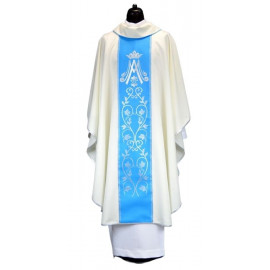
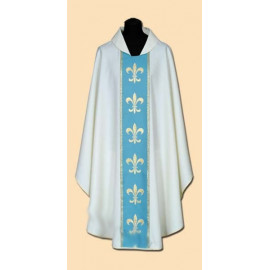
Saturday has been kept as the day of the Blessed Virgin since the early Middle Ages, and the Roman Missal provides a full set of votive Masses of Our Lady for Saturdays in Ordinary Time. In parishes where the Saturday morning Mass is offered with the people, a Marian chasuble is the natural vestment — with the Marian chasuble matched to a Marian stole.
May and October Devotions
May is the month of Our Lady and October the month of the Rosary. In many parishes the evening devotions of these months — Benediction, the Rosary, the litany of Loreto — are the year's most visible Marian liturgies. Where a Mass accompanies the devotions, the Marian vestments come out for the whole season rather than for a single day.
Marian Vestments Beyond the Chasuble
"Marian vestments" is the wider family. The chasuble is the central piece; around it a complete Marian set can include:
- the Marian stole, worn under the chasuble and seen at the anointing and in processions;
- the chalice veil and burse in the same fabric, completing the set at the altar;
- and where the church uses one, a cope in the same Marian embroidery for processions and Benediction.
Keeping the set in one fabric and one motif is the old sacristy rule: the vestments of a celebration should read as one.
Which Colour for Which Feast
For most Marian feasts the answer is white or gold, following the Missal. Blue — the colour of Marian devotion rather than of the liturgical code — belongs to devotional use, to shrines and to the Spanish privilege. Ecru and ivory are a quietly festive alternative for memorials and for churches whose altar linen sits in the cream tones. Our guide to the meaning of blue vestments explains the difference.
Frequently Asked Questions
Q: When do you wear a Marian chasuble?
A: On the feasts and memorials of the Blessed Virgin Mary listed above, on Saturdays in Ordinary Time, during the May and October devotions, and for any parish celebration offered under Our Lady's patronage. On Marian memorials that fall in Advent or Lent, the seasonal violet or rose is worn instead.
Q: What colour vestments for a Marian feast?
A: White or gold, following the Missal — for example on the Immaculate Conception, the Assumption and Our Lady of Guadalupe. Blue is worn by privilege in Spain and at Marian sanctuaries, and devotionally elsewhere.
Q: Are Marian vestments the same as Marian chasubles?
A: Not quite — "Marian vestments" is the whole set: the chasuble, the stole, and where used the chalice veil, burse and cope embroidered with the same Marian imagery. The Marian chasuble is the central piece and the others are made to match it.
Q: Can a deacon or bishop wear Marian vestments?
A: A bishop celebrating a Marian Mass wears the Marian chasuble and may add a mitre and crozier; a deacon wears his own dalmatic and stole, which can be made in the same Marian fabric so the ministers read as a set.
See our full range of Marian chasubles — 92 models from $139, each with a matching stole.