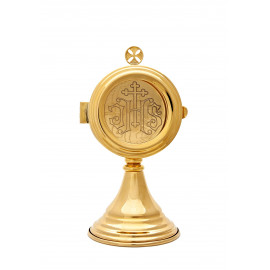
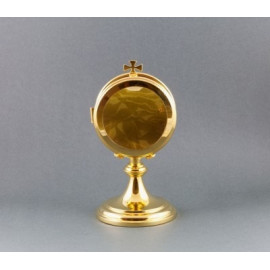
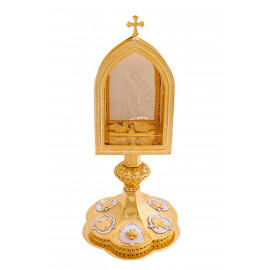
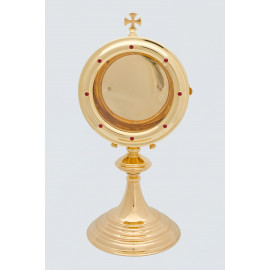
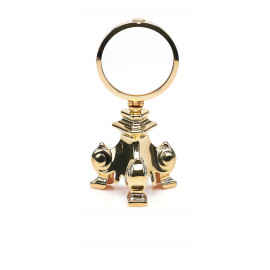
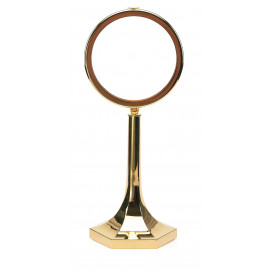
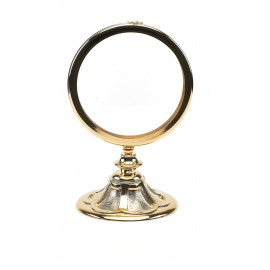
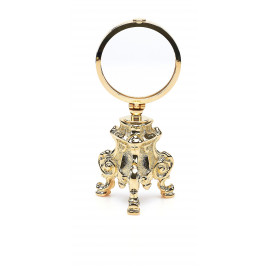
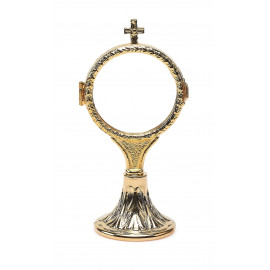
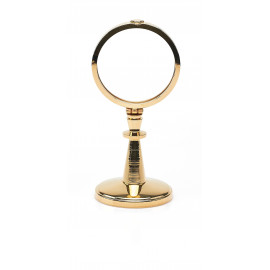
To choose a custodia for a large host, start with the host diameter, then check the lunette or adjustable guide, the glass capsule, the height, the stability of the base, and whether the vessel will be carried in procession. A tall custodia is not automatically suitable for a large host; the opening and the lunette matter more than the overall height.
This guide walks through the six checks in the order that prevents expensive mistakes. It uses the measurements from our custodia collection, where capsule diameters are 8 cm, 9 cm and 16 cm, and the large-host models are designed for a correspondingly larger host.
1. Start with the host diameter
Measure the host across its widest point. The 21 cm custodia in our collection accepts a host up to 7 cm (2.75 in). The 36 cm large-host custody is designed for a larger host, and the 16 cm capsule models give more room around the host. If your parish uses a large host for exposition, do not assume that a 40 cm custodia has a wide lunette; check the product measurements.
If you already have a lunette, measure its opening and outer diameter. A custodia that fits the lunette is more useful than one that only matches the height. If you are buying both, choose them together.
2. Check the lunette and adjustable guide
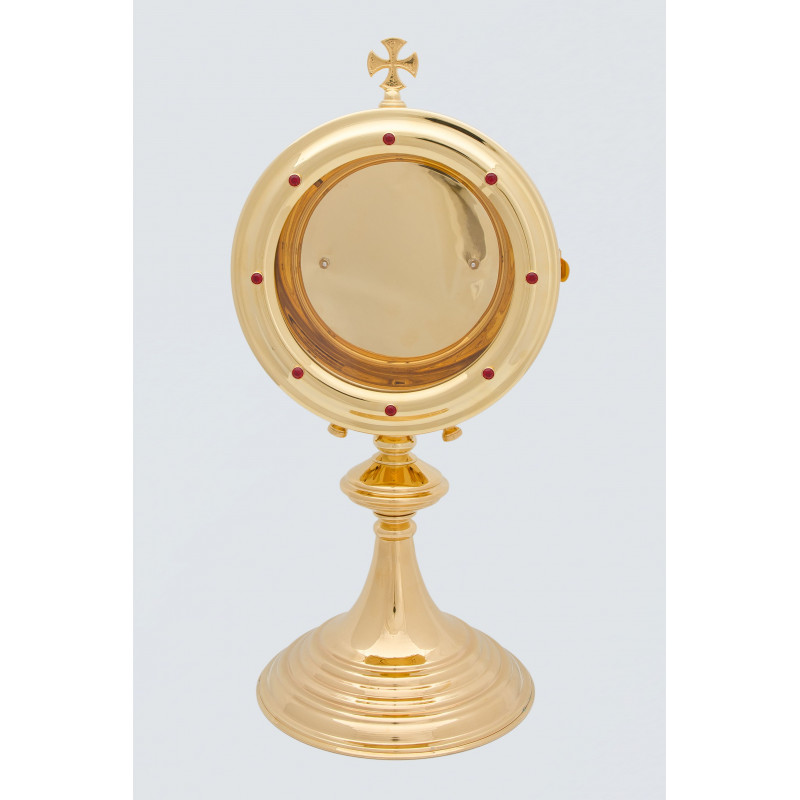
A large host needs a lunette that grips it firmly. An adjustable guide or a track lets you center the host and keep it upright when the vessel is moved. The 21 cm custodia and the 36 cm large-host custody both use an adjustable guide.
A loose lunette is a safety issue, not just an aesthetic one. If the host can tilt, the vessel is not suitable for a procession. Check the fit before the first liturgical use.
3. Match the glass capsule
The glass capsule protects the host and the lunette. An 8–9 cm capsule is intended for smaller hosts and mini custodias. A 16 cm capsule gives more room around a large host and is used on the larger display custodias. The capsule diameter is listed on each product page; compare it with the lunette and the host.
A larger capsule also affects the visual proportions. A 16 cm capsule on a 25–40 cm stand gives the host a clear field of view; a smaller capsule on a tall stand can look empty. Choose the combination that keeps the host as the visual center.
4. Consider height and visibility
A 36–40 cm custodia is easier to see from the back of a church than an 18 cm mini custodia. Check the sightline from the nave, the height of the altar or throne, and the height of the priest or deacon who will expose the Blessed Sacrament. If the vessel will be placed on a tabor, measure the tabor top and the total height.
Height is not the same as prominence. A 25 cm custodia with a wide capsule can be more visible than a 40 cm custodia with a narrow one. Look at the proportions, not just the number.
5. Test stability and weight
A tall custodia needs a broad base. The 40 cm custody with a hexagonal base is more stable than a narrow round base. Consider who will carry the vessel and whether it will be placed on a smooth altar or a moving tabor. A heavy vessel may be dignified but difficult to handle; a lighter vessel may be easier but less stable in a procession.
If the custodia will be carried, practice the lift and the turn before the liturgy. Check that the lunette does not shift and that the base fits the carrying arrangement.
6. Decide between procession and static use
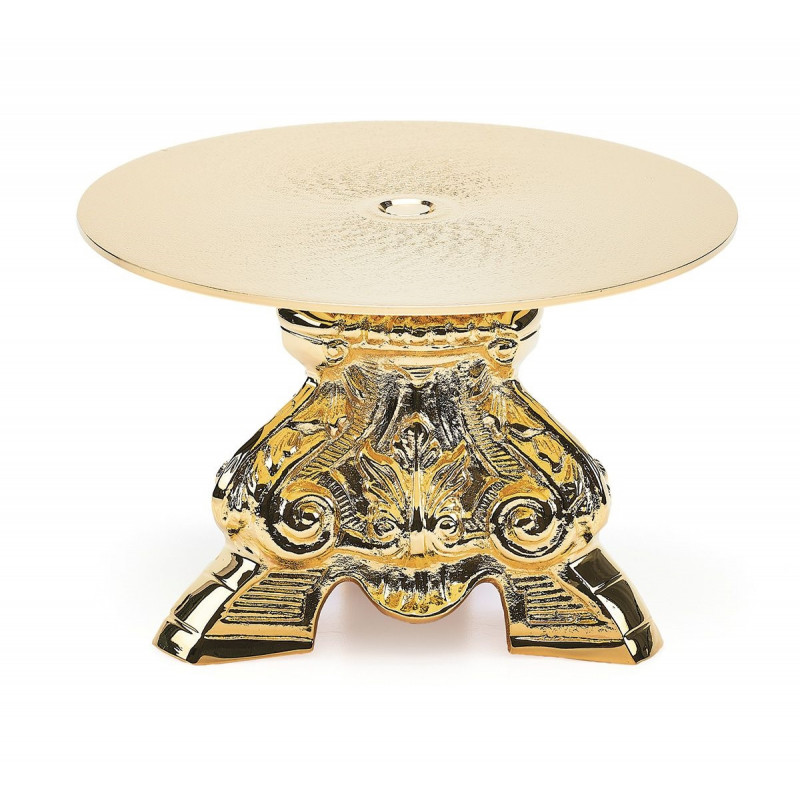
If the custodia will stay on the altar or in a chapel, a smaller model may be easier to handle and store. If it will be carried in a Corpus Christi procession, choose a secure lunette, a stable base and a size that matches the tabor or canopy. A monstrance throne (tabor) can provide a stable platform between stations.
For a large-host parish, the 36 cm large-host custody is the most specialized piece in our collection. For a smaller large host, the 21 cm custodia with adjustable guide is the practical choice. If you need a taller silhouette, compare the 40 cm tall custody and the 40 cm hexagonal-base custody.
Frequently Asked Questions
Q: What size host does a large-host custodia hold?
A: It depends on the model. The 36 cm large-host custody is designed for a larger host; the 21 cm custodia accepts up to 7 cm. Check the lunette opening and the capsule diameter before ordering.
Q: Can I use a large-host custodia for a small host?
A: A large lunette may not grip a small host securely. If you usually use a small host, choose a model with an 8–9 cm capsule and a matching lunette; if you need both, ask whether a spare lunette is available.
Q: Is a taller custodia always better for visibility?
A: No. A wide capsule and a clear sightline matter more than height alone. A 25 cm custodia with a 16 cm capsule can be more visible than a 40 cm custodia with a narrow one.
Q: Can a large-host custodia be carried in a procession?
A: Yes, if the lunette is secure and the base is stable. Check the weight, the grip and the fit on the tabor or carrying arrangement. Practice the lift and the turn before the liturgy.
Q: What is the difference between a large-host custodia and a monstrance?
A: The job is the same — exposing the host — but a monstrance is usually larger and more elaborate, often for public processions. A large-host custodia is a smaller, more manageable exposition vessel for a large host.
Related reading
Read what a lunette is, custodia vs monstrance vs ostensorium, and how much a monstrance costs. Browse all custodias.