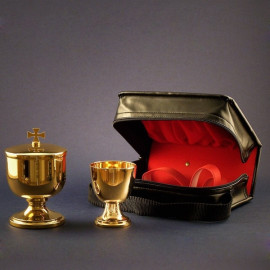


A sick call set is a compact kit that holds everything a priest needs to bring Holy Communion - and often the Anointing of the Sick - to a person who is ill or dying at home, in a hospital, or in a care facility. The classic set is a small burse or case containing a pyx for the consecrated hosts, a corporal, a stole, a small cross, and a container for the holy oils; larger sets add a sprinkler for holy water and a purificator.
What Is a Sick Call Set?
The name comes from the "sick call" - the summons a priest receives to attend someone who is seriously ill or dying. A sick call set (also called a sick call kit, sick call outfit, or viaticum set) is the portable kit he takes on that visit. It is built around the pyx, the small vessel that carries the Blessed Sacrament, because the heart of a sick call is Communion: viaticum for the dying, or ordinary Holy Communion for the homebound. Sets made for parish visiting ministry usually add a container for the oil of the sick, a stole, and a corporal, so the visit can include a Communion service, a blessing, or the Anointing of the Sick. Our sick call kits and travel Mass kits follow this pattern, from $137 to $242 for the compact sets.
What Is Inside a Sick Call Set?
A typical priest's sick call set contains:
- A pyx for the consecrated hosts - often 5.5 cm across, holding five to seven hosts
- A corporal - the square white linen on which the pyx rests during the visit
- A stole - worn for Communion, confession, or anointing
- A small cross - wood or metal, placed on the table beside the sick person
- Oil stocks - vessels for the oil of the sick (and chrism where the rite requires it)
- A purificator and, in fuller sets, a sprinkler for holy water
- A fitted case - rigid and lockable, zippered, or a leather burse
Our compact sets measure from 7 x 9 cm to 15 x 9 cm closed, and the largest sick call kits add a 12 cm metal sprinkler, a wooden cross, double oil vessels, a small stole, a corporal, and a purificator.
Two Meanings: The Priest's Kit and the Family's Crucifix Set
In Catholic supply catalogs, "sick call set" can mean two different things. The first is the priest's kit described above. The second is the household sick call set - a crucifix that opens to hold two blessed candles, a small bottle of holy water, and a cloth for the table beside the bed. Families keep this set ready so that when the priest arrives, the anointing and Communion can take place at a prepared bedside. If you are shopping for a family, look for a sick call crucifix set; if you are shopping for a priest or a parish, you want the vessels kit.
What Is Viaticum?
Viaticum is Holy Communion given to a person who is dying - the Church's "food for the journey." The Latin word viaticum means the provisions prepared for a traveler setting out on a journey. It is the final and most important Communion of a Catholic's life, and the pyx in a sick call set exists mainly to carry it. You can read the full explanation in our guide to what viaticum is.
Sick Calls, Last Rites, and the Anointing of the Sick
"Last rites" is the traditional name for the three sacraments given at the end of life: Penance (confession, with the Apostolic Pardon), the Anointing of the Sick, and viaticum. A sick call visit may include any or all of them. Only a priest or bishop can administer the Anointing of the Sick and hear confession; Holy Communion can also be brought by deacons, instituted acolytes, and commissioned Extraordinary Ministers of Holy Communion - which is why parishes keep simple pyx kits for everyday Communion calls and fuller sets for the priest's visits. See our oil stocks and pyxes for the individual pieces.
Choosing a Sick Call Kit
Match the kit to the ministry. For everyday Communion calls by parish ministers, a compact pyx kit with a corporal and cross is enough. For a priest's hospital and hospice rounds, choose a set that adds the oil stocks, a stole, and a sprinkler. For a home Mass for the housebound, step up to a full travel Mass kit with a chalice, paten, and linens. Every kit in our sick call and travel Mass collection is made in Poland and ships from our own stock; our burses for the sick call paten and burses for the ailing cover the parish visiting ministry.
Frequently Asked Questions
Q: What is the difference between a sick call set and a travel Mass kit?
A: A sick call set is built for Communion visits - a pyx, corporal, stole, cross, and often oil stocks. A travel Mass kit is a fuller portable set: it adds the chalice, paten, cruets, and linens needed to celebrate Mass itself outside a church. Some sets sit between the two and serve both purposes.
Q: What is included in a sick call set?
A: A priest's sick call set typically includes a pyx for consecrated hosts, a corporal, a stole, a small cross, and a container for the oil of the sick. Fuller sets add a sprinkler and purificator. Household sick call sets instead contain a crucifix, two candles, and a holy water bottle.
Q: Can a sick call set be used for viaticum?
A: Yes - viaticum is simply Holy Communion given to someone in danger of death, carried in the pyx. That is the original purpose of the sick call set, so any set with a clean, well-kept pyx can serve for viaticum.
Q: Who may bring Communion to the sick?
A: A priest or deacon can always bring Communion. Instituted acolytes and Extraordinary Ministers of Holy Communion may also bring it when commissioned by the pastor, following diocesan norms. The Anointing of the Sick, however, is reserved to priests and bishops.
Q: Where can I buy a sick call set?
A: Our sick call kits start at $137 and include a pyx, cross, and corporal in a lockable case, with larger sets adding oil stocks, sprinklers, and stoles - all made in Poland and ready to ship.
Where to Buy a Sick Call Set
Explore our travel Mass kits and sick call sets - compact kits from $137 plus complete celebrant's cases - and pair them with a pyx and oil stocks for the full ministry of Communion to the sick. Free shipping on orders over $100.