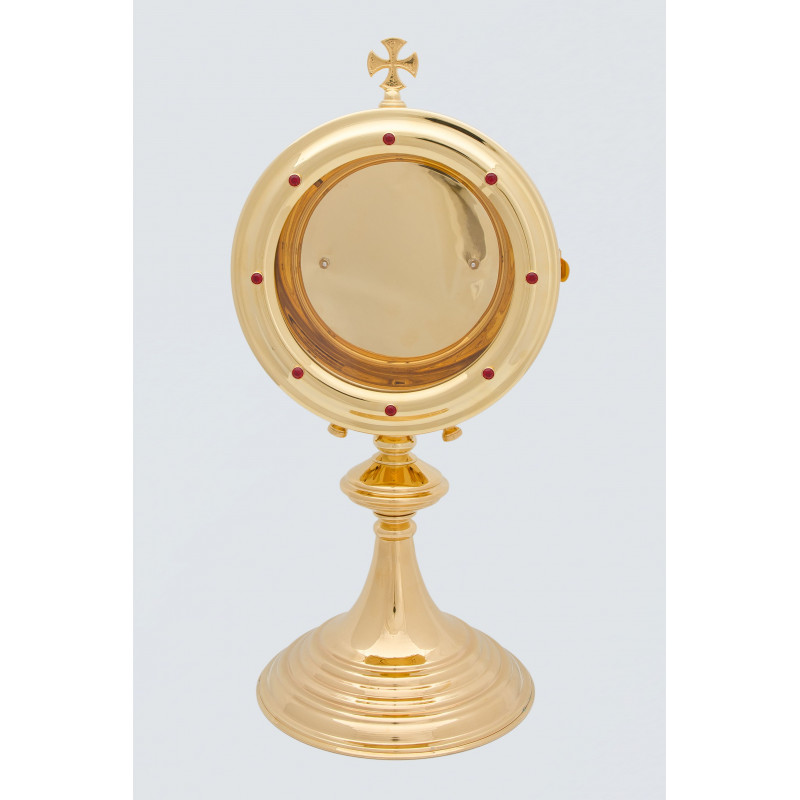
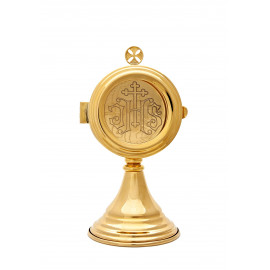
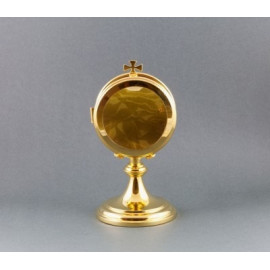
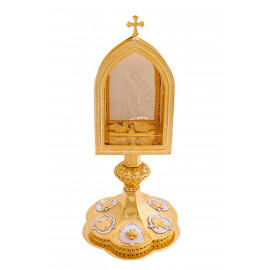
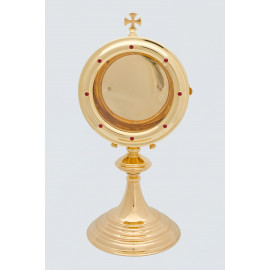
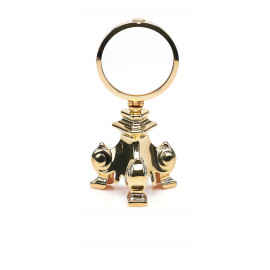
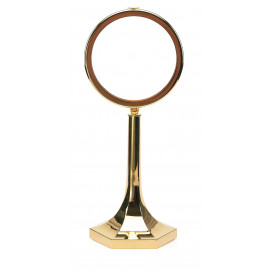
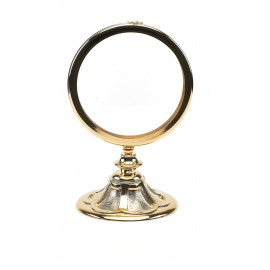
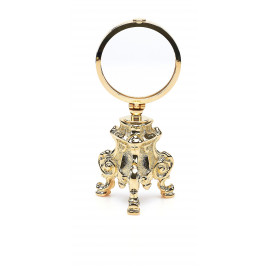
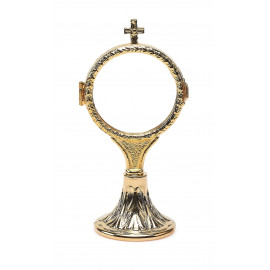
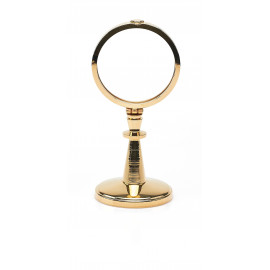
The lunette — also called the luna — is the metal holder that grips the consecrated host so it stands upright inside a custodia or monstrance. It usually has two glass panes and a curved or adjustable track. The host is placed between the panes, the lunette is slid into the vessel, and the glass capsule protects the host from dust and touch.
Without a lunette, a large host would slump or fall inside the capsule. The lunette gives the host a firm edge, keeps it centered, and makes it possible to move the vessel without touching the host. It is a small part, but it determines whether the host is visible and secure.
Lunette, luna, host holder — the same thing?
Yes, in ordinary liturgical use. “Lunette” is the English term; “luna” is the Latin-derived form used in many catalogues. “Host holder” is a descriptive name. The object is a small frame, often silver- or gold-plated, with a glass front and back. Some lunettes have a fixed opening; others have an adjustable track so the host can be centered.
The word “lunette” comes from the crescent shape of some older holders. Modern lunettes are usually rectangular or slightly curved, but the name has stayed. If a product description says “luna holder” or “custodial,” it is describing the same part.
How to measure a host and a lunette
Two measurements matter: the host diameter and the lunette opening. Measure the host across its widest point. Then measure the lunette opening — the clear area between the glass panes — and the outer diameter of the lunette. The host must fit inside the opening without bending, and the lunette must fit inside the custodia’s glass capsule.
If you already have a custodia, measure the capsule’s inner diameter and the slot that receives the lunette. If you are buying both, choose them together. A 16 cm capsule gives more room than an 8–9 cm capsule, but the lunette still has to match the host. Our custodias list the capsule diameter for each model; the 21 cm custodia accepts a host up to 7 cm.
Lunette in a custodia vs a monstrance
The principle is the same in a custodia and a monstrance: the lunette holds the host, and the glass capsule protects it. The difference is scale. A mini custodia uses a small lunette and an 8–9 cm capsule; a large monstrance uses a larger lunette and a larger capsule. Some monstrances have a removable lunette that can be carried separately in a case.
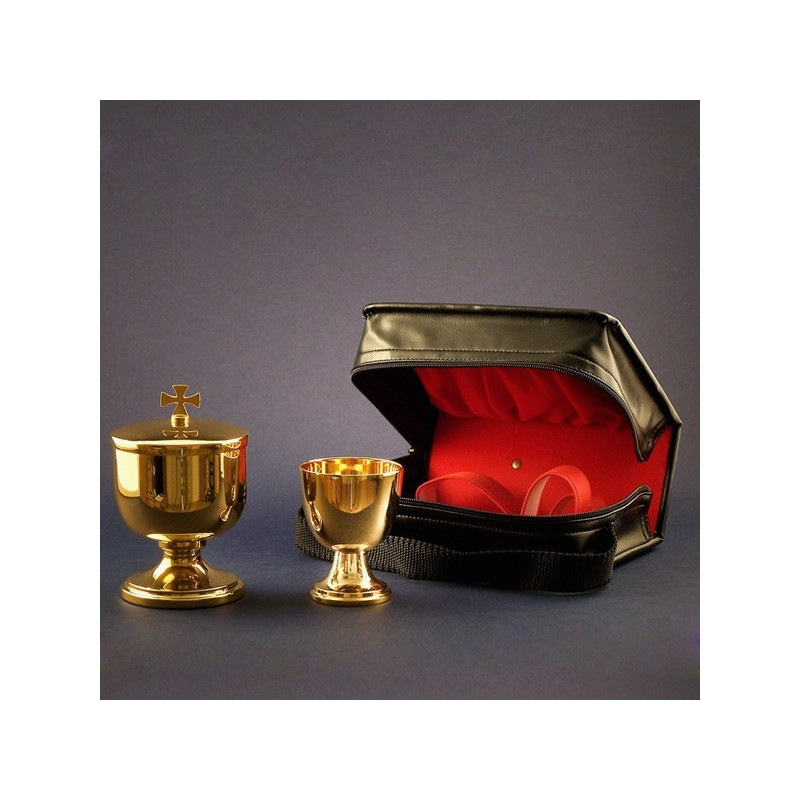
If you move a lunette between vessels, check the fit. A lunette that is too loose can tilt; one that is too tight can scratch the capsule. A small felt or leather case protects the lunette in storage and transport.
How to care for a lunette
Handle the lunette by its frame, not by the glass. Avoid touching the glass with bare fingers; fingerprints and oils can dull the surface. Wipe the glass with a soft lens cloth. Do not use abrasive polishes, and do not immerse the lunette in water if the frame has a finish that could be affected.
Store the lunette in a dry place, ideally in a case. Check the glass for chips or cracks before each use. If the frame is silver-plated, it may tarnish; a specialist can clean or re-plate it. Do not attempt to bend or tighten a lunette yourself if the host no longer fits; have it adjusted by someone who works with sacred vessels.
Frequently Asked Questions
Q: What is a lunette in a custodia?
A: The lunette, or luna, is the metal holder with glass panes that grips the host upright inside the custodia. It keeps the host centered and visible while protecting it from touch and dust.
Q: Is a lunette the same as a luna?
A: Yes. “Lunette” is the English term; “luna” is the Latin-derived form used in many catalogues. Both refer to the host holder inside a custodia or monstrance.
Q: How do I know which lunette size I need?
A: Measure the host diameter and the lunette opening. The host must fit inside the opening without bending, and the lunette must fit inside the custodia’s glass capsule. If you are buying both, choose them together.
Q: Can I use a lunette from one custodia in another?
A: Only if the sizes match. A loose lunette can tilt; a tight one can scratch the capsule. Check the capsule diameter and the slot before swapping parts.
Q: How should I clean a lunette?
A: Handle it by the frame, avoid touching the glass, and wipe the glass with a soft lens cloth. Do not use abrasive polishes or immerse the frame in water. Store it in a dry case.
Related reading
See our custodias, the guide to custodia vs monstrance vs ostensorium, and what a monstrance is.