


Viaticum is Holy Communion given to a person who is dying - the Church's "food for the journey" from this life into the next. It is the last and most important of the last rites, and pastoral practice allows it to be given under the form of wine alone, or a small piece of a host, when the person can no longer take solid food. The word itself is Latin: viaticum means the provisions prepared for a traveler setting out on a journey.
The Meaning of the Word Viaticum
In ancient Rome, the viaticum was the food, money, and supplies a traveler took for the road. The Church adopted the word for the final Eucharist because death is the last journey, and the dying Christian travels it with Christ himself as food. The Catechism of the Catholic Church describes viaticum as "the sacrament of passing over from death to life" - the point at which the Eucharist received in this life becomes the pledge of the life to come.
Viaticum and the Last Rites
"The last rites" traditionally means three sacraments celebrated at the end of life: Penance (confession, concluded with the Apostolic Pardon), the Anointing of the Sick, and viaticum. Viaticum is the culmination, not an optional extra: when a dying person can receive only one of the three, the Church makes sure it is Holy Communion. If the person cannot confess, the anointing and viaticum may still be celebrated; the rites are designed so that grace is never blocked by impossibility.
Who Can Receive Viaticum?
Any Catholic in danger of death who is able to receive Holy Communion may receive viaticum. The Church strongly recommends it even for someone who has already received Communion that same day - this is precisely the moment the sacrament was reserved for. When swallowing has become difficult, the minister may give viaticum under the form of wine alone or a very small piece of the host, so that the dying person can still communicate.
What the Priest Brings
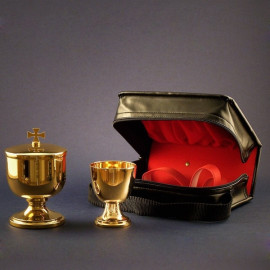
For viaticum, the priest or deacon brings the Blessed Sacrament in a pyx - or a small ciborium - together with a stole, holy water, and, if the Anointing of the Sick will be celebrated, the oil of the sick and the ritual text. In a hospital or a home, a single fitted case holds all of it: our sick call kits gather the pyx, cross, corporal, oil stocks, and stole exactly for this purpose.
Viaticum at Home, in Hospital, and in Care Facilities
Call the parish as soon as death appears near - do not wait for the final hours, because the person should be able to receive consciously if possible. Hospitals and care facilities usually have a chaplaincy service that can respond quickly, but the family's own parish priest should also be called. For the visit, families often prepare a small table with a white cloth, a crucifix, and two candles - the traditional bedside arrangement, and the reason many homes keep a sick call crucifix set.
Preparing for a Loved One's Final Communion
Practical steps that help: keep the parish number where the family can find it at any hour; tell the priest the person's condition and whether confession or anointing is desired; keep the room quiet and the bedside table clear. If the dying person can still speak, this is also the time for the Apostolic Pardon and any final words of faith. Viaticum is not a rite of despair but of hope - the Church's confident accompaniment of a brother or sister to the threshold of eternal life.
Frequently Asked Questions
Q: What is the difference between viaticum and the last rites?
A: The last rites is the traditional name for the final sacraments together - confession, Anointing of the Sick, and viaticum. Viaticum is specifically the final Holy Communion given in danger of death; it is the heart of the last rites.
Q: Who can bring viaticum to the dying?
A: A priest or deacon normally brings viaticum; in urgent cases Communion may also be brought by an instituted acolyte or a commissioned Extraordinary Minister of Holy Communion. The Anointing of the Sick, however, can only be given by a priest or bishop.
Q: Can viaticum be given more than once?
A: Yes. If the danger of death persists or returns, viaticum may be given again - the Church strongly recommends Communion as viaticum even to someone who has already received Communion that same day.
Q: What does a priest bring for viaticum?
A: He brings the Blessed Sacrament in a pyx or small ciborium, a stole, and holy water - plus the oil of the sick if the Anointing of the Sick will also be celebrated. Our sick call sets gather exactly these items in one case.
Q: What does the word viaticum mean?
A: Viaticum is Latin for the provisions - food and money - prepared for a journey. The Church uses it for the final Communion because it is food for the journey from this life to eternal life.
Bringing Viaticum: Pyxes and Sick Call Sets
Keep a pyx ready for Communion calls with our Catholic pyxes, or carry a complete set: our sick call kits and travel Mass kits from $137 include the pyx, cross, and corporal a priest needs for viaticum. For the full picture of the visit, read what a sick call set is.
