
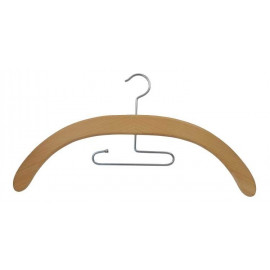
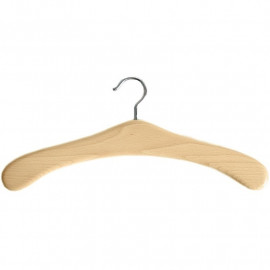
A vestment hanger is the wrong size more often than it is the wrong material. Sacristies are full of solid wooden hangers that are simply too narrow for the garment on them, and the result is a permanent crease across the shoulders — exactly where the embroidery sits.
This guide explains how to measure a vestment, what width each garment needs, and when a straight hanger stops being enough.
The Short Answer: 52 cm and 56 cm
Two widths cover almost every vestment in a Catholic sacristy:
| Garment | Minimum hanger width | Our hanger |
|---|---|---|
| Chasuble | 52 cm / 20.5 in | 52 cm wooden vestment hanger |
| Dalmatic | 52 cm / 20.5 in | 52 cm wooden vestment hanger |
| Cassock | 48–52 cm | 52 cm wooden vestment hanger |
| Surplice | 56 cm / 22 in | 56 cm surplice hanger |
| Alb | 56 cm / 22 in | 56 cm surplice hanger |
| Cope | 56 cm or a triangular cope hanger | 56 cm for light copes |
The difference between the two sizes is not cosmetic. A surplice is gathered at the neck and carries more fabric across the shoulder than a chasuble of the same chest size, which is why the surplice needs the wider hanger.
Why Hanger Width Matters More Than Material
Fabric creases where it is unsupported. On a narrow hanger the shoulder of a vestment folds over the ends of the arms, and the fold runs diagonally through the embroidery and the orphrey. Left long enough, the fold becomes a memory in the cloth: pressing removes the line, but the gold thread stays slightly flattened and the appliqué work lifts at the edge.
A hanger that matches the shoulder seam keeps the garment flat. The weight of the vestment falls into the body of the garment instead of hanging from two points, and the shoulder line stays where the tailor put it.
How to Measure a Vestment for a Hanger
You need one measurement: the distance from shoulder seam to shoulder seam, taken flat across the back of the garment.
- Lay the vestment face down on a flat table.
- Smooth the shoulders without stretching the fabric.
- Measure from the left shoulder seam to the right shoulder seam.
- Choose a hanger with arms at least as long as that measurement. A centimetre or two more is fine; less is not.
For a chasuble, most measurements land between 48 and 54 cm. For a surplice or an alb, between 52 and 58 cm. If the vestment is between sizes, take the wider hanger.
What Happens If the Hanger Is Too Narrow
Three things, in order. First, the shoulder collapses inward and the front and back panels hang from a single line, so the vestment loses its shape. Second, a crease forms at the point where the fabric bends over the end of the hanger. Third, the embroidery at that point takes the fold, and after a few months the crease is visible during Mass even after pressing.
Wire and thin plastic hangers make it worse: the narrow edge concentrates the load on a few square centimetres of fabric, and a wire hanger can also rust in a damp sacristy.
What Happens If the Hanger Is Too Wide
Less damage, but still a problem. If the arms extend well past the shoulder seam, the sleeves or the front panels of the vestment drape over the ends and pick up a fold lower down. For a chasuble, 2–3 cm of overhang is harmless; 8–10 cm is not.
This is why a 56 cm surplice hanger is a poor choice for a small chasuble, and why a 52 cm hanger should not be used for a large alb.
Width Is Not the Only Dimension
Two hangers of the same width can behave differently. A solid beech hanger holds its line under the weight of a brocade chasuble; a hollow plastic hanger bends and stays bent. A varnished surface lets the vestment slide into place without friction, while a raw wooden surface can catch silk and gold thread.
Our hangers are cut from solid beech and finished with clear varnish for exactly this reason — see the full range of wooden vestment hangers.
When a Straight Hanger Is Not Enough
A cope is the exception. It is wider, heavier and cut in a semicircle, so a straight hanger supports only the centre of the shoulder. A light cope can hang on the 56 cm surplice hanger, but a heavy embroidered cope needs a triangular cope hanger that carries the full width. The same logic applies to heavily embroidered copes and to dalmatics with wide sleeves.
Frequently Asked Questions
Q: What size hanger do I need for a chasuble?
A: 52 cm (20.5 in) across the arms for most chasubles. Measure the shoulder seam to shoulder seam first; if the garment measures more than 52 cm, choose a wider hanger or a triangular one.
Q: Can I use a 56 cm surplice hanger for a chasuble?
A: Only if the chasuble is large. On a standard chasuble the extra 4 cm lets the front panels drape over the ends of the hanger and crease lower down.
Q: How do I measure a vestment without a tape measure?
A: Use a piece of string along the shoulder line, then lay the string against a ruler. The measurement only needs to be accurate to about a centimetre.
Q: Do hangers need to be wider for heavy vestments?
A: Wider and stronger. Weight is carried by the hanger body, so a solid wooden hanger is the right choice for brocade and heavily embroidered vestments; a thin plastic hanger will bend.
Q: What width hanger does a dalmatic need?
A: The same 52 cm as a chasuble. The dalmatic is wider in the sleeve, not in the shoulder, so the hanger width stays the same.
Ready to check your sacristy? Our vestment hangers come in 52 cm and 56 cm, both in stock.
