
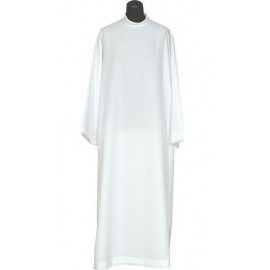
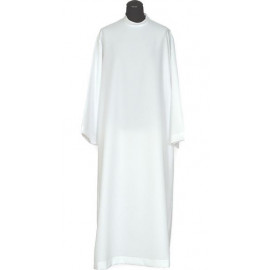
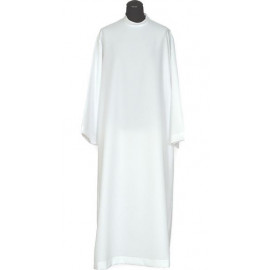
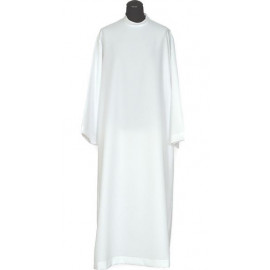
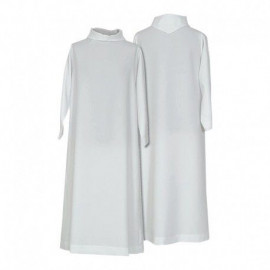
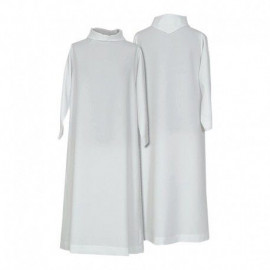
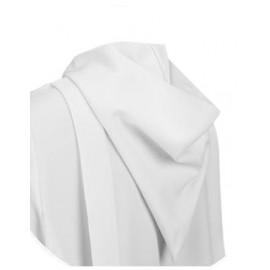
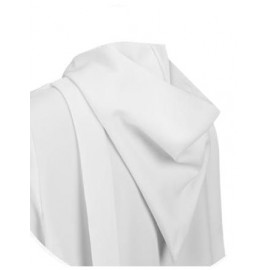
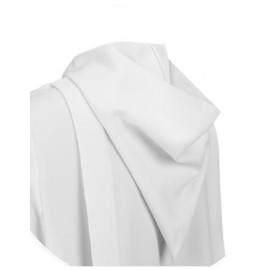
Among server vestments, the hooded alb is the one with the most character. In vestment catalogs it often appears under the French name capuche, and parishes choose it for a look that is unmistakably traditional — a white alb with a hood gathered at the back, closer in spirit to a monk’s habit than to a plain tunic.
What Is a Capuche?
Capuche is French for “hood,” and in vestment catalogs it names the hood attached at the back of an alb. The hooded alb is an old form of the garment: the alb has been worn with a hood since the Middle Ages, when churches were cold, processions were long, and a hood was simply part of a good tunic. What began as practical clothing became a stylistic tradition — and today the capuche signals a more monastic, more ceremonial look.
Hooded Alb vs Collar Alb: Which to Choose
The choice comes down to the look and the sacristy routine:
- Hooded alb (capuche) — a hood at the back, often with tabs at the front and back for a clean fit. Slightly more formal in appearance, and a favorite for servers in parishes with a strong ceremonial tradition.
- Collar alb — a plain neckline, sometimes a stand-up collar or a turtleneck that forms a triangle at the back. Faster to iron and arguably easier to store flat.
Within hooded albs there are two practical variants. The front-zipper style slips on in seconds and is the easiest for younger servers to manage on their own; the over-the-head style, usually cut from lighter fabric, has no zippers at all and often features a reversible double collar. Our hooded altar server albs include both — three zippered models in polyester-stretch (164–188 cm) and two panama-fabric models with reversible collars (176–182 cm).
How to Wear a Hooded Alb
Put the alb on over the head (or zip it, on zippered models), let the fabric fall, and tie the cincture at the waist — the hood stays at the back, lying flat against the shoulders. The hood is a decorative, traditional feature of the garment, not a head covering used during the liturgy; it should lie neatly down the back, which is why the tabs and the reversible collar matter: they keep the whole garment sitting straight.
If the hood has been stored folded, smooth it with your hand or a cool iron before Mass. A hood that stands up on its own is the one thing that makes a hooded alb look untidy.
How to Care for a Hooded Alb
Wash a hooded alb the same way you would any server alb — low temperature, mild detergent, no bleach — and dry it flat or on a hanger so the hood keeps its shape. Iron on low, pressing the hood from the inside, and store the alb folded with the hood smoothed or on a hanger in a garment bag. For a complete routine, see our guide How to Care for an Altar Server Alb.
Frequently Asked Questions
Q: What is a capuche on an alb?
A: Capuche is the French word for the hood attached at the back of an alb. In vestment catalogs, a “capuche alb” is simply a hooded alb.
Q: Do altar servers wear hooded albs?
A: Many parishes choose hooded albs for their servers, especially for a traditional or monastic look. There is no rule requiring or forbidding the hood — it is a matter of parish custom and taste.
Q: Is the hood on an alb worn on the head?
A: No. On liturgical albs the hood rests at the back as a traditional feature of the garment; it is not worn over the head during Mass.
Q: What is the difference between a hooded alb and a collar alb?
A: The hooded alb has a hood (capuche) at the back; the collar alb has a plain, stand-up, or turtleneck collar instead. Otherwise the two are cut the same way and are sized by the wearer’s height.
Q: How do you wash a hooded alb?
A: Wash at low temperature with mild detergent, without bleach, and dry flat or on a hanger so the hood keeps its shape. Press the hood from the inside on a low setting.
See the hooded styles in our altar server alb collection — with front zipper or with a reversible collar, from $52.
