
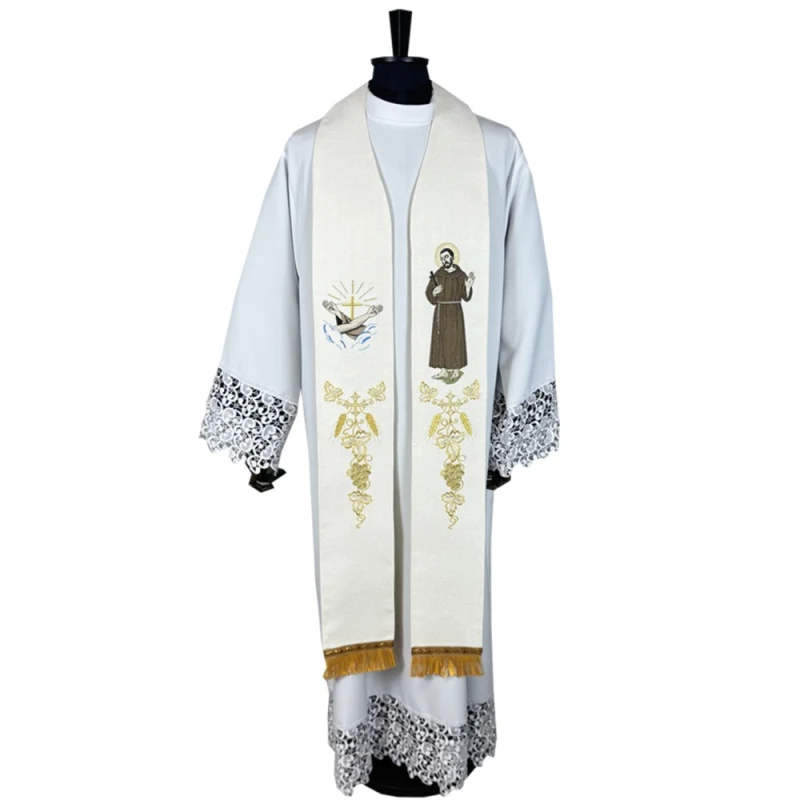


The symbols on a stole are attributes: objects or signs associated with a saint in Christian art. A key, a sword, a lily or a wheel is not decoration. It is a way of naming the saint without writing the name, and it lets the faithful recognize the patron at a distance.
Why Saints Carry Attributes
Christian art developed a visual shorthand. A saint is shown with the instrument of his martyrdom, with a object from his life, or with a sign of his office. The attribute distinguishes two saints with the same name and makes the image readable even when the face is stylized by embroidery.
On a stole, the attribute is usually placed near the figure or held in the hand. A small object can identify the whole design, which is why the same stole can show a saint with very few details.
The Most Common Symbols on Stoles
St. Peter carries keys, the sign of the keys of the kingdom. St. Paul carries a sword, the instrument of his martyrdom. St. Joseph is shown with a lily, a sign of purity, and sometimes with a carpenter's square. St. Francis of Assisi carries the stigmata and is often shown with birds or a wolf.
St. Anthony of Padua holds the Child Jesus, often with a lily and a book. St. Thomas the Apostle carries a spear, the instrument of his martyrdom. St. Michael the Archangel carries a sword and scales and is shown overcoming a dragon. St. Barbara is shown with a tower and a chalice. St. Catherine of Alexandria carries a wheel and a sword.
St. Florian is shown with a pitcher of water and fire, the signs of his work as a firefighter and of his martyrdom. St. Christopher carries the Child Jesus and a staff. St. Hubert is shown with a stag carrying a crucifix between its antlers. St. Mary Magdalene carries an alabaster jar. St. Rita is shown with roses and a crucifix. St. Padre Pio carries the stigmata. St. Faustina is associated with the Divine Mercy image and its rays.
Symbols of Christ and the Holy Spirit
Not every stole shows a saint. Some show a title of Christ: the Sacred Heart, the Good Shepherd, the Lamb of God, or the Holy Spirit as a dove with tongues of fire. These images work in the same way as a saint's attribute: they identify the mystery or the person represented, and they set the tone of the vestment.
The Lamb of God is a symbol of Christ sacrificed and risen; the Good Shepherd recalls the pastoral office; the Sacred Heart points to the love of Christ; the dove and the tongues of fire recall Pentecost and the gifts of the Holy Spirit.
Reading a Stole With Several Figures
When a stole shows two figures, the attribute tells them apart. St. Peter and St. Paul are usually shown together with keys and a sword. St. John Paul II and Our Lady of Częstochowa are shown together as a papal and a Marian pair. The position also matters: the figure on the front of the stole is usually the patron, while the second figure completes the devotion.
When the Symbol Is Ambiguous
Some attributes are shared. A sword can point to St. Paul, St. Thomas or St. Catherine; a lily can point to St. Joseph, St. Anthony or St. Clara. In those cases the product page is the reliable source: it names the saint, the color and the technique. On an antique stole without documentation, the combination of attributes and the style of the figure are the best guide.
Frequently Asked Questions
Q: What do the symbols on a stole mean?
A: The symbols are attributes of the saint or titles of Christ. A key identifies St. Peter, a sword St. Paul, a lily St. Joseph, a wheel St. Catherine. They name the patron without writing the name.
Q: How do I identify the saint on a stole?
A: Look at the object held by the figure, at the instrument of martyrdom, and at the companions. If the attribute is shared by several saints, check the product page, which names the saint and the motif.
Q: Why is St. Peter shown with keys?
A: The keys are the sign of the keys of the kingdom, the authority given to Peter and to his successors. They are the most common attribute of St. Peter in Christian art.
Q: Why is St. Paul shown with a sword?
A: The sword is the instrument of his martyrdom. St. Paul was executed by the sword in Rome, and the sword became his attribute in art.
Q: What does the Lamb of God symbolize on a stole?
A: The Lamb of God is a symbol of Christ sacrificed and risen. On a stole it identifies the mystery represented rather than a canonized saint.
Related Reading
See the stoles with saints and the full collection of liturgical stoles. For the colors of the vestments, read stole colors by liturgical season.


