

What Is a Nativity Chasuble?
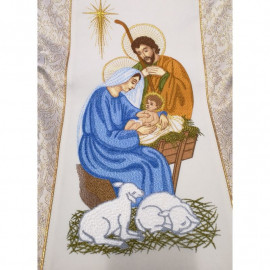
A Nativity chasuble is a Christmas vestment that shows the birth of Jesus: the stable, the manger, the Holy Family, the shepherds, the star, and sometimes the Magi. It is a visual sermon. The congregation sees the mystery of the Incarnation before the readings are proclaimed, and the embroidery continues to speak during the Eucharistic prayer.
The best Nativity chasubles are not crowded. A few clear symbols, arranged around a central image, communicate more than a dense scene in which every figure competes for attention. The front band and the central orphrey are the natural places for the main image; the border and the sleeves can carry secondary symbols.
The Star of Bethlehem
The Star of Bethlehem is the star that, according to the Gospel of Matthew, guided the Magi to Jesus. In Christian art it symbolizes divine guidance, hope, and the light of Christ. On a chasuble it is usually placed above the stable or above the Holy Family, sometimes as a single gold star and sometimes as a radiant star with a trail.
The star is a useful symbol for Christmas because it connects the birth of Jesus with the journey of the Magi. It also gives the embroiderer a chance to use gold thread and reflective materials that catch the light of the sanctuary. A star that is too large can dominate the composition; a small, well-placed star is usually more effective.
The Magi
The Magi, also called the Wise Men, were visitors from the East who came to adore the newborn Jesus and offered gold, frankincense, and myrrh. In Christian art they represent the recognition of Christ by all nations. They are usually shown as three crowned figures, sometimes on camels, following the star.
On a Christmas chasuble, the Magi may appear on the front band, on the back, or in a smaller medallion. Their presence turns the vestment into a narrative: the birth is not a private event but a revelation to the world. The feast of the Epiphany, which celebrates their visit, is a natural occasion for a Nativity chasuble with this motif.
The Manger
The manger is the crib in which the newborn Jesus was laid. It speaks of humility, poverty, and the Incarnation: the Son of God enters the world not in a palace but in a feeding trough. On a chasuble, the manger is often shown at the center of the stable, with Mary and Joseph on either side.
The manger is also a reminder of the Eucharist. The same Christ who was laid in the crib is present on the altar under the appearance of bread and wine. A well-designed Nativity chasuble makes that connection without needing a caption.
How the Symbols Are Arranged on a Chasuble
The main image usually sits on the front band, the central orphrey, or the back of the chasuble. The star is placed above the scene; the Magi may be on the sides or in a smaller panel; the manger is at the center of the stable. The border can carry floral ornament, crosses, or the IHS monogram. The colors are usually white, ecru, and gold, with red or blue accents in the embroidery.
The arrangement should respect the cut. A Roman chasuble has a narrower front panel, so the image must be compact. A Gothic chasuble has more surface area, which allows a wider scene but also demands more restraint. A semi-Gothic cut is a good compromise for a large Nativity scene.
Choosing a Nativity Chasuble
Start with the liturgical color and the cut, then check the measurements and the stole. The standard measurements in our collection are 125–130 cm in length and 158–160 cm in width, with the newer Urbanowicz models at 128 cm from shoulder to hem. Most chasubles list a matching inner stole; the two Satinowool models (10U and 12U) are described without one.
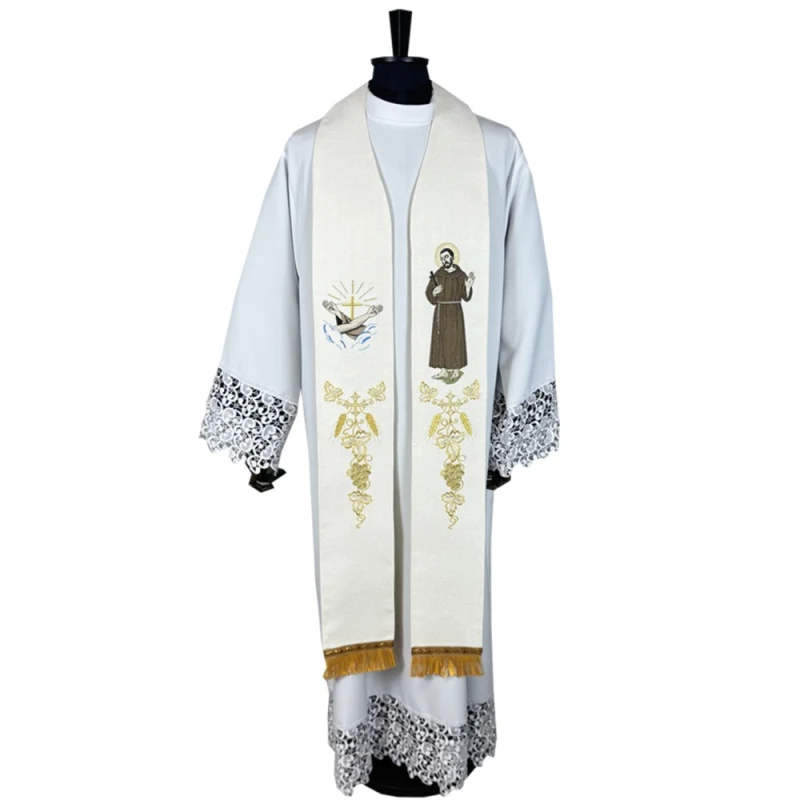
If you want a complete Christmas set, pair the chasuble with the Christmas stoles and the embroidered Christmas chasubles collection. For the color calendar, see Christmas vestment colors. For a guide to setting up a crib in church or at home, see Setting Up the Christmas Crib.
Frequently Asked Questions
Q: What is a Nativity chasuble?
A: A Nativity chasuble is a Christmas vestment that shows the birth of Jesus, usually with the stable, the manger, the Holy Family, the star, and sometimes the Magi and the shepherds.
Q: What does the Star of Bethlehem symbolize?
A: The star symbolizes divine guidance, hope, and the light of Christ. According to the Gospel of Matthew, it guided the Magi to Jesus.
Q: Who were the Magi?
A: The Magi, also called the Wise Men, were visitors from the East who came to adore the newborn Jesus and offered gold, frankincense, and myrrh. In Christian art they represent the recognition of Christ by all nations.
Q: Why is a manger shown on a Christmas chasuble?
A: The manger is the crib in which the newborn Jesus was laid. It recalls the humility of the Incarnation and the poverty of Bethlehem, and it points to the Eucharist.
Q: Is a Nativity chasuble the same as a Holy Family chasuble?
A: They overlap. A Holy Family chasuble focuses on Jesus, Mary, and Joseph; a Nativity chasuble may show the wider scene, including the stable, the star, the Magi, and the shepherds. Many Christmas chasubles combine both.
Q: When should a Nativity chasuble be worn?
A: It is worn for Masses of Christmastide, from the Vigil of Christmas through the Feast of the Baptism of the Lord, and on other occasions when white or gold is prescribed.
Related: Browse the Christmas chasuble collection and the Christmas stoles.