

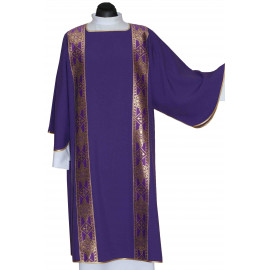
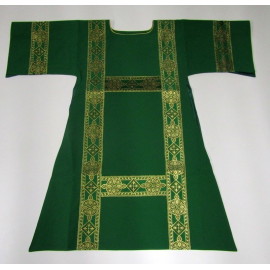
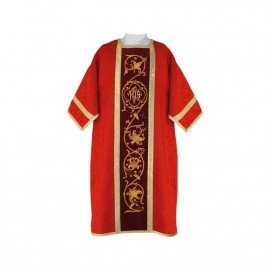


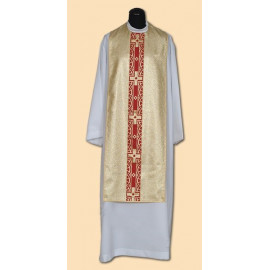
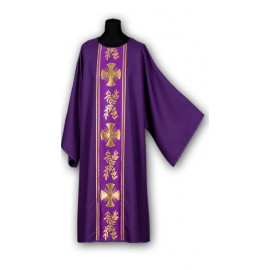
Two dalmatics, same colour, similar price — but one carries a Y-shaped band and a hood-like fold, the other a straight cross and clean lines. Gothic and Roman dalmatics descend from two different traditions of vestment design, and the choice shapes how a parish's whole vestment set looks at the altar.
Two Great Traditions
Since the 19th-century Gothic Revival, vestment makers have worked in two principal styles. The Gothic style revives the flowing lines of medieval vestments; the Roman style follows the more austere, symmetrical tradition of the Roman basilicas. Both are fully correct for the Ordinary Form of the Mass.
Gothic Dalmatics
A Gothic dalmatic is recognisable by its Y-shaped orphrey — the decorative band that runs over the shoulders and down the front and back — and by the hood-like fold at the neck, a survival of the medieval garment's cowl. Gothic dalmatics tend to be the richest pieces in a collection: woven jacquard patterns, damask, velvet stripes and metallic-thread embroidery. In our collection, Gothic dalmatics run from $234 to $371 — see the Gothic models.
Roman Dalmatics
A Roman dalmatic carries a straight cross or a pair of straight vertical bands on the front, with simpler ornament and a lighter drape. It pairs naturally with a Roman (semi-conical) chasuble. Our Roman dalmatics run from $200 to $355, including stretch-fabric models with woven stripes and a glitter-fabric model with IHS embroidery.
Side-by-Side Comparison
| Gothic | Roman | |
|---|---|---|
| Orphrey | Y-shaped, over the shoulders | Straight cross or bands |
| Neckline | Hood-like fold | Square or round neck |
| Fabrics | Jacquard, damask, velvet stripes | Jacquard, stretch, glitter fabric |
| Look | Rich, flowing, medieval | Clean, symmetrical, lighter |
| Our price range | $234–$371 | $200–$355 |
Which Should You Choose?
The first rule is matching: the dalmatic should follow the style of the parish's chasubles. A Gothic chasuble with a Roman dalmatic looks discordant at the altar. The second consideration is the church itself — a neo-Gothic building with a high altar and rich ornamentation carries a Gothic set beautifully, while a simpler church often suits the cleaner Roman lines. Both styles are liturgically equal; the choice is artistic, not doctrinal.
Matching Your Chasuble Set
If your parish is buying its first deacon vestment, look for a collection where dalmatics and chasubles are cut from the same fabric — ours are: compare the dalmatics with our chasubles, and add a matching deacon stole.
Frequently Asked Questions
Q: What is the difference between a Gothic and a Roman dalmatic?
A: The Gothic dalmatic has a Y-shaped orphrey and a hood-like fold; the Roman dalmatic has a straight cross or bands and a simpler, lighter cut.
Q: Which style is more traditional?
A: Both are traditional. The Gothic style revives medieval vestments; the Roman style follows the Roman basilica tradition. Neither is "more correct" in the Ordinary Form.
Q: Can I mix a Gothic dalmatic with a Roman chasuble?
A: You can, but it looks inconsistent. Matching styles within one set is the usual and better practice.
Q: Why are Gothic dalmatics more expensive?
A: They use richer fabrics — jacquard, damask and velvet with metallic embroidery — and more complex construction, which raises the price.
Q: Which style do most American parishes use?
A: American parishes commonly use Gothic vestments, but Roman sets are also widespread, especially in churches with simpler interiors.
