
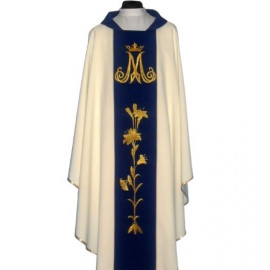

Every symbol embroidered on a Marian vestment is a compressed doctrine. The Church has never treated Marian art as decoration; the roses, lilies, stars, crowns and monograms that run along the orphreys of a Marian chasuble are the Litany of Loreto worked in thread. This guide walks through the symbols you are most likely to see on Catholic vestments — and what each one claims about the Mother of God.
The Immaculate Heart of Mary
The most recognisable of all Marian emblems: a heart encircled by roses, pierced by a sword, sometimes crowned and sometimes flaming. The sword is Simeon's prophecy — "a sword will pierce your own soul too" — and the roses are the joys and sorrows of Mary's life read together. As a vestment symbol the Immaculate Heart appeared widely after the apparitions of Fatima, where Our Lady asked for devotion to her Immaculate Heart; on a chasuble it places the whole Mass under the sign of Our Lady's love and her share in the work of redemption.
The Marian Monogram
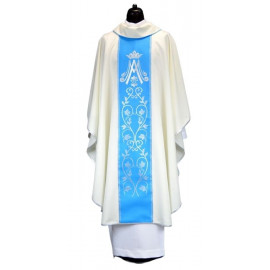
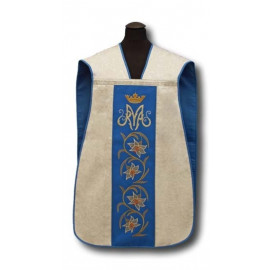
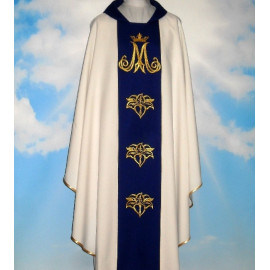
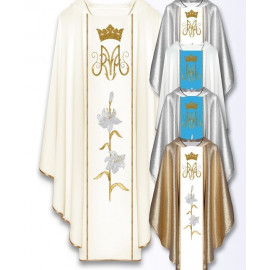
The oldest Marian sign in Western art is not a picture but a pair of letters: AM, for Ave Maria, or an M beneath a cross or a crown. The monogram appears in Roman mosaics, in medieval seals and in the great Marian churches of the Baroque, and it survives on vestments because it can be embroidered at any scale — small on a stole, large on a chasuble's back panel. Where a parish cannot afford a full pictorial embroidery, the monogram gives a complete Marian statement in a few centimetres of thread.
Roses and Lilies
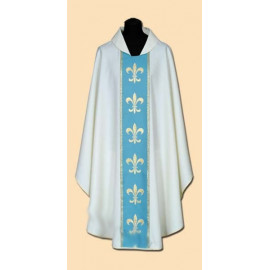
The two flowers of the Litany of Loreto. The lily is the flower of purity — the flower of the Annunciation, carried by the angel Gabriel in countless paintings; the rose is the "Mystic Rose", the title given to Mary as the flower of the redeemed creation. On vestments the two are often worked together in a band of embroidery, lilies alternating with roses, so that purity and fruitfulness appear side by side. A rose alone, or a rose window pattern on a cope, is a common shorthand for Our Lady across church textiles.
The Crown of Twelve Stars and the Queenship of Mary
"A great sign appeared in heaven: a woman clothed with the sun, with the moon under her feet, and on her head a crown of twelve stars" (Revelation 12:1). The twelve-star crown is the most scriptural of the Marian symbols, and it carries a second meaning with it: the woman of Revelation is a queen. A crowned monogram or a crown held above the "M" on a chasuble makes the same claim as the feast of the Queenship of Mary (22 August) — that the Mother of God is Queen of Heaven and Earth. On our Marian chasubles, crowned monograms and star crowns appear across the embroidered bands of the Gothic and Roman models.
Star of the Sea
Stella Maris — the star among the titles of the Litany of Loreto, and the image that guided sailors into the harbours of the Middle Ages. The star is the Marian symbol of guidance: Mary does not replace the light of Christ but points to it, as a star points the way. On a vestment the star is usually placed above the monogram, at the centre of a woven or embroidered panel; its five points also echo the five mysteries of the Rosary in older iconography.
Portraits of Our Lady
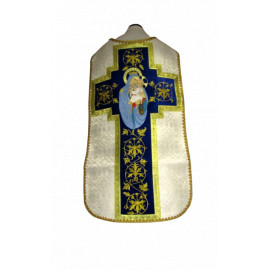
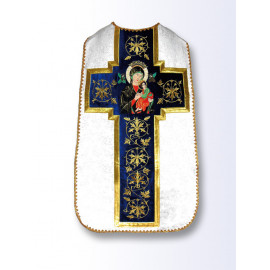
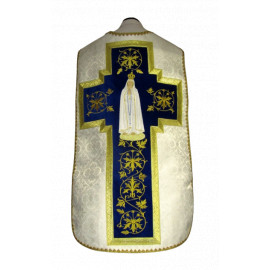
Beyond the symbols, the most direct Marian embroidery is the portrait: Our Lady of Guadalupe with her mantle of stars, Our Lady of Fatima with the rosary, the Mother of Perpetual Help with the instruments of the Passion, the Black Madonna of Częstochowa, the Madonna of the Gate of Dawn. A portrait makes a vestment specific — it fits a parish to the title under which it is dedicated — and our guide to Our Lady under many titles walks through the ones we embroider.
Reading a Vestment at a Glance
Put the symbols together and a Marian chasuble reads like a sentence: the star above the monogram, the monogram above the heart, roses and lilies running the length of the band. The next time you see one, the embroidery will tell you which mysteries of Mary the parish has chosen to keep in view — and that is exactly what the symbols were for.
Frequently Asked Questions
Q: What do roses and lilies symbolize on a Marian vestment?
A: The lily symbolizes Mary's purity, especially in the Annunciation; the rose is the "Mystic Rose" of the Litany of Loreto, the flower of her fullness of grace. Worked together on a vestment they express purity and fruitfulness.
Q: What does the letter M mean on Catholic vestments?
A: The M is the Marian monogram — usually read as the initial of Mary or of "Ave Maria", often with a cross above it. It is one of the oldest Marian symbols in Christian art and appears on vestments, banners and church facades.
Q: What does the crown of twelve stars mean?
A: It comes from Revelation 12, the woman clothed with the sun — an image of Mary — and proclaims her queenship. On vestments a crown or crowned monogram marks the same feast as the Queenship of Mary on 22 August.
Q: Why is Mary called the Star of the Sea?
A: "Star of the Sea" (Stella Maris) is one of the oldest titles in the Litany of Loreto. It presents Mary as a guide — a star that points toward Christ — and the star symbol on vestments usually sits above the Marian monogram.
See these symbols worked in gold and thread on our hand-embroidered Marian chasubles — 92 models from $139.
