
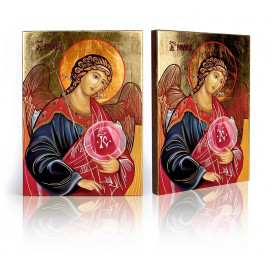




The symbols of the archangels are the attributes that identify each of the three archangels in Catholic art. St. Michael is shown with a sword, scales, or a banner; St. Gabriel with a lily, a trumpet, or a cross-staff; and St. Raphael with a fish, a staff, or a pilgrim's flask. Once you know these attributes, you can read any archangel icon at a glance.
The Three Archangels and Their Symbols at a Glance
| Archangel | Symbols | Meaning |
|---|---|---|
| St. Michael | Sword, scales, banner, shield | Victory over evil, divine justice, protection of the faithful |
| St. Gabriel | Lily, trumpet, cross-staff | Purity, announcing God's will, the Incarnation |
| St. Raphael | Fish, staff, pilgrim's flask | Healing, safe journey, divine guidance |
Each symbol is not decoration — it is a summary of the archangel's role in salvation history, drawn from Scripture and fixed by centuries of iconographic tradition. Below we take them one by one.
St. Michael: Sword, Scales, and Banner
St. Michael is the warrior of God and captain of the heavenly hosts. The Book of Daniel calls him "the great prince who stands guard over your people" (Daniel 12:1), and Revelation shows him leading the angels in battle against the dragon (Revelation 12:7–9). His symbols follow directly from those texts:
- Sword — usually raised or resting on his shoulder: the weapon of the heavenly battle. In some icons he holds a flaming sword.
- Scales — the scales of divine justice. Michael is often shown weighing souls, a scene tied to the words "you have been weighed in the balances" (Daniel 5:27) and to Last Judgment imagery.
- Banner — the cross banner of the Resurrection, the sign of Christ's victory that Michael serves. The banner is standard in Western depictions of the victorious Michael.
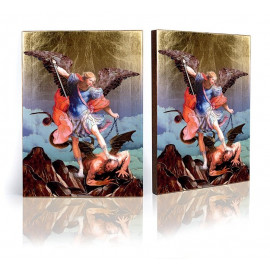
- Shield and defeated dragon — the shield is a defensive symbol; the dragon or serpent under his feet is Satan defeated (Revelation 12:9).
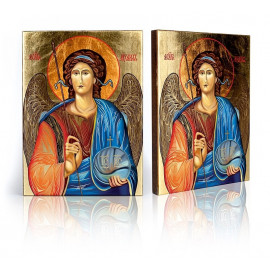
St. Michael is the patron of soldiers, police officers, firefighters, and — since the famous prayer composed in 1886 — the protector of the Church and of souls in their final trial. In our collection he appears in two icons: with sword and orb, and defeating Satan.
St. Gabriel: Lily, Trumpet, and Cross-Staff
St. Gabriel is the messenger of God. He explains visions to the prophet Daniel (Daniel 8:16; 9:21), announces the birth of John the Baptist, and — most importantly — brings the message of the Incarnation to Mary: "I am Gabriel, who stand before God" (Luke 1:19; Luke 1:26–38). His symbols all speak of message and purity:
- Lily — the flower of purity, held toward Mary in Annunciation scenes; it shows that the message he carries is holy.
- Trumpet — the instrument of the herald, pointing to Gabriel as the one who announces God's will (and, in some traditions, the trumpet of the Last Day).
- Cross-staff — the pilgrim's staff topped with a cross, carried by messengers on the road; in some icons it becomes a scepter of divine authority.
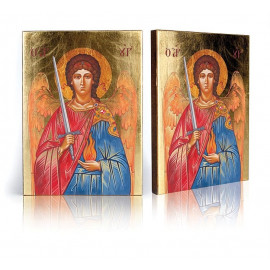
- Sword and flame — in some Eastern icons Gabriel carries a sword and a flame, signs of divine zeal and of the word that "is living and effective" (Hebrews 4:12).
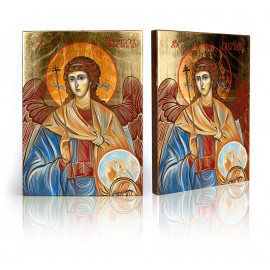
He is the patron of messengers, postal and communication workers, and expectant mothers. Our two St. Gabriel icons show him with the cross-staff and with sword and flame.
St. Raphael: Fish, Staff, and Pilgrim's Flask
St. Raphael is the healer and guide. The Book of Tobit tells how he travels with young Tobias disguised as a companion, drives out the demon Asmodeus from Sarah, and heals Tobit's blindness — before revealing himself: "I am Raphael, one of the seven angels who stand and serve before the Glory of the Lord" (Tobit 12:15). His attributes come straight from that story:
- Fish — the fish of the Tigris from which Tobias takes the gall that heals his father's eyes (Tobit 6:2–9; 11:7–15). Raphael is often shown holding a fish on a line or a plate.
- Staff — the traveler's staff, sign of the long road he walked with Tobias.
- Pilgrim's flask (and pouch) — the marks of a fellow traveler; in many icons Tobias walks beside him with the dog from the story.
He is the patron of travelers, the sick, physicians, pharmacists, and young people setting out on their way. Our St. Raphael icon follows the traditional composition of the traveling companion.
Shared Symbols: Wings, Halos, and Inscriptions
Beyond their personal attributes, the archangels share a common visual language:
- Wings — the mark of a messenger of God, present in Christian art from the earliest centuries.
- Halo (nimbus) — a sign of holiness. In many icons the archangels' halos carry ornamental patterns that distinguish them from the plain halos of saints.
- Inscribed names — the name is often written beside the figure or in the halo, in Greek or Latin letters (for example MI-XA-EL). The inscription is part of the identity of the icon: an icon of Michael is Michael because it is named and painted as him.
- Military or traveler's dress — Michael wears armor or a chlamys; Raphael wears the tunic of a traveler; Gabriel often wears the robes of a messenger.
The Symbols of the Seven Archangels
Tobit 12:15 speaks of "seven angels who stand and serve before the Glory of the Lord." Scripture names three of them; Christian tradition remembers four more. The attributes used for them in Eastern iconography are:
| Archangel | Traditional symbol | Meaning |
|---|---|---|
| Michael | Sword, scales | Justice and victory over evil |
| Gabriel | Lily, trumpet | The message of the Incarnation |
| Raphael | Fish, staff | Healing and guidance |
| Uriel | Flame or sword | The light and fire of God |
| Barachiel | White rose (or bread) | Blessing |
| Jehudiel | Crown | Reward for faithfulness |
| Sealtiel | Censer, hands in prayer | Intercession, prayer rising to God |
Two things are worth keeping clear. First, only Michael, Gabriel, and Raphael are named in Scripture and celebrated in the Roman calendar — the feast of the three archangels is September 29. Second, devotion to the seven archangels is a pious tradition: it is not part of the Church's official teaching, and the names and attributes of the other four vary between traditions.
Are Archangel Symbols the Same as Sigils?
No. Catholic archangel symbols are scriptural attributes — the sword, the lily, the fish — that illustrate what the Bible says each archangel does. Sigils, by contrast, belong to esoteric and modern new-age angel practices: geometric signs, "gemstone correspondences," and channeled names. When you see a chart mixing archangels with crystals and sigils, you are looking at a different tradition. Catholic iconography identifies an archangel by his attribute, his name, and the witness of Scripture — nothing else.
See the Symbols in Our Archangel Icons
At our workshop in Lublewo Gdańskie, Poland, we make hand-gilded icons of the archangels: two icons of St. Michael (with sword and orb; defeating Satan), two of St. Gabriel (with cross-staff; with sword and flame), and one of St. Raphael. Each icon is made on an alder wood board, finished by hand with gold leaf, and available in four sizes from 10.5 × 14 cm to 29 × 39 cm — from $48, with a certificate of authenticity and a protective box.
You can also browse the full sacred icons collection — including icons of Our Lady and icons of Jesus Christ — and our guide to understanding Catholic icons.
Frequently Asked Questions
Q: What are the symbols of the archangels?
A: St. Michael is shown with a sword, scales, or a banner; St. Gabriel with a lily, a trumpet, or a cross-staff; and St. Raphael with a fish, a staff, or a pilgrim's flask. Each symbol points to the archangel's role: victory over evil, the announcement of God's will, and healing with divine guidance.
Q: What does the Archangel Gabriel hold in icons?
A: Most often a lily (the purity of the Annunciation), a trumpet (the messenger of God), or a cross-staff (the pilgrim's staff of the herald). In some Eastern icons he carries a sword and a flame. The two most common Western compositions show him with the lily at the Annunciation and with the cross-staff.
Q: What are the symbols of the seven archangels?
A: Michael: sword and scales; Gabriel: lily and trumpet; Raphael: fish and staff; Uriel: flame or sword; Barachiel: white rose; Jehudiel: crown; Sealtiel: censer. Only the first three are named in Scripture and celebrated in the Roman calendar on September 29 — the others belong to pious tradition.
Q: What do the scales in St. Michael icons mean?
A: The scales are the scales of divine justice. St. Michael is often shown weighing souls, an image tied to Daniel 5:27 ("you have been weighed in the balances") and to the Last Judgment. The scales remind the viewer that every life is measured by God's justice and mercy.
Q: Do archangels have sigils in Catholic tradition?
A: No. Sigils come from esoteric and new-age traditions, not from Catholic iconography. Catholic art identifies the archangels by scriptural attributes (sword, lily, fish), by their inscribed names, and by the texts of Scripture — not by sigils or gemstone correspondences.
